


Share this article


The limits of traditional consumer insight
Synthetic personas are emerging as a critical capability for accelerating innovation cycles in volatile markets.
Innovation has always depended on understanding customers. What has changed is the speed at which that understanding must evolve.
Traditional consumer insight models were built for depth and rigor. They rely on defined research cycles, periodic data collection, and structured synthesis. That model has delivered value for decades. But it assumes a level of stability in markets and timelines that is increasingly rare.
Static personas reflect behavior at a point in time. Trend reports and concept tests often arrive after key decisions are already underway. These methods remain important — but they are inherently retrospective.
In compressed innovation cycles, retrospective insight alone is insufficient.
Why backward-looking research struggles with speed, cost, and uncertainty
Three structural pressures are converging. First, market volatility has increased. Consumer expectations shift in real time, shaped by digital ecosystems, global competition, and algorithm-driven discovery. Weak signals amplify quickly.
Second, innovation cycles are shorter. Teams are expected to generate, refine, and validate ideas in tighter windows — often before formal research can be completed.
Third, research budgets are under scrutiny. Large enterprises invest heavily in consumer research, yet duplication, fragmentation, and delayed activation reduce return on that investment.
Retrospective systems explain what has happened. They do not inherently anticipate what may happen next. Yet product, strategy, and R&D teams are building for future markets — not past ones.
The pressure is measurable. A 2025 Forbes Technology Council article noted that 66% of research teams reported a dramatic increase in demand for insights, forcing them to rethink how quickly intelligence can be delivered.
The growing gap between insight generation and decision-making
The result is a widening structural gap.
Innovation decisions now occur continuously — in sprint reviews, portfolio discussions, and scenario planning sessions. These decisions require directional confidence long before formal validation studies can be completed.
Traditional research operates in stages: commission, field, analyze, synthesize, present. The cadence of insight generation does not always match the cadence of strategic choice.
Organizations are forced into a trade-off: wait for rigorous validation and risk losing speed, or move forward with partial evidence and absorb uncertainty.
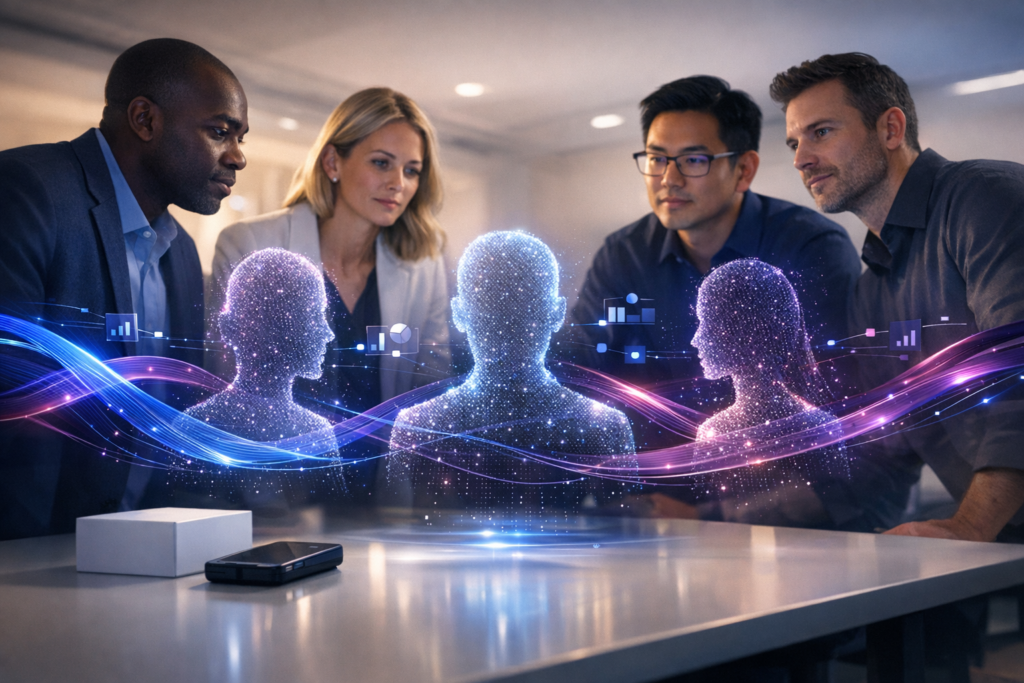
Synthetic personas — continuously updated through predictive AI and informed by real-time trend signals — represent an attempt to close this gap. Rather than replacing traditional research, they extend insight upstream in the innovation process. They allow teams to explore potential reactions, motivations, and trade-offs earlier and at lower cost.
When combined with AI-driven trend forecasting, they shift consumer understanding from periodic measurement to dynamic modeling — enabling exploration of where demand may be heading, not only where it has been.
In accelerated innovation cycles, that distinction becomes strategic.
What are synthetic personas — and why now?
The concept of personas is not new. For decades, organizations have used archetypes to humanize data, align teams around target segments, and anchor strategic decisions in consumer understanding.
What is new is the ability to make those representations computational, interactive, and continuously adaptive.
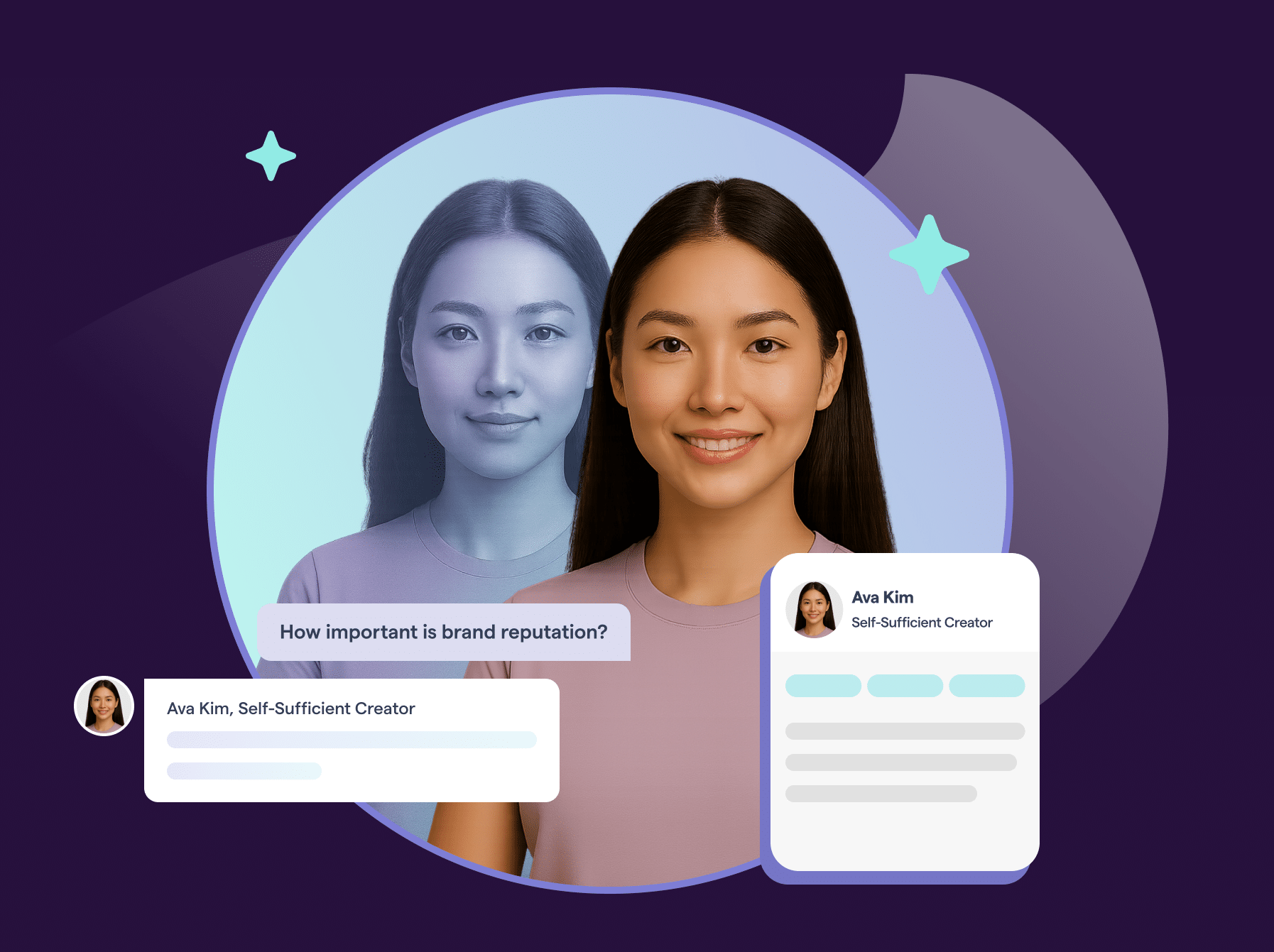
Synthetic personas are AI-generated personas built from structured and unstructured evidence — research repositories, behavioral data, attitudinal studies, and relevant external signals. Rather than existing as static summaries in presentation decks, they operate as queryable systems capable of simulating likely motivations, reactions, and trade-offs.
As outlined in Market Logic’s guide to AI-powered synthetic personas, their value lies in being purpose-built, agentic systems grounded in proprietary research ecosystems.
This evolution is already visible across the industry. In a 2026 AI & Innovation session at Quirk’s Virtual, Market Logic’s Director of Product Management, Joseph Rini, described persona agents as “large language model–powered, synthetic customers built on a company’s proprietary understanding of its segments” — designed to move teams from passive report consumption to interactive exploration.
They are not fictional constructs. Nor are they generic outputs from public language models. Their credibility depends on being grounded in validated data sources and governed knowledge environments.
As Harvard Business Review observed in late 2025, generative AI tools are already transforming market research by enabling simulation of consumer responses, large-scale synthesis of data, and faster research cycles. Synthetic personas sit squarely within that evolution.
Traditional personas are descriptive. They age.
Synthetic personas are generative and adaptive. They can be refreshed as new data enters the system. Instead of asking what a segment looked like during the last research wave, teams can explore how it may respond under new conditions.
Where classic archetypes support communication, synthetic personas support iteration.
The role of AI in making personas dynamic, scalable, and predictive
Artificial intelligence enables this transition.
Agentic AI introduces structured analytical workflows — comparing evidence, surfacing gaps, generating scenario-based responses, and modeling trade-offs.
It makes AI-based personas scalable. Multiple segments can be simulated simultaneously, enabling cross-portfolio comparison without commissioning parallel studies.

And it makes them predictive. When continuously informed by emerging behavioral signals and trend data, AI-powered personas allow organizations to test ideas not only against current consumer logic, but against plausible future trajectories.
They cease to be artifacts. They become operating components within innovation workflows.
AI-driven trend forecasting as the missing layer
The strategic case for synthetic personas becomes clearest when examined against everyday innovation pressures: slow ideation, fragile early validation, and rising development cost.
Accelerating AI-assisted ideation cycles
Adoption is accelerating. According to Forbes Technology Council reporting, 95% of CMOs and insight leaders either already use synthetic data or plan to within the next 12 months.
Ideation often relies on static inputs — persona decks created months ago, archived research summaries, partial recollections of past studies.
AI-generated personas introduce a different dynamic.
Teams can interrogate likely reactions to feature sets, explore motivational trade-offs, and test messaging directions during ideation itself.
Agentic AI extends this further by running structured comparisons, surfacing contradictions, and identifying evidence gaps.
Weak concepts are filtered earlier. Stronger hypotheses enter formal testing with greater coherence. Speed improves — not because rigor is reduced, but because iteration happens upstream.
Raising confidence and acceptance in early concept testing
Early-stage ideas often struggle to secure internal buy-in. Formal research is expensive and time-consuming, yet stakeholders demand confidence.
At the same time, organizations are experimenting with generative AI to fill the gap. But speed alone does not create trust. In 2025, the BBC reported factual distortions in AI-generated summaries — reinforcing a critical lesson: authoritative tone does not equal grounded evidence.
Synthetic personas address this by grounding exploratory responses in validated research and trend-informed modeling.
They provide structured pre-validation. Teams can identify:
- Where assumptions are well-supported
- Where consumer logic appears weak
- Where further validation is required
Human testing remains essential. But when formal concept testing begins, hypotheses have already been pressure-tested internally.
Confidence is built progressively rather than deferred to a single validation moment.
Reducing time, cost, and waste in innovation development
Innovation waste typically appears as duplication or late pivots.
Research is re-commissioned because prior insights are difficult to surface quickly. Ideas advance too far before structural weaknesses become visible — forcing costly course corrections.
Synthetic personas mitigate both risks.
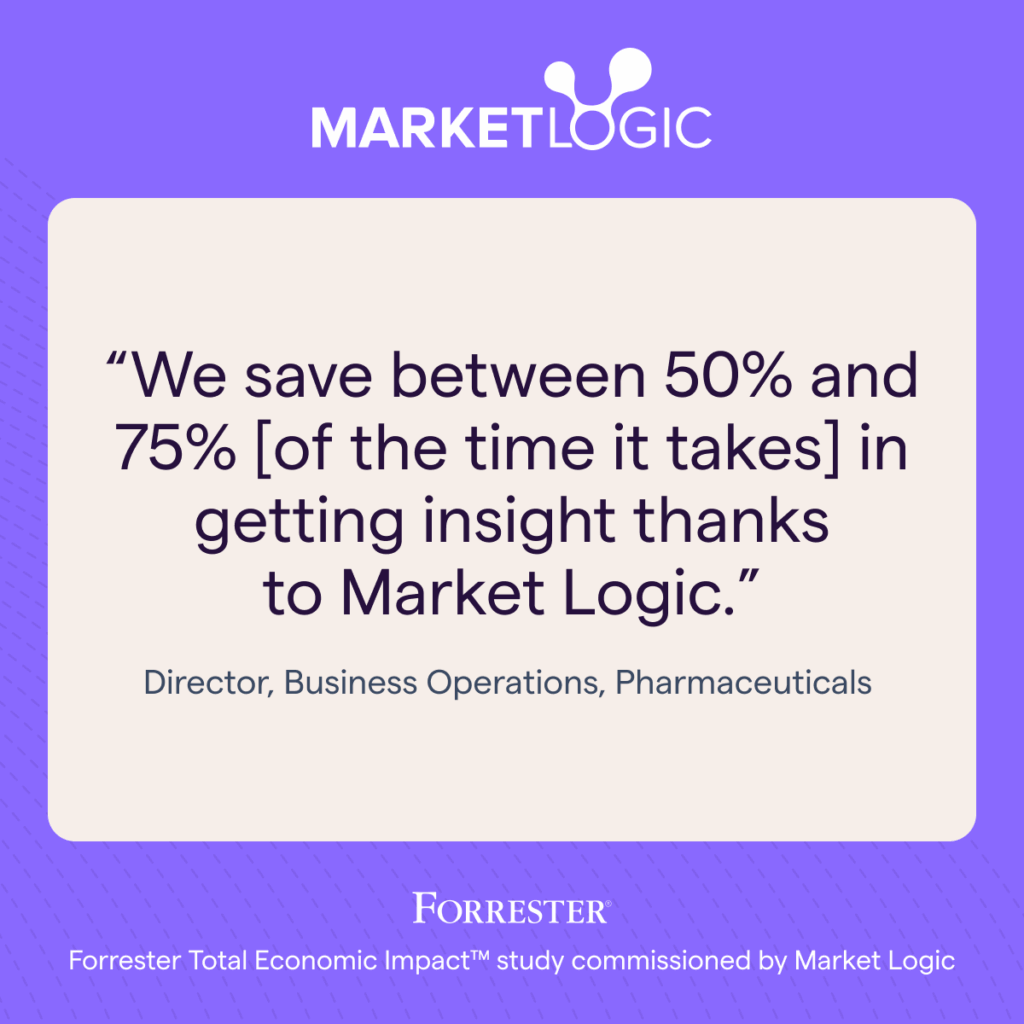
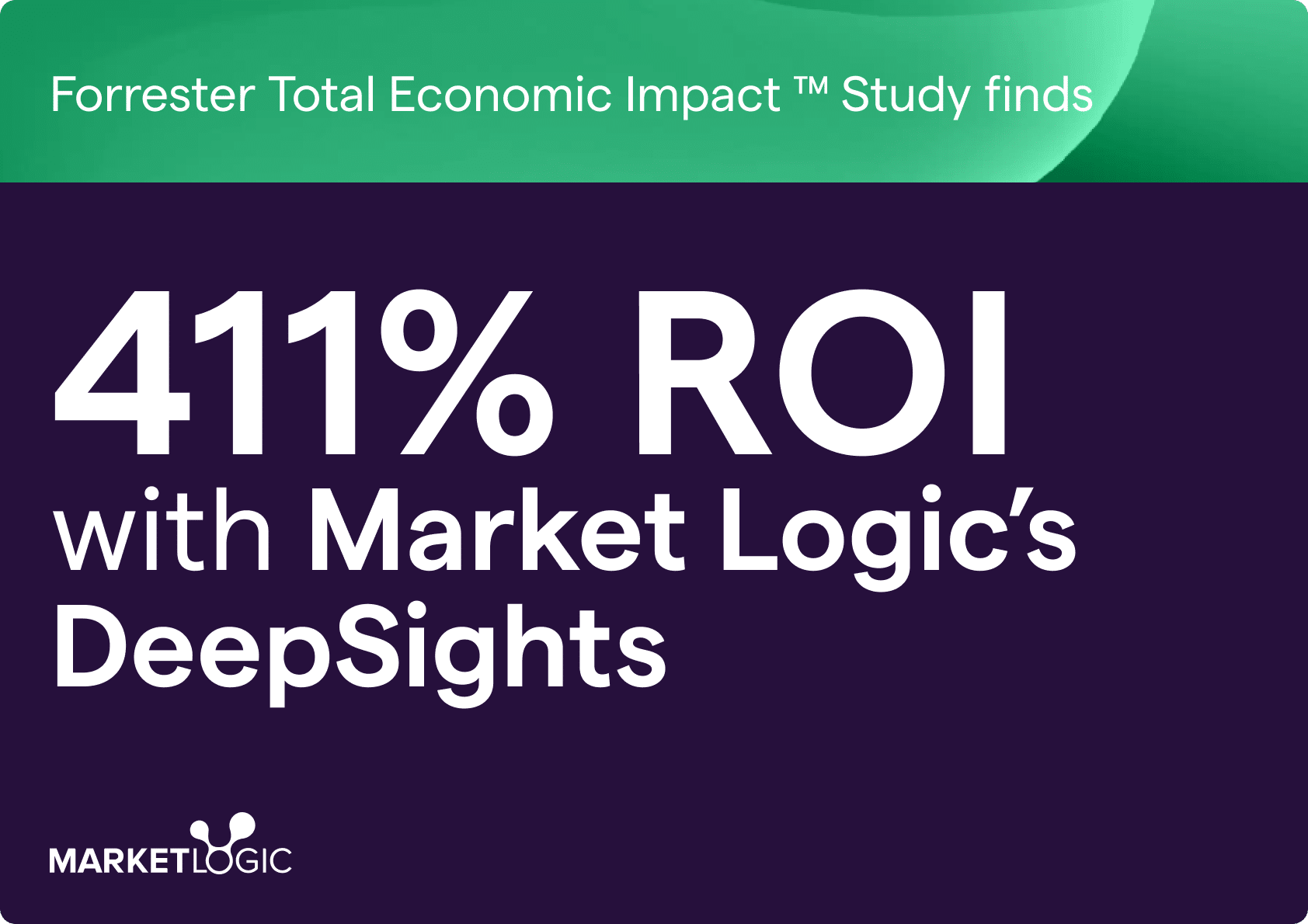
A 2025 Forrester Total Economic Impact™ study of Market Logic’s DeepSights™ found:
- 27% reduction in research duplication
- 97% reduction in time required to respond to insight requests by Year 3
- Up to 55% faster time-to-insight in innovation and market review projects
At Market Logic’s 2025 Zurich Roundtable, Ian Hook of Novartis described how their internal knowledge engine reduced duplicative research and saved $28 million in one year — cutting response time from two weeks to as little as five to ten minutes.
Faster access to trusted intelligence does more than improve productivity. It accelerates decision-making across innovation workflows.
From insight to future-back planning
In volatile markets, validation alone is insufficient. Innovation requires anticipation.
Future-back planning explores plausible future states and designs toward them, rather than extrapolating incrementally from historical performance.
Synthetic personas, continuously informed by AI-driven trend forecasting, provide a mechanism for doing this systematically.
Teams move from asking: “What do we know about this segment today?” to “How might this segment respond as these forces develop?”.
The distinction is subtle but consequential.
Operationalizing synthetic personas in innovation at Philips
Leading organizations are already moving from experimentation to operationalization.
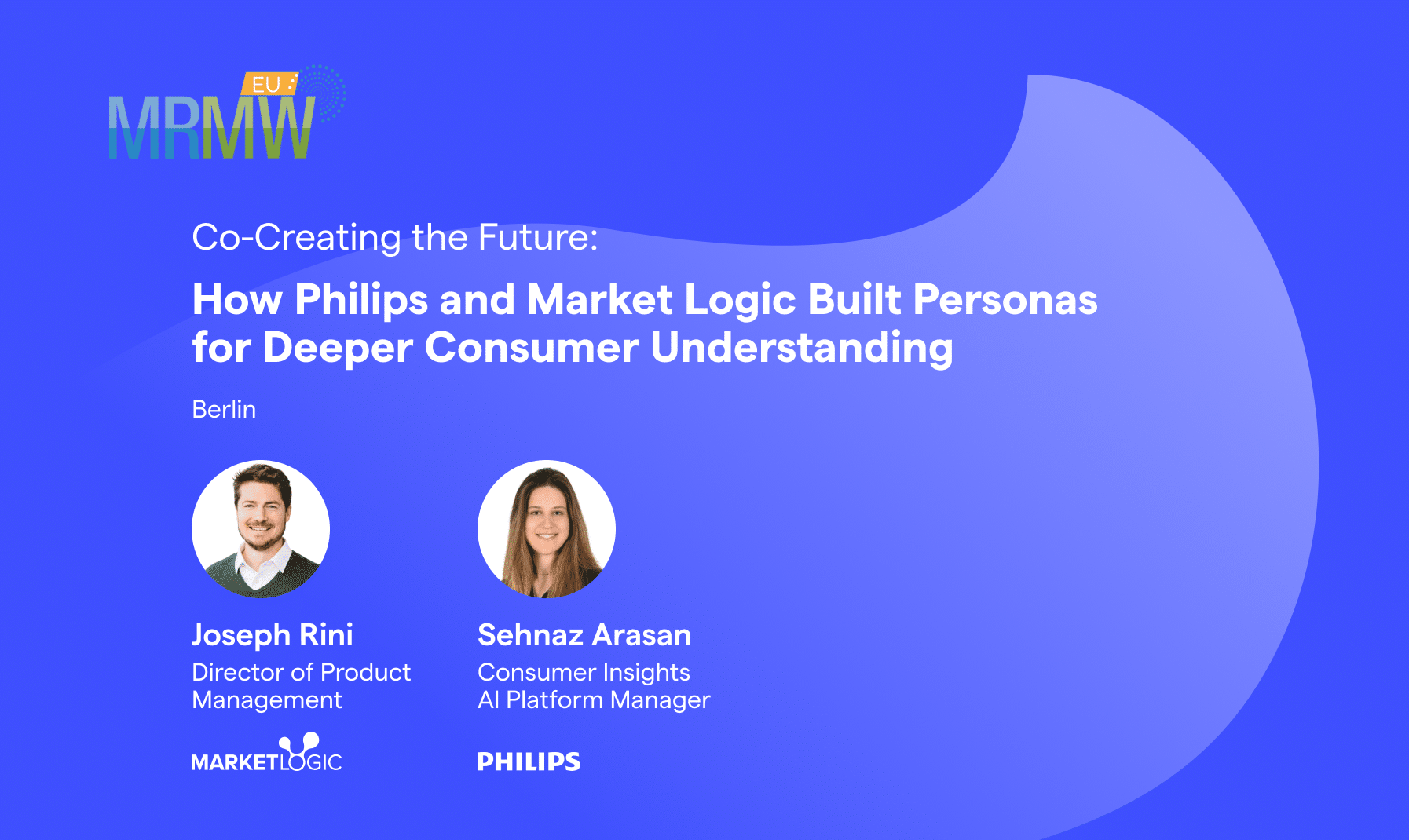
At MRMW 2025, Philips shared how it co-created synthetic personas with Market Logic and embedded them into product development workflows.
Personas were built from proprietary data, consumer research reports, and interview transcripts. Use cases focused on early-stage concept testing, claims optimization, packaging feedback, and adoption journey exploration. Integration via API connected personas to the broader innovation ecosystem.

The goal was to raise the quality of early-stage thinking — providing a fast, realistic sounding board before committing budget to formal validation.
AI-powered personas change the economics of innovation by enabling more ideas to be stress-tested earlier and at lower cost.
Swiss Federal Railways: embedding customer-centric thinking
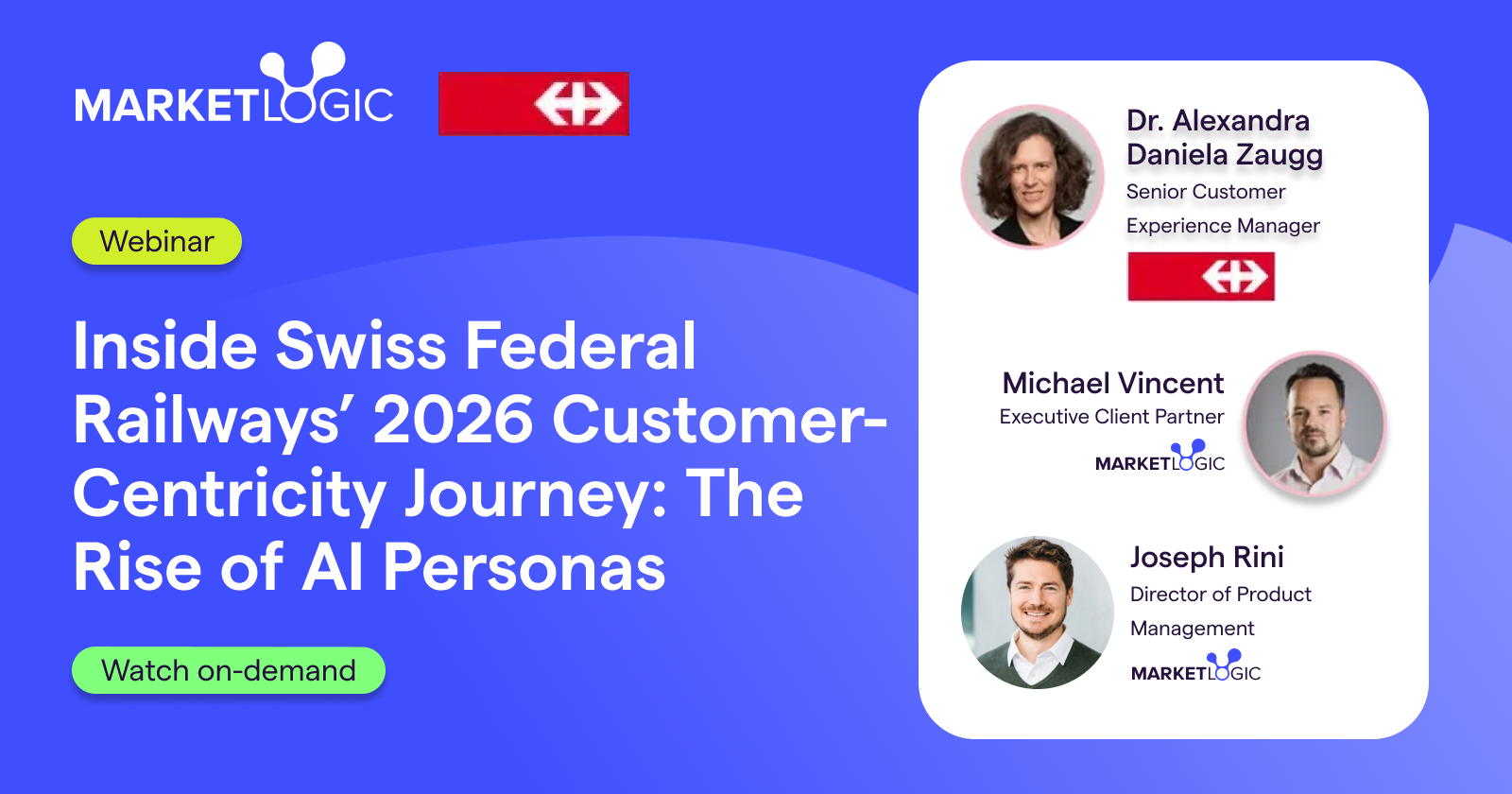
Swiss Federal Railways (SBB), serving approximately 1.39 million passengers daily, embedded AI-powered personas into its 2026 Customer Centricity program.
Rather than limiting personas to the insights function, SBB integrated them into leadership discussions across management levels.
As Dr. Alexandra Daniela Zaugg emphasized, personas are not final truth. They provide a structured way to engage with customer perspectives and test assumptions before they solidify into strategy.

When embedded correctly, AI-based personas become part of the operating model — making consumer understanding conversational, accessible, and scalable.
A new lens on consumer futures
Representation alone is no longer sufficient.
Consumer understanding must evolve from static documentation to dynamic modeling. From periodic validation to continuous anticipation.
Synthetic personas, informed by predictive AI and real-time trend signals, enable this shift.
- They accelerate ideation.
- They strengthen concept testing.
- They reduce waste in innovation development.
Competitive advantage increasingly depends on testing ideas against possible futures — not only past behaviors.
Synthetic personas by DeepSights, powered by agentic AI and combined with AI-driven trend forecasting, enable faster ideation, higher-confidence concept testing, and lower-cost innovation — while redefining how organizations understand future consumers.
The shift toward anticipatory modeling is already underway. The organizations that prepare now will shape the next generation of markets rather than react to them.

Market Logic’s trusted and award-winning DeepSights™ platform empowers enterprise teams to operationalize synthetic personas, AI-driven trend forecasting, and always-on consumer intelligence in one governed ecosystem. If you’re ready to accelerate innovation cycles with predictive, AI-powered insight, book a demo today to see DeepSights™ in action.