



Share this article


AI hallucination is when a general-purpose AI produces a confident, fluent answer that is factually wrong. Independent testing puts the error rate at roughly 3 to 5 per cent, and these tools cannot judge source quality. On a decision worth millions, that unexamined confidence, not the occasional error, is the expensive part.
The greatest risk in a general-purpose AI answer is not that it can be wrong. It is that it is wrong with complete confidence. The response is fluent and well organised, and it looks no different from a good answer until the decision has already been taken.
Fluency is not accuracy
Large language models are designed to produce convincing text, and they do so effectively. Convincing and accurate are not the same thing. Independent testing puts the error rate of general-purpose models at roughly 3 to 5 per cent, and they cannot judge the quality of the sources they draw on. They gather material from a wide range of documents, including emails, messages, and research reports, treat all of it as equally reliable, and then present a confident conclusion.
There is a second problem beneath the first. Because a general tool reasons over whatever it happens to retrieve in the moment, its answers are not even consistent. Ask the same question twice, and the reply can change. For a first draft, this is a small risk. For a decision that commits real money, it is a serious one.

What AI hallucination is, and where the cost lands
An AI hallucination is a confident, well-written answer that is factually wrong. The trouble is that AI hallucinations rarely announce themselves. The cost of a confidently wrong answer seldom appears as an obvious mistake. It appears later, and somewhere else.
- A category strategy is built on a study that had already been superseded.
- An investment is approved on the strength of a trend that two other studies contradicted, a contradiction that no one surfaced.
- A campaign is aimed at a customer motivation that the data did not in fact support.
When general-purpose AI is confidently wrong, each answer looks perfectly sound on the slide. The cost emerges only afterwards, in money spent against a faulty premise. Because the original answer read so well, it is rarely questioned at the time.
The pattern is familiar to anyone who has watched a decision unravel. The analysis was quick, the deck was clean, and the flaw only surfaced once the spend was committed, and the results failed to match the promise. By then, the confident answer had done its damage.
Removing the risk: traceable, source-weighted answers
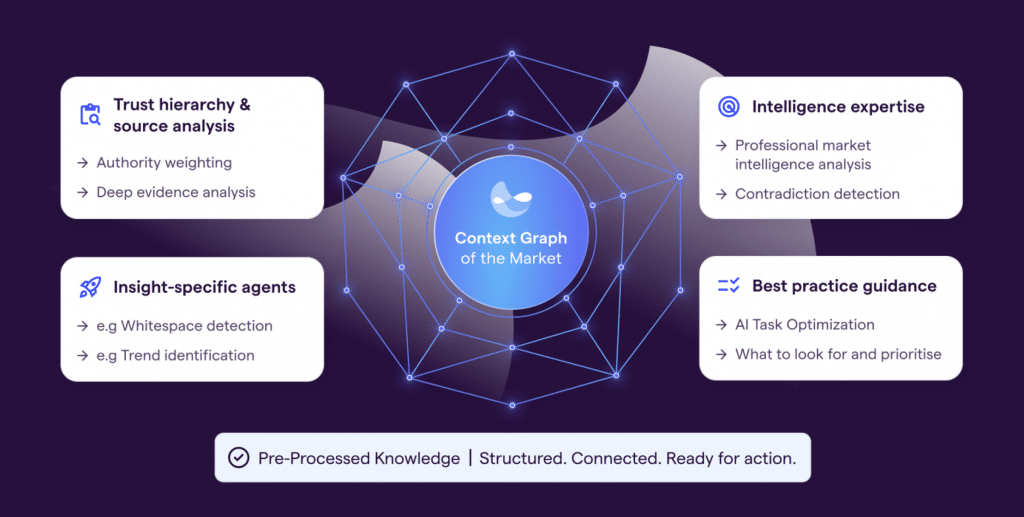
You cannot prompt your way out of this with a general-purpose tool, because the weakness is built in. There is no weighing of sources, no detection of contradictions, and no way to trace a claim back to its origin. The solution is specialized AI for market intelligence, a layer that provides all three.
A specialist layer such as the DeepSights platform, built by Market Logic Software, examines the evidence behind every answer. It classifies each source at the point it enters the system, assigns authority by source type and recency, flags contradictions, and references every finding back to the study or report it came from. It does not simply sound right. It shows its working, which lets a decision-maker verify an insight rather than trust it blindly, and which is what allows a conclusion to be defended in front of a board.
Here is why trust and traceability matter in enterprise AI: Traceability is what makes the answer auditable. When every claim carries its source, a reviewer can follow an insight back to the study behind it and judge it on the evidence, rather than accepting or rejecting it on the strength of how it reads. A confident sentence and a defensible one look identical on the page. The difference is whether you can check it.
It also watches for the business risk of AI hallucination that you did not think to ask about. Because DeepSights Radar monitors the market continuously, it can identify an emerging problem, such as a fall in volume in one region, in time to address it before the next promotional period rather than after.
For most organizations, there is a clear gap that needs to be filled between questions and accurate, traceable answers. The missing layer in enterprise AI is trusted insight intelligence.
The bottom line
This is the direction the market is taking. Gartner expects domain-specific models to account for 131 billion dollars in revenue by 2035, for a simple reason it describes as consistently higher reliability in business-critical workflows. For low-value work, the confidence of a general tool does no harm.
For decisions worth millions, the question is not whether the answer is well written. It is whether the evidence behind it can be trusted and proven. If your AI cannot answer that, its confidence is the most expensive thing about it.
Book a proof session with Market Logic
Bring a decision your team is weighing now and see the difference between an answer that sounds right and one you can trace, check, and defend.
Frequently asked questions
What is AI hallucination in business terms?
How common are AI hallucinations?
How do you reduce AI hallucination risk in decisions?
Why is confident-but-wrong AI more dangerous than an obvious error?