

Share this article


Enterprise AI is everywhere. From Copilot to internal ChatGPT deployments, organizations are embedding AI into daily workflows — and seeing real productivity gains for tasks like summarizing documents, drafting emails, and answering quick questions.
But productivity alone doesn’t drive competitive advantage. Innovation does, and that depends on reliable market and consumer insights.
For insights teams, delivering trustworthy intelligence is increasingly difficult. Data lives across fragmented systems, context matters, and decisions require timely, evidence-based inputs. As a result, organizations are often collecting more information than they can meaningfully use.
In fact, a C-suite survey by Market Logic, Ipsos, and Alchemy-Rx found that nearly 70% of companies are gathering data faster than they can use it. At the same time, 46% say they lack enough insights to develop new ideas, while 32% cite insufficient consumer understanding as a barrier to innovation.
As AI adoption accelerates, with 88% of organizations now using AI in at least one business function (McKinsey & Company, 2025), a critical gap is emerging.
General-purpose AI tools may be fast, but speed doesn’t solve the real challenge: confidence in insights. The question for insights and business teams isn’t how quickly AI can respond — it’s how reliably it can support real decisions.
Market and consumer intelligence requires structure, provenance, and validation. Yet tools like Copilot weren’t designed for these needs. Without governed knowledge sources and contextual grounding, AI can produce answers that sound plausible but are difficult to verify — especially at enterprise scale.
This is why a new model is emerging: Active Intelligence. Enterprise AI delivers speed and scale, but insight-led organizations require more than faster outputs. They need structure, governance, and reasoning grounded in evidence. What’s missing is a dedicated insight intelligence layer that connects fragmented data, preserves institutional knowledge, and ensures that decisions are informed by trusted sources and grounded in trusted evidence.
Enterprise AI delivers speed, but not insight confidence
There’s no doubt enterprise AI is changing how work gets done. Organizations are rolling out AI assistants to accelerate research, automate reporting, and streamline collaboration.
Yet many insight leaders are discovering a familiar pattern:
- Answers arrive faster.
- But confidence in those answers remains low.
That’s because most enterprise AI tools are built for productivity, built for productivity — tools that excel at retrieving and summarizing information. But when asked to interpret research, connect fragmented data sources, or synthesize market signals, accuracy quickly breaks down.
Independent evaluations show that enterprise AI frequently produces hallucinated or unreliable responses when working with complex, unstructured knowledge. And as usage scales across teams and datasets, these inconsistencies become harder to spot — and riskier to ignore.
For decisions that shape product strategy, customer experience, or market entry, “probably right” isn’t good enough.
Insight reasoning requires evidence, context, and traceability. And ultimately, speed without confidence isn’t insight.

Where AI for enterprise breaks down for market and consumer insights
Tools like Copilot and enterprise ChatGPT are designed for general knowledge work. They’re effective at retrieving information, summarizing documents, and speeding up routine tasks.
But market and consumer insights operate differently.
Organizations struggle to make faster, smarter decisions because:
1. Insights are fragmented
Research reports, survey data, competitive analyses, dashboards, and presentations are scattered across disconnected systems. General AI has no inherent understanding of how these sources relate — or which ones carry the most weight.
2. Context gets lost
Insights depend on methodology, sample size, timing, geography, and business relevance. Strip away that context, and conclusions become misleading.
3. Governance is missing
Most enterprise AI tools lack built-in validation, provenance tracking, and enforceable standards. Teams can’t easily verify where an answer came from — or whether it should be trusted.
When AI is asked to synthesize insights across fragmented, unstructured sources, hallucination rates rise significantly. This isn’t a user error — it’s a structural limitation of general-purpose systems.
For insight teams, the risk is subtle but serious: answers arrive faster, while confidence declines.
The result? Data remains underutilized, and decisions revert to gut feeling, with 40% of key decisions taken without reference to data, an Insight Platform survey found in 2024.
Why insights need more than an enterprise AI platform
The stakes are rising. C-suite research from Market Logic Software, conducted with Ipsos and Alchemy-Rx, shows that 82% of executives expect innovation to become even more critical to growth in the coming years, yet many organizations struggle to translate insight into successful launches.
This gap highlights a structural challenge.
With today’s data deluge, organizations don’t need more insight or dashboards. They need AI to bring clarity out of that data, and how it can translate to a new product targeted toward their consumer.
This is where many organizations hit a wall. They’ve invested in an enterprise AI platform. They’ve rolled out assistants across the business. Yet, insight adoption remains inconsistent, and adoption and research ROI stay low.
To support confident decision-making within the business, insight workflows require:
- Structured knowledge models
- Clear source attribution and traceability
- Preservation of research context
- Governance across internal and external data
- Consistent reasoning frameworks
- Cross-silo connectivity
Without these foundations, democratization fails. People may have access to information, but they don’t trust it.
In fact, many enterprises report that less than 40% of commissioned research is ever reused, largely due to poor discoverability and lack of context. Valuable insights get buried in folders and forgotten, while teams continue commissioning redundant studies.
Enterprise AI alone doesn’t fix this. It simply accelerates access to fragmented content.
What’s missing is an intelligence layer purpose-built for insights. This is where DeepSights™ comes in.
DeepSights as the active intelligence layer for enterprise AI
DeepSights™ is Market Logic’s AI-powered active intelligence platform, purpose-built for enterprise market and consumer insights. Unlike general AI tools, DeepSights is designed to reason over complex, fragmented data — delivering consistent, explainable, and actionable insight. DeepSights transforms fragmented research into a connected intelligence system grounded in trusted knowledge. It does not compete with enterprise AI. It completes it.
The platform uses advanced AI to extract findings from existing research reports and documents, then applies that knowledge to answer new business questions in natural language. Instead of starting from scratch each time, DeepSights builds on validated insights already within your organization.
Rather than competing with enterprise AI, DeepSights provides the missing insight layer — organizing knowledge, governing sources, and enabling trusted reasoning at scale.
Built around how insights teams actually work, DeepSights connects research assets across silos, preserves critical context, and transforms scattered data into structured, reusable intelligence.
With DeepSights, organizations can:
- Centralize market and consumer research in a governed system
- Maintain provenance and traceability for every insight
- Enable consistent, explainable AI-powered answers
- Deploy assistants and agents that reason over trusted sources
- Power synthetic personas grounded in real evidence
The result isn’t just faster answers — it’s better decisions.
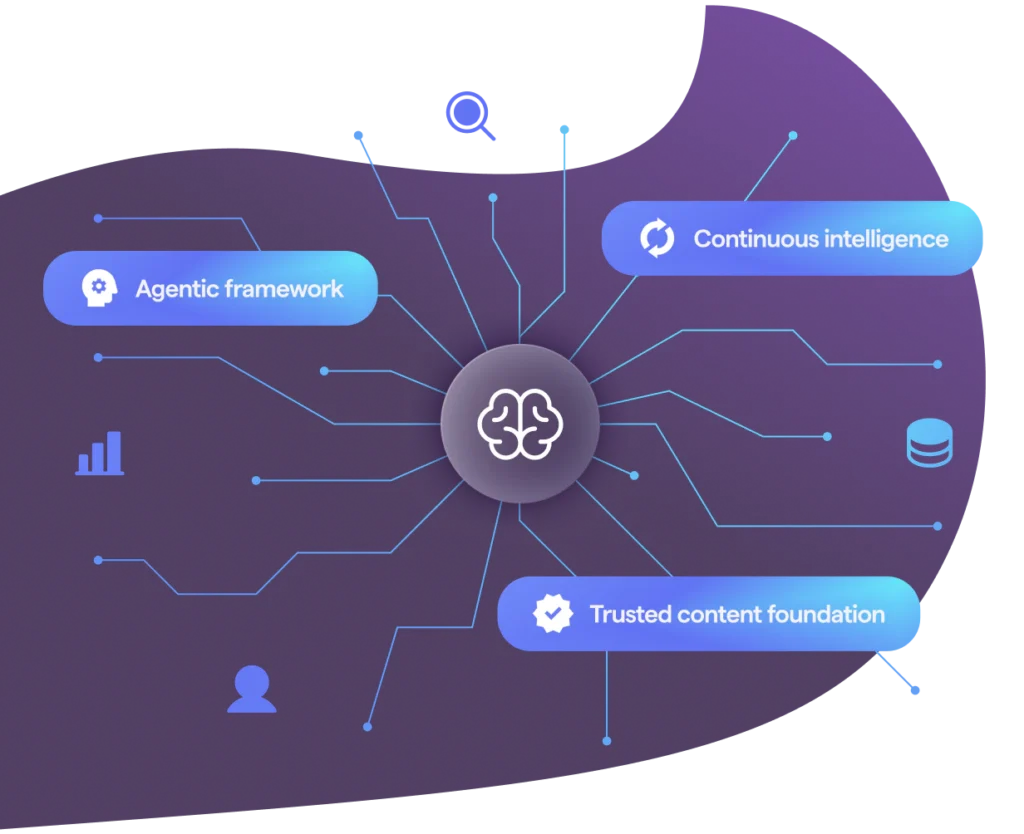
At its core, connected intelligence brings together three critical elements that enable organizations to turn fragmented information into meaningful, decision-ready insight:
• Trusted knowledge — Internal research, syndicated studies, news signals, and structured datasets are unified into a single governed foundation. By connecting these sources, organizations can move beyond isolated reports and ensure that insights are grounded in verified evidence rather than scattered information.
• AI agents — Purpose-built AI agents help teams reason across large volumes of information, continuously monitoring signals, synthesizing findings, and validating emerging insights on your behalf. Rather than simply retrieving data, these agents support deeper understanding by identifying patterns and surfacing relevant intelligence at the moment decisions need to be made.
• Continuous learning — Instead of producing static outputs, connected intelligence enables organizations to build a living system of knowledge that evolves over time. As new data, research, and signals are added, the system accumulates organizational understanding—helping teams refine insights, connect evidence across studies, and build institutional knowledge that grows more valuable with every interaction.
Teams using structured insight platforms routinely see higher insight usage, along with significant reductions in time-to-decision, a Forrester TEI Study commissioned by Market Logic, found. By creating a governed foundation for insight intelligence, DeepSights helps organizations move from isolated research outputs to continuous, always-on learning.
This is how enterprise AI evolves from a productivity tool into a true decision engine.
What makes DeepSights fundamentally different from Copilot in an enterprise AI platform
1. Ecosystem
It centralizes and structures your insight universe
DeepSights unifies internal research, syndicated sources, news, and structured data into a governed system of intelligence. By bringing fragmented knowledge together, it creates a trusted foundation where insights teams can access and build on the full breadth of available evidence.
It doesn’t just retrieve documents — it understands how findings relate across time, markets, and categories. By connecting signals and research across sources, DeepSights surfaces patterns, links evidence, and reveals insights that would otherwise remain buried in disconnected reports. The result is a richer understanding of consumers and markets, enabling faster discovery and more confident decision-making.
It reasons with context
Through structured ingestion, intelligent tagging, automated routing, and hybrid search enhanced by AI relevance classification, DeepSights preserves the full research context behind every insight. Rather than flattening documents into generic text, the system recognizes and maintains the structural elements that matter to professional researchers, including:
- Study background
- Methodology
- Audience and sample characteristics
- Category and market definitions
- Organizational taxonomies and knowledge frameworks
This enables explainable answers grounded in evidence — not generic summaries.
By retaining this context, DeepSights ensures that insights are interpreted within the same analytical structure used by research teams. This allows the platform to connect findings across studies, assess contextual relevance more accurately, and surface evidence that aligns with how insights professionals actually work.
Unlike generic enterprise AI systems that rely heavily on public web data or unstructured corporate documents, DeepSights works exclusively with validated internal research and licensed external sources.
The result is explainable intelligence: answers that are grounded in validated internal research and licensed sources, supported by clear evidence trails rather than generic AI summaries. Teams can trace conclusions back to their original context, enabling faster discovery while maintaining the rigor and trust that high-stakes decisions require.
2. It deploys AI agents that work on your behalf, for faster decisions
DeepSights includes purpose-built AI agents designed to support the way insight teams work. Rather than acting as generic assistants, these agents operate as specialized collaborators within the intelligence workflow:
- Radar Agents continuously monitor trusted research sources, news signals, and market data to detect emerging trends, competitive shifts, and changing consumer behaviors.
- Persona Agents allow teams to validate ideas and explore scenarios by interacting with research-grounded customer personas—making it possible to test concepts, messaging, and assumptions before investing in full research cycles.
- Innovation Agents support innovation with ideation, optimization, and evaluaton of ideas, helping teams identify whitespace opportunities and pressure-test concepts earlier in the process.
Together, these agents introduce an agentic intelligence layer that actively works alongside insight teams. Instead of manually scanning studies, synthesizing findings, or assembling first drafts of analysis, teams can rely on AI agents to continuously monitor signals, connect evidence across sources, and structure emerging insights.
Agents perform structured reasoning humans shouldn’t have to — monitoring, first-drafting, synthesizing — so teams focus on judgment and decisions. This fundamentally changes how insights are produced and used.
Rather than operating through periodic research cycles and manual synthesis, organizations gain an always-on intelligence capability—one that surfaces signals earlier, accelerates learning loops, and allows human experts to focus on interpretation, judgment, and strategic decision-making.
The platform integrates seamlessly with over 150 syndicated sources, live newsfeeds, and internal systems like Microsoft 365, Teams, and SharePoint. By fitting directly into existing workflows and removing the need for prompt engineering, DeepSights reduces IT overhead, streamlines collaboration, and ensures trusted insights are accessible across the organization.
3. It integrates seamlessly into enterprise AI ecosystems
DeepSights is designed to integrate intelligence directly into the enterprise technology ecosystem. It provides:
- REST APIs and Model Context Protocol (MCP) support headless AI workflows, allowing organizations to embed insight reasoning directly into enterprise applications. This enables intelligence to flow seamlessly into business processes rather than remaining confined to standalone tools.
- Integrations with platforms such as SharePoint, Microsoft Teams, Slack, and Google Drive, ensuring that trusted research and market intelligence are accessible within the collaboration environments where teams already work. Insights can be surfaced, shared, and applied without forcing users to change tools or workflows.
- A governed intelligence layer that strengthens enterprise AI systems, including Copilot and other generative AI tools. By structuring, contextualizing, and validating the knowledge that flows into these systems, DeepSights ensures that AI outputs are grounded in trusted research rather than generic or unverified information.
Together, these capabilities allow organizations to move beyond isolated AI experimentation and build a connected intelligence infrastructure — one where insights are accessible across the enterprise, embedded into daily workflows, and consistently grounded in reliable evidence.
It’s less like using a tool and more like adding an always-on member to the team. With DeepSights Always-on Consumer Trends Agents, organizations gain AI-powered partners that continuously scan, analyze, and connect information across research, reports, and data sources. These agents surface relevant insights, answer complex questions, and proactively support teams throughout the innovation process — from early exploration to decision-making.
Instead of searching for answers across scattered sources, teams can rely on a dedicated, active intelligence partner that is always working in the background — ensuring the right insights are available at the right moment.
4. It is built for enterprise security and compliance
Models are not trained on customer data. Information is encrypted in transit and at rest.
DeepSights runs on enterprise-grade infrastructure (Google Cloud Platform and Azure OpenAI in the EU), aligned with ISO 27001 best practices.
Models are never trained on customer data, ensuring that proprietary research and internal knowledge remain fully protected. All information is encrypted both in transit and at rest, safeguarding sensitive insights as they move through the system and while they are stored. This architecture ensures that organizations retain full control over their data while benefiting from advanced AI capabilities.
This approach allows DeepSights to continuously evolve with the AI ecosystem while shielding organizations from model volatility or vendor lock-in. Customer data remains fully protected: models are never trained on client data, and all information is encrypted both in transit and at rest.
For regulated industries such as Healthcare and Financial services, governance is not optional — it’s foundational. DeepSights provides peace of mind through its adherence to strict protection standards, by embedding enterprise-grade security, compliance, and data protection directly into the intelligence layer, ensuring organizations can scale AI-powered insights without compromising trust.

Why DeepSights and enterprise AI is the right model to unlock innovation
Enterprise AI excels at task acceleration:
- Drafting content
- Summarizing meetings
- Answering operational questions
DeepSights excels at insight confidence:
- Structuring knowledge
- Governing sources
- Preserving context
- Enabling trusted reasoning
So, the future isn’t about choosing between Copilot and DeepSights. It’s about using both — together.
Enterprise AI accelerates everyday work: drafting content, summarizing meetings, and answering operational questions.
DeepSights delivers insight confidence by structuring knowledge, governing sources, preserving context, and enabling trusted reasoning.
Organizations combining enterprise AI with a dedicated insight intelligence layer consistently see stronger outcomes — including significantly faster insight response times, reduced research duplication, and measurable ROI gains.
This is the shift from productivity AI to decision intelligence.
Organizations that pair enterprise AI with a dedicated insight intelligence layer consistently unlock greater value. According to the Market Logic Forrester TEI study, customers using DeepSights achieved a 411% ROI over three years, 97% faster insight response times, and 27% reduction in research costs, while also driving 3% incremental revenue growth.
These results show that efficiency gains from enterprise AI are amplified when combined with trusted, structured insight — because decisions are grounded in validated evidence, not just convenience.
Enterprise AI helps teams move faster and smarter, but DeepSights ensures they move in the right direction.
By complementing existing AI investments, DeepSights ensures that what flows into Copilot, or any enterprise AI system, is accurate, contextualized, and aligned with how insights teams actually work. That’s how organizations unlock real value from AI at scale.

Trusted insights require purpose-built intelligence at scale to unlock growth
Enterprise AI will continue to shape how organizations work, but for insights and business teams, the real challenge is ensuring answers can be trusted. Reliable intelligence requires systems built to preserve context, connect evidence, and support consistent reasoning.
As enterprises continue to navigate the complexities of the modern business landscape, the need for reliable and actionable market insights has never been greater.
While enterprise AI will remain a foundational part of modern organizations, for insights and business teams, the challenge is no longer access to answers. It’s ensuring the intelligence behind those answers can be relied on – and introduced with the right frameworks.
Reliable market and consumer intelligence requires systems designed to connect evidence, preserve context, and support consistent reasoning. That’s where purpose-built platforms like DeepSights come in — complementing enterprise AI, not competing with it, by providing the structured insight layer needed for confident, decision-ready intelligence.
By transforming static repositories and siloed data into an insights-led engine, DeepSights helps organizations achieve faster go-to-market strategies, reduced research costs, and enhanced cross-functional alignment. With DeepSights™, organizations can put the consumer at the heart of every decision, unlocking new opportunities for growth and staying ahead of the competition.
This is how enterprise AI becomes a true decision engine — and how insight-led organizations unlock sustainable growth.
If your organization is serious about driving research ROI, reducing duplication, and empowering confident decision-making, it’s time to think beyond AI productivity tools.
The missing layer in enterprise AI is intelligence.
Schedule a demo with award-winning active intelligence partner DeepSights to see how a purpose-built insight platform can help your teams turn trusted research into real business impact — faster and at scale.