


On this page
On this page
Specialized AI for market intelligence and insights: Where generic LLMs fall short
Every organisation is now ramping up its use of AI, and insights leaders are under pressure to keep pace with demand for faster access to intelligence. Business teams armed with an array of generic AI assistants are impatient to put AI to work in giving them quicker answers. IT teams are pushing to consolidate as many processes as possible into their chosen AI platform. Budgets are being squeezed to do more with less. When it comes to market intelligence quality, though, the buck stops with insights leaders. They remain accountable for ensuring insights are grounded in accurate data. They need to use the best AI for market research and analysis.
Against this backdrop, we hear the same question keeps returning: what AI tools should we build ourselves for market intelligence, and what should we bring in from specialists?
The answer for insights-related workloads is clear: domain-specific AI is needed to make sense of market research and intelligence data.
General-purpose assistants such as Microsoft Copilot, ChatGPT, Claude, and Gemini are very good at understanding the world inside your organisation. They see the relationship between your documents, your emails, your meetings, and your day-to-day operations. They draft, summarise, and format quickly and well.
But the decisions that move a business forward demand an additional perspective. Where to compete, how to win and what customers will want next all depend on a deep understanding of the world outside your organisation, the market itself.
This external market view isn’t what general-purpose AI was built to comprehend. Limitations that generic LLMs have in dealing with the analysis of market research and intelligence data create a costly gap in their decision-making processes.
This page sets out how wide the gap is, the market intelligence layer that closes it, and how that layer works alongside the enterprise AI you already use.
What is specialized AI for market intelligence?
Specialized AI for market intelligence is purpose-built artificial intelligence that interprets the external market — consumer behavior, competitors, trends, and research data — rather than a company’s internal documents and workflows. Unlike general-purpose assistants such as Microsoft Copilot or ChatGPT, it weighs sources by reliability and recency, references every finding back to its origin, flags conflicting evidence, and monitors the market continuously, making it suitable for high-stakes strategic decisions where accuracy is non-negotiable.
Strategic decisions need accurate market insights
The Golden Context, for strategic decisions brings together internal and external market knowledge. This is the complete picture that AI needs to support a high-stakes decision. Rely on internal knowledge alone and you are working from half the data you need.
Internal knowledge about the business: strategy, finances, operations, people, systems and risk. This is the world AI assistants such as Copilot are built to understand.
External knowledge of the market: consumer needs and behaviour, segments, research findings, competitors, trends, third-party data, and the way customers respond to new ideas. This is the world special-purpose competitive and market intelligence (C&MI) platforms, like DeepSights are built to understand.
DeepSights exists to supply the missing half. It is built to reason like an experienced market intelligence professional rather than a general office assistant.

Where generic productivity AI falls short for market understanding
A generic AI assistant, like Copilot, is designed to increase productivity. It’s a powerful tool but it is the wrong tool for market intelligence, for four clear reasons:
- It begins every intelligence task from a blank page. It holds no reference understanding of your market and instead searches for answers amongst whatever documents it retrieves at the moment you request help. Ask the same question on two days and will get two different answers, with no account of what changed.
- It treats every source as equal. A remark in a Teams message counts for as much as a commissioned quantitative study. It doesn’t factor in which sources should be trusted more than others.
- It cannot see the wider context of each data point. It will not flag that two studies disagree, or that the report it is quoting has been superseded.
- It waits to be asked for help. It does not monitor the market or warn you when something in the market shifts. Specialized AI does. See AI-supported competitive and market intelligence monitoring. The task of knowing what to look for stays with you.
For drafting an email, none of these matters. For a decision worth millions of dollars in strategies for go-to-market (GTM), product development and marketing planning, each point is a liability.
Critical capabilities for specialised market intelligence AI
To be effective, AI needs to behave like a market intelligence professional rather than a super smart intern. Accuracy in what the AI communicates is non-negotiable for strategic decision makers. These are the capabilities that set specialised AI for insights apart.
Building market context
AI should organise every element of your knowledge into a coherent picture of the market. This builds the foundation of your intelligence system. It involves the AI actively reading each asset that enters the system from any source whether a survey, a piece of qualitative research, a tracking study, a third-party report or a news item. As it reads information, it maps how all the entities and findings mentioned relate to one another.
The output of the mapping is commonly known as a market context graph. This represents a connected understanding of your market that goes well beyond what can be gleaned from any single document. DeepSights, for example, continuously enriches market context by analysing every new datapoint added to the platform.

Applying domain expertise to insights analysis
To deliver concrete outcomes, AI needs instructions and tools on how to approach tasks. Just as you’d expect from an insights professional, AI needs expertise around how to analyse and make sense of market research and intelligence data.
Basic synthesis of a sub-set of relevant documents doesn’t add any value. DeepSights, on the other hand, knows how to assign different levels of authority to different sources and balance this against the recency of information. Applying this trust hierarchy to data and knowing how to cross correlate across sources is essential when it comes to filtering out what is important vs what is not important. Where there are conflicts in data sources or gaps in knowledge, specialist AI must note and flag this to business leaders. You’d expect the same of your insights colleagues.
Deploying highly skilled AI agents for insights-specific tasks
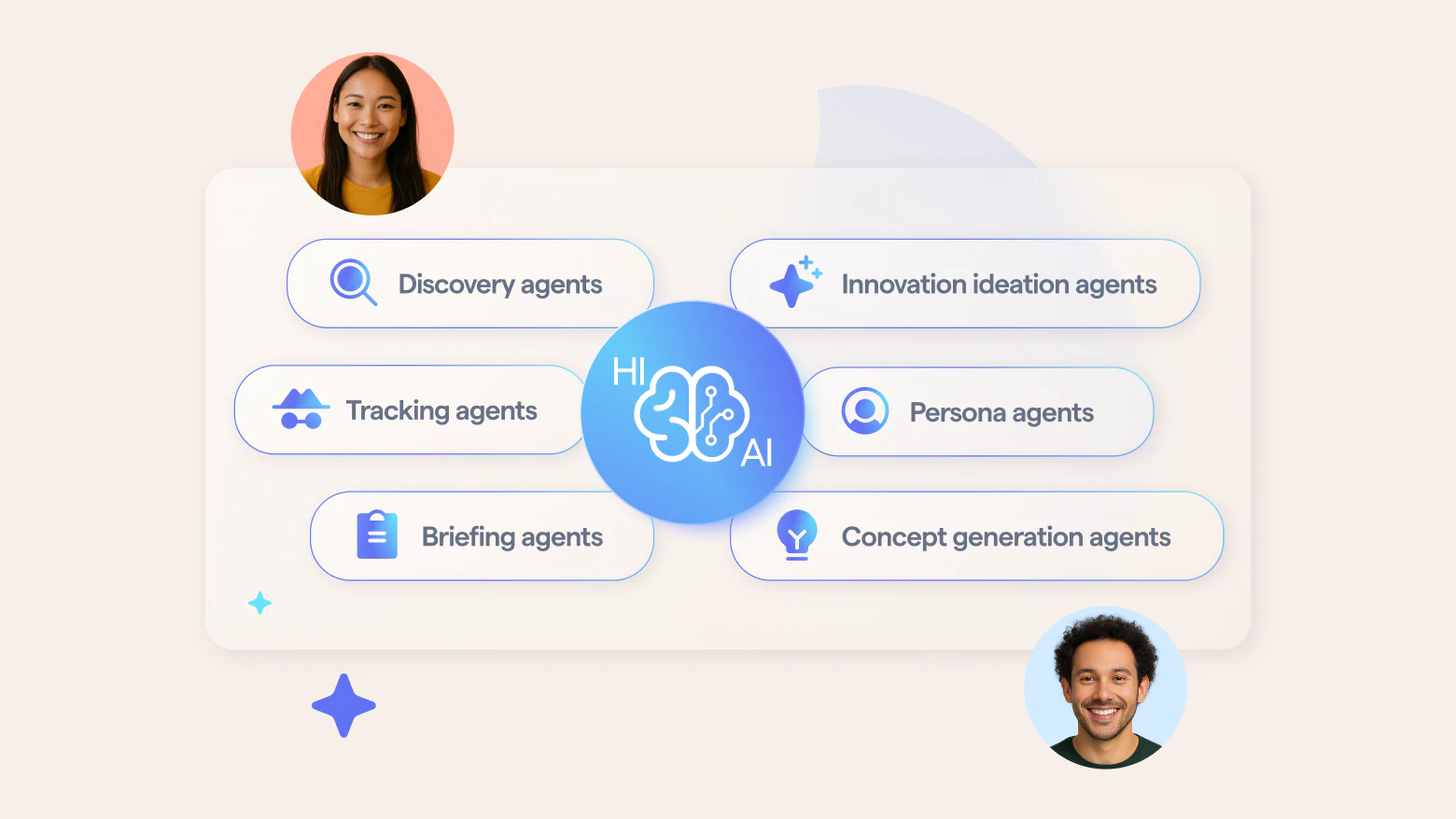
DeepSights agents are not general-purpose. They are finely tuned to execute specific insights tasks such as consumer trend analysis, competitor intelligence, concept testing, whitespace identification, and innovation ideation. These agents encompass best-practice reasoning and guardrails developed with market research professionals from the world’s leading brands across more than 15 years. Each agent is engineered to use best-in-class LLMs selected specifically for each task type. As the agents build on memory across interactions, they continuously drive performance quality over time.
Bringing insights into workflows
AI can’t operate as an island. Impact is delivered only when business users interact with trusted insights. By bringing customer and market insight into daily workflows, specialised AI shapes decisions to become more customer centric. Where DeepSights has been implemented, enterprises regularly see a jump in engagement in usage.
At eBay, the global online retailer, DeepSights was introduced to a wide number of business teams to democratize access to insights. In the first year of roll out more than 2,200 employees put questions to DeepSights, driving platform usage up by 200% on the previous year. By changing accessibility to intelligence, eBay brought insights into the heart of the business.
The insights team at Philips Personal Health, recently introduced synthetic personas to the product and marketing units. Despite having invested in very extensive segmentation studies, the insights team recognized that this data was hard to work with on a day-to-day basis. They saw an opportunity for synthetic personas to bring this rich analysis to life and so created their first crop of DeepSights Personas. The feedback has been overwhelmingly positive. Business leaders are now testing product claims, packaging, and campaign messaging with DeepSights Personas as a matter of course. These tests are run faster than was previously possible, and business users are seeing an improvement in the quality of campaign communications.
In Forrester’s Total Economic Impact study of DeepSights, a global, CPG brand, reports a 50% acceleration in the time to insight for strategic projects. The insights leader is quoted as saying, “In terms of innovation, development, advertising, and market review projects, we went from taking on average six months to taking half the time.”
Proactive intelligence orchestration maximises insights impact
A modern intelligence system needs to do far more than providing AI-powered knowledge retrieval. New era C&MI platforms will be judged by their ability to put leaders on the front foot, spotting opportunities and risks earlier to drive revenue growth. Agentic-AI capabilities need to be integrated into a comprehensive active intelligence system that continuously orchestrates the use of market and consumer insights across the enterprise. This approach closes the gap between insights discovery and action, so businesses can anticipate consumers and get ahead of their competition.
Checklist: Evaluate AIs ability to deliver an active intelligence system
An active intelligence system achieves superior business outcomes by running and continuously linking tasks that support insights discovery all the way through to evidence-backed business action. This table provides a checklist of intelligence tasks AI must perform.
Intelligence work executed
Evaluation Question
Proactively connects and interprets market intelligence data to uncover fresh insights.
Is the AI able to create relationships across your entire knowledge base autonomously?
Detects early market and consumer signals.
Can agents spot how new information impacts existing trends or identifies new trends?
Triggers alerts and notifications when something changes.
How do agents communicate important changes to users and other AIs? Do they just wait to be asked?
Prompts actions directly in business workflows.
Do AI to AI connections streamline use of insights? Can business users shape next steps based on insights data, for example, in building their innovation pipeline?
Validates options against virtual customers.
How can business users test ideas with market segments?
Identifies and helps fill knowledge gaps.
How do you know where to prioritise limited research budget? How do ensure you build on previous research not repeat it?

Companies that deploy an active intelligence system will be able to move first, learn faster, and outperform those that don’t.
Is building your own market intelligence AI a viable option?
Large IT teams have been tempted to build their own agents for market research and intelligence but the challenges they face in creating a fit-for-purpose system are huge. To begin with the surface area of what’s really involved is much larger than it seems to a non-market research expert at the outset. Each of the foundational elements alone is a serious engineering programme covering data ingestion, evidence classification, trust hierarchy design, and governance.
The opportunity cost of diverting your AI experts to figuring how to build an insights infrastructure rather than advancing capabilities for your core business becomes harder to justify as timelines get longer. This drain on your IT resources is exacerbated by the requirement to scale and update your custom build. Agents and integrations will need constant investment to keep up with the latest AI technologies as well as evolving business needs.
Integrate a special-purpose C&MI solution into your enterprise AI stack
The most common question we hear is whether DeepSights competes with Copilot or other generic AI assistants. It does not. DeepSights is not a replacement for your enterprise AI. It is the specialist AI alongside Copilot, your specialist market-intelligence layer that connects to it through the Model Context Protocol (MCP), an open and widely adopted standard, with no lock-in to any single supplier.
The division of labour is clear. Copilot owns the productivity surface: creating and editing documents, collaboration and meetings, and the internal context of the organisation. DeepSights owns the market: connecting to your market sources, understanding them, weighing their reliability, bringing them together accurately and monitoring them for change. Used together, they produce better decisions, faster answers, less duplicated research and more confident investment.
In practice it is seamless. A marketer preparing a quarterly category review in PowerPoint asks Copilot to add the latest trends in functional beverages. Copilot recognises that the request needs market intelligence, passes it to DeepSights through MCP, receives a set of findings with every claim referenced to its source, and writes them straight into the slide. There is no switching between tools and no separate research step.
DeepSights’ proven AI aligns with where the market is heading
DeepSights is used daily by more than 100,000 business users at world’s leading brands, among them Mars, Novartis, eBay, Colgate-Palmolive, Philips, Tesco, Vodafone and REWE. Independent analysis by Forrester confirms it reduces the time taken to find an insight by 97 per cent. Explore customer success stories →
In New Zealand, Fonterra, the world’s largest dairy exporter, saw a 58% rise in the number of unique business users accessing insights directly after it introduced DeepSights. In just four months, the number of market intelligence intelligence-related questions being answered on the platform rose by 35%.
Fonterra is now at the start of a strategic programme to drive a foresight-driven innovation agenda with DeepSights Innovate. The new approach is targeting 11,000 hours of time-saving efficiencies that the insights team will save in preparing and writing up innovation and ideation workshops. The bigger prize for Fonterra’s insight team will be impacting future revenues by changing the content used in innovation development. Firstly, the team is bringing in market signals that stretch beyond shorter term customer demand data using DeepSights Radar. For example, this will involve examining emerging science and tech patents to spot opportunities for long long-term growth. Secondly, it is bringing the customer into the very front-end of the innovation process by making it possible to interact with audience segments using DeepSights Personas.
The role of specialized AI is noted by Gartner, which predicts that Domain Specific Language Models (DSLMs) and the applications they underpin will account for $131 billion in revenue by 2035. The reasoning behind the predicted growth is straightforward: ‘consistently higher reliability in business-critical workflows’.
Productivity AI is now essential. But competitive advantage comes from understanding your market, and that is the layer DeepSights provides.
Next steps

Keep reading
Learn how companies are embedding insights into their business processes, and discover how Fonterra is transforming innovation with DeepSights.
Read more
FAQ
Can general-purpose AI like Copilot or ChatGPT be your main tool for market intelligence work?
What is the difference between domain-specific AI and general-purpose AI for business decisions?
How accurate is generic AI for market research, and what is the hallucination risk?
How can AI insights be made source-traceable and auditable?
Why use a dedicated market intelligence platform instead of Copilot or ChatGPT?
Does specialized market intelligence AI replace Microsoft Copilot?
How do you add market intelligence capability to an enterprise AI stack?
What is an active intelligence system?
Is it better to build your own market intelligence AI in-house?
What is the best AI for competitive and market intelligence?