


Share this article


Innovation has become a paradox. Across industries, executives agree it is essential for growth. In fact, innovation ranks as the number one strategic priority, with 82% of C-suite leaders expecting it to become even more important over the next three years.
Yet at the same time, 60% say their organizations are not effective at generating and executing innovation, a newly published report by Market Logic, Ipsos, and Alchemy-RX reveals. The flagship C-suite research on innovation surveyed 250 CEOS and senior executives working in CPG, Healthcare, and other industries.

This disconnect — between intention and impact — defines the innovation stall that many organizations globally are now experiencing. Despite unprecedented access to data, tools, and technology, innovation outcomes are becoming increasingly incremental, predictable, and fragile.
So what’s really holding innovation back?
And what would it take to move from stalled pipelines to sustained growth?
The innovation gap is structural, not creative
The newly published Innovation Reignited research paints a sobering picture.
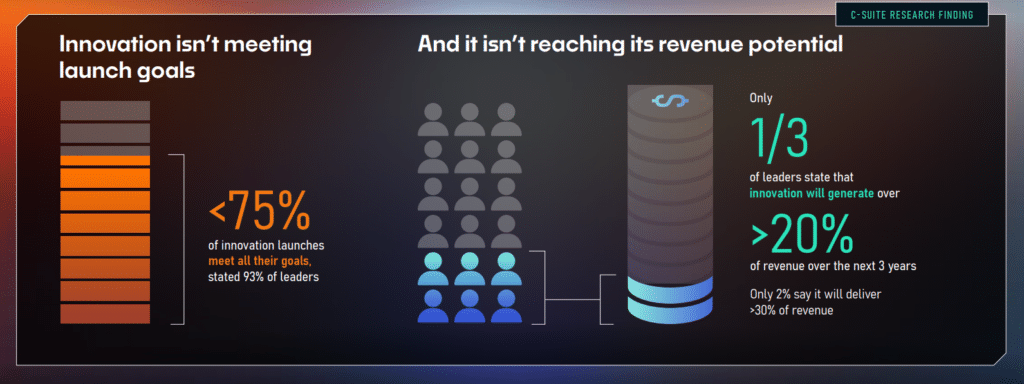
Most leaders report that fewer than three-quarters of innovation launches meet all their objectives. Only one in three executives expects innovation to generate more than 20% of revenue over the next three years, and just 2% believe it will contribute over 30%. These are surprisingly modest expectations for something positioned as a primary growth engine.
At the same time, organizations are increasingly defaulting to renovation rather than true innovation. Roughly 74% of launches are renovations, with only 26% classified as genuine innovation.
Renovation plays a pivotal role: it protects existing business, refreshes brands, and meets short‑term commercial needs. But renovation alone rarely creates new demand, unlocks white space, or builds durable differentiation.
As Gonzalve Bich, former CEO of BIC, put it during our joint Innovation Reignited webinar:
“First you have to set the vision for what 10 years from now is going to look like… and innovate towards that.”
– Gonzalve Bich, CEO of BIC
Many organizations simply aren’t operating with that long-term lens.
Instead, innovation becomes reactive — driven by competitors, technology trends, or internal urgency — rather than by a clear view of evolving consumer needs.
The real bottleneck is insight
When leaders look beneath the surface, a consistent pattern emerges.
The top barriers to meaningful innovation are not a lack of ideas or tools — they are fundamentally about consumer understanding. As the report uncovered:
- 46% cite “not enough insights available” as the #1 hurdle to developing more ideas
- 32% identify “lack of consumer understanding” as a major internal barrier to innovation
Yet paradoxically, less than half of innovation ideas originate from consumer research. Most are instead derived from competitors or technology. This is more than an operational inefficiency. It’s a strategic risk.
When innovation starts with competitors rather than consumers, differentiation erodes. Teams converge on the same spaces. Concepts become interchangeable. And launches struggle to stand out in crowded markets.
The consequences are stark:
- 75% of innovations fail to meet expectations because they’re disconnected from consumers
- 91% of business leaders say the sheer volume of data has limited their organization’s success
- 70% report collecting data faster than they can analyze or apply it
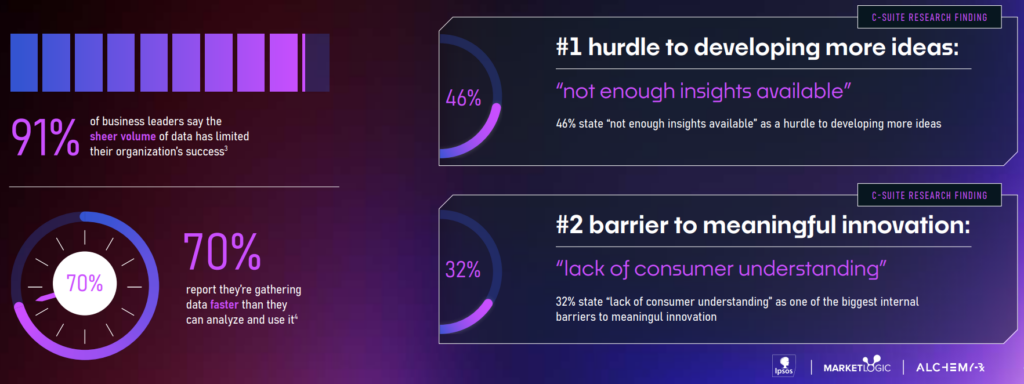
In essence? Organizations are rich in data, but poor in actionable insight.
It’s not about the shortage of information, but the gap of translating insight into everyday decision-making.
Why AI hasn’t delivered on its promise yet
Many hope artificial intelligence will close this gap, with 86% reporting they believe it will be critical over the next three to five years.
But although initial adoption is already widespread, early results are underwhelming:
- 97% of companies have implemented AI in their innovation processes
- Only 32% of AI users have reported improved idea generation and innovation so far.
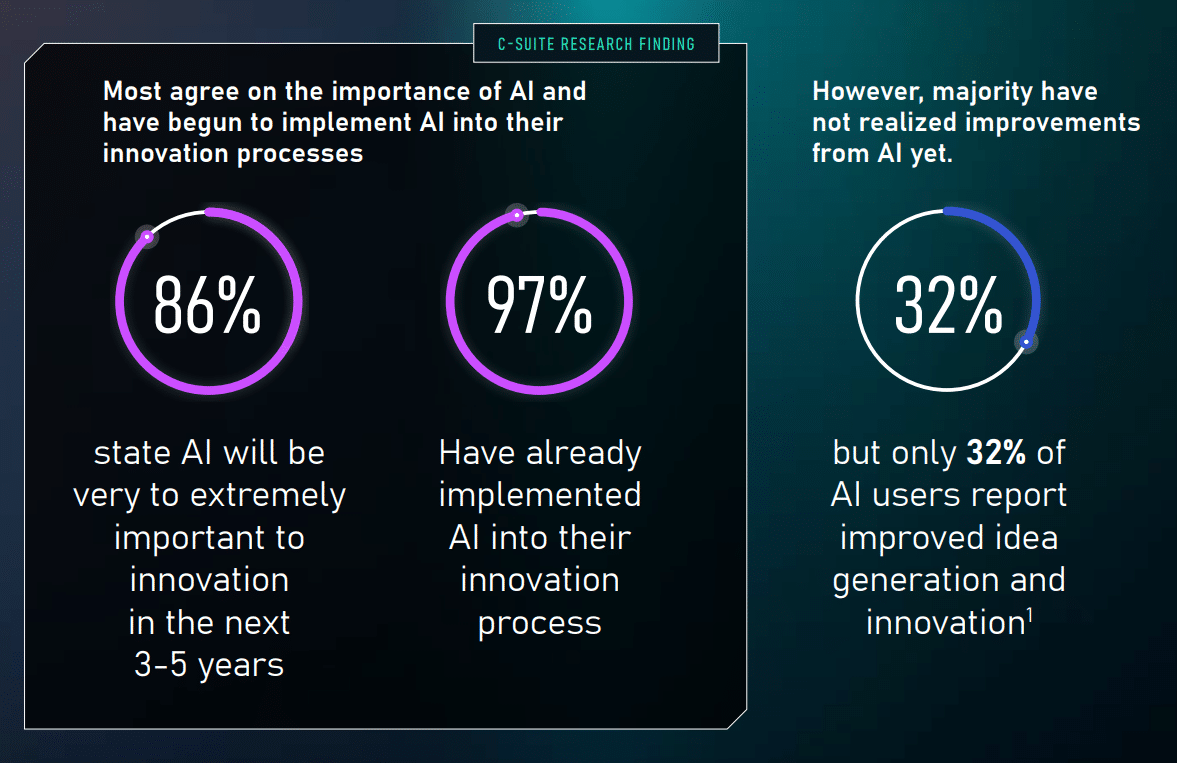
The issue isn’t AI itself. It’s how it’s being used – as the chief innovator, rather than a power tool.
Many organizations are applying AI tactically — summarizing reports, searching databases, and accelerating administrative tasks. These deliver great efficiency gains, but not innovation breakthroughs.
Common pitfalls include:
- Implementing AI without a clear innovation framework
- Failing to pair AI with human judgment and strategic context
- Underutilizing proprietary consumer insight assets
As the Innovation Reignited report makes clear, the true power of AI lies not in replacing the process, but in accelerating it.
This requires a different model: one where AI amplifies human insight rather than operating in isolation as the chief innovator.
But meaningful progress requires more than deploying AI. To the AI move the organization forward, insight teams must actively guide the organization across three critical dimensions — supported by deliberate organizational design:
- Operationally: moving from disconnected systems to a seamless, end-to-end insight ecosystem
- Culturally: shifting from insight as a periodic input to continuous insight discovery acting as a catalyst for everyday decision-making
- From a governance perspective: evolving from experimental usage to dependable, enterprise-grade intelligence at scale
These shifts require more than process change alone — they need new capabilities that make continuous, trusted insight possible at scale. This is where synthetic personas and agentic AI come in.
Together, they provide the practical foundation for operationalizing insight across the organization: connecting fragmented research, preserving critical context, and enabling teams to move from static reports to ongoing learning. Rather than acting as standalone tools, they support a new way of working, where insights are always accessible, continuously updated, and embedded directly into everyday decisions.
Agentic AI to power continuous innovation
To support innovation programs that are always on, not episodic, organizations are turning to AI agents — autonomous AI workflows that proactively monitor, synthesize, and surface intelligence in ways that go beyond basic search or summarization.
Rather than waiting for individual queries, these agents can continually scan your research ecosystem, flag emerging signals, and generate structured insight outputs that inform strategy at every stage of innovation.
What this means in practice for your organization is a shift to active intelligence:
- Continuous trend intelligence — Always-on agents that monitor evolving consumer needs, competitive moves, and category shifts in real time, helping teams anticipate change instead of reacting to it.
- Scenario exploration at scale — agents remix insights to model the impact of different product decisions, price points, or positioning strategies, enabling decision-makers to explore “what if” scenarios with evidence-based confidence.
This pattern mirrors how top innovation organizations operate: instead of episodic research cycles, they run a continuous insight engine that feeds ideation, development, and execution.
A new operating model for innovation
Modern innovation teams are adopting a coordinated framework where AI agents, synthetic personas, and human expertise work together to fuel ongoing discovery and decision support. In this model:
- Synthetic personas represent dynamic, evidence-grounded customer segments that teams can interact with to test ideas, narratives, and scenarios.
- AI agents act as always-on collaborators that continuously harvest insights, update profiles, and surface patterns across data silos.
- Human experts interpret, challenge, and apply these outputs, turning them into strategy and action.
This approach helps remove the bottlenecks that typically slow innovation: it reduces reliance on one-off research cycles, democratizes access to insight, and embeds evidence directly into product and business decisions. By aligning people, processes, and intelligent systems around a shared innovation engine, organizations gain the agility to respond to shifting consumer expectations and competitive dynamics — not just once, but continuously.

For organizations ready to operationalize this approach, DeepSights™ Innovation Studio provides a dedicated digital space where AI agents and human experts collaborate across the front end of innovation. It brings structured workflows, always-on intelligence, and evidence-grounded outputs into a single environment — enabling teams to generate ideas, identify whitespace opportunities, refine concepts, and accelerate innovation, all powered by their own trusted data.
How synthetic personas help with consumer understanding
At the heart of this model is a deeper, more actionable understanding of customers. Synthetic personas move beyond static profiles to become living representations of consumer needs, motivations, and behaviors — grounded in real research and continuously refined as new insights emerge. Teams can engage with these personas to pressure-test ideas, explore trade-offs, and anticipate reactions, accelerating early-stage concept development while keeping decisions anchored in evidence.
Rather than replacing traditional research, synthetic personas such as DeepSights Persona Agents extend its value — making insights more accessible, interactive, and usable across functions. This enables marketing, product, and strategy teams to align faster around customer realities and make confident choices earlier in the innovation process.

The future of innovation is continuous
The future of innovation isn’t about adopting AI in isolation — it’s about building systems that turn insight into action, continuously.
By combining agentic AI with evidence-based personas and human expertise, organizations can move from episodic research to always-on learning, enabling faster decisions, stronger customer alignment, and more resilient innovation pipelines. Those that succeed will be the ones that treat insight not as an input, but as a core operational capability powering growth.
Ready to see how a trusted, award‑winning consumer insights platform can help you move from episodic research to always‑on learning and boost your innovation pipeline? Explore DeepSights and request a demo to see how always‑on consumer understanding can work inside your organization.