

Share this article


AI is often described as revolutionary, but it isn’t the silver bullet for innovation success.
61% of leading CEOs expect investments in AI to accelerate innovation1, and many see it as the answer, rather than part of a broader solution. However, AI can’t build a commercially successful innovation pipeline on its own. Human strategic capability, creativity, and judgement will remain central to innovation.
Brands that use AI successfully will see it as a collaborator, to enhance, not replace, the creative process of innovation. AI integration into the innovation process represents both an unprecedented opportunity and a profound test for business leadership.

Why many aren’t seeing results
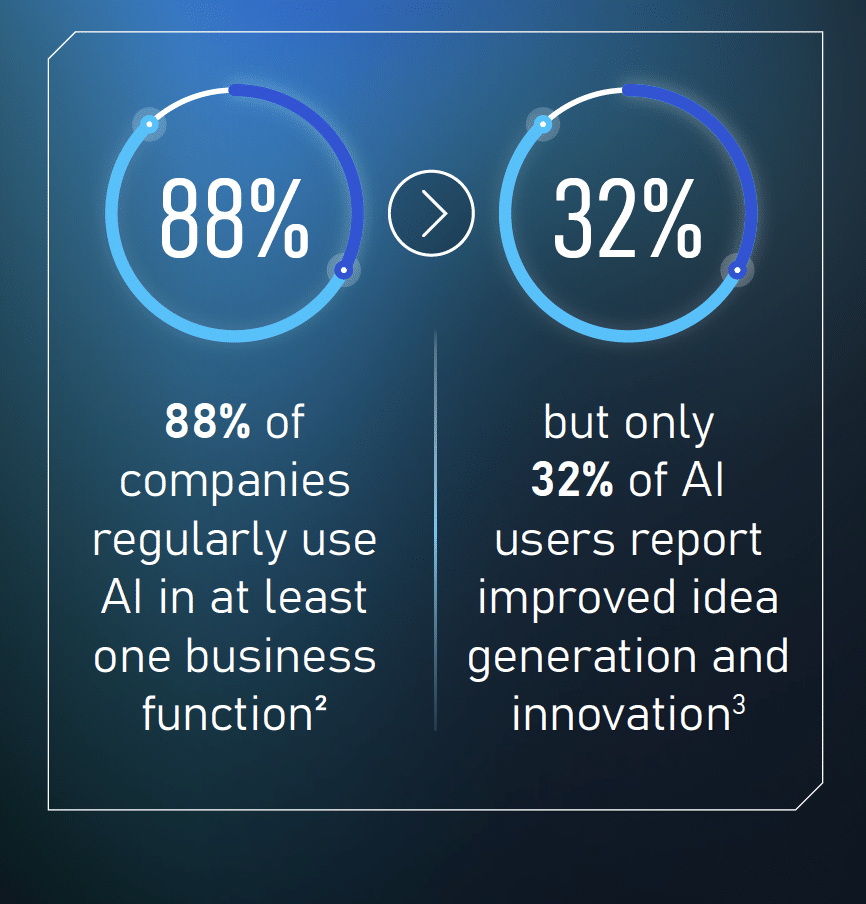
Common pitfalls:
- Implementing AI without a clear strategy, realistic expectations, or a framework of how they fit into the existing processes
- Lack of human collaboration to instruct AI on how to approach the problem, what data sources are best to answer it, and what type of outputs are needed
- Not using unique source material, or all of your source material, leading to bland, obvious ideas.
Understanding AI’s strengths and its boundaries is critical to building a successful human-AI innovation partnership.
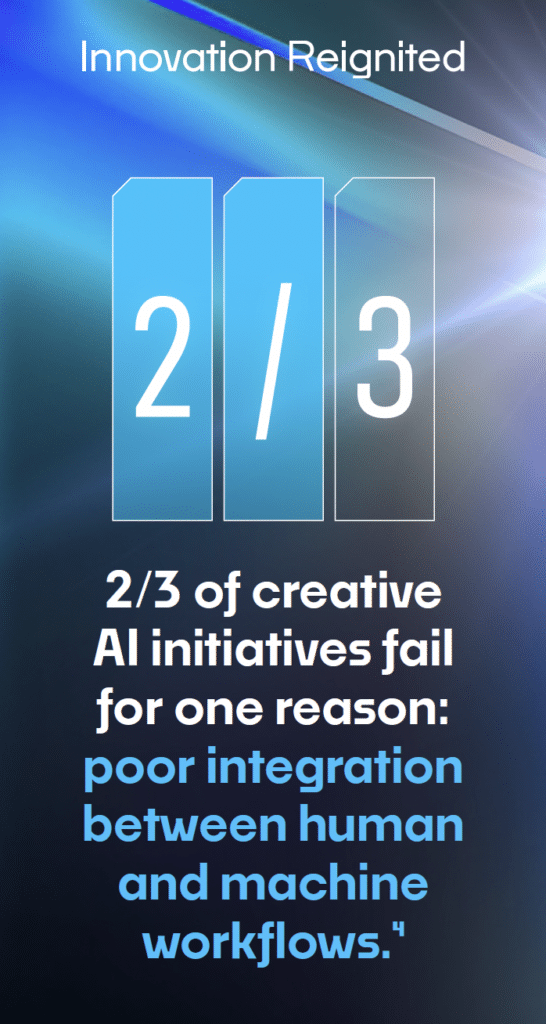
AI can supercharge many aspects of the innovation process, like speeding up data synthesis over vast data sets or accelerating early exploration – but strong human oversight needs to control the source material, train it, and oversee outputs. And many parts of the innovation process simply can’t be automated or done without humans.
The true power of AI lies not in replacing the process, but in accelerating it: giving teams better starting points, saving time, and making sense of more data.
Dos and don’ts of AI for… innovation insights
Traditionally, this process required a mosaic of inputs: market research, trend tracking, expert interpretation, and commercial judgement. Teams would spend days in a Post-It-filled room, just to reach synthesis of unique insights.
Today, teams are frequently paralyzed by the sheer volume of data and often too overwhelmed to make sense of it all. Read more in a previous article, Innovation Reignited: Becoming First to Insight, Not Just First to Market.
AI can quickly surface insights from large datasets, but it can’t replace strategic thinking or real consumer research. DO use AI to:
- Speed up data analysis: AI can process and organize massive datasets in hours, not weeks.
- Maximize past research: AI can surface underused insights and eliminate duplicate efforts.
- Spot patterns and tensions: Use AI to process, cluster, and highlight patterns, but human context is required to validate what’s most meaningful and relevant.
- Tailor summaries to your needs: AI can summarize insights into themes, or segment by category, based on the defined opportunity.
DON’T use AI to:
- Substitute real consumer research: Without differentiated input, AI will produce the same ideas it can produce for anyone else. Actual consumer research is still needed to gain unique insights.
- Create your strategy or define whitespace: AI can’t define which spaces your brand should pursue or determine growth opportunities. Only people in the business can define, with much broader context, where the business should invest.
- Replace critical thinking: AI may make connections that aren’t meaningful or overlook others. It doesn’t distinguish between correlation and causation, between signal and noise, or understand nuance, cultural context, or emotions.
Dos and Don’ts of AI for… Ideation
Whether through workshops, inventor submissions, or solo brainstorming, ideas can still come from anywhere. Today, the bigger challenge is breaking from business-as-usual to generate fresh, insight-led ideas and knowing which are worth pursuing before investing precious resources to develop them.
AI can fuel ideation with speed and structure, but it can’t replace human creativity or strategy. There are limitations on how much the fuzzy front end can be automated, and success depends on strategic framing, consumer understanding, and creative thinking.
DO use AI to:
- Compile and organize insights for ideation: AI can quickly synthesize existing insight, trends, and research to ground ideation in consumer needs.
- Get the obvious ideas out of the way: AI can generate a starting list of starter ideas, so that teams can build upon them and push thinking further.
- Stretch team thinking: With the right prompting, AI can offer stimulus to help humans explore multiple angles on a problem or insight.
- Iterate and refine ideas: Properly trained AI LLMs can simulate insight-based consumer reactions to ideas, providing rapid feedback to improve or evolve ideas.
- Support prioritization: If trained, AI can compare ideas against defined criteria, such as evaluation against strategic fit, brand alignment, and feasibility.
- Be part of the innovation idea: AI can also be part of the product or service idea. Brands should ask: how can AI be used to deliver new benefits, enhance experiences, or solve real pain points?
DON’T use AI to:
- Replace human creativity: True creativity that connects disparate dots, reframes problems, or imagines something entirely new still relies on human minds.
- Displace innovation expertise or facilitation: AI needs training, context, and structure to be effective, so the person training needs innovation expertise. AI won’t lead a strategic session, ask the right questions, or push thinking on its own.
- Write winning concepts: AI can format or draft concepts, but it lacks the nuance, tension, and persuasion of a strong human-written concept.
- Predict real consumer reaction: AI can’t predict how consumers will think or react to a new idea. It can only help refine based on historical insights, and it lacks real consumer emotion, motivation, and behavior. Only real testing can gauge potential.
- Be part of every innovation idea: Not every idea needs to include AI. Like past tech trends (e.g., IoT), AI may not need to be part of the product or service, and it isn’t a solution unless it solves a real consumer problem.
How to get more from AI in early-stage innovation
Once the strengths and limitations of AI for insight and ideation are clear, the next step is building a system that enables AI to enhance, not replace, early-stage innovation.
1. Define AI’s role in your Innovation pipeline. Define clearly how and where AI adds value, how it integrates with existing processes, and what guardrails apply. Ensure outputs are evaluated through the lens of brand strategy and consumer insight, not just novelty or volume.
2. Upgrade data infrastructure. The quality of AI output depends entirely on the integrity of the input. Treat data infrastructure as a strategic asset, not a back‑office function. Consolidate and clean historical research assets, unify data sources, and establish metadata standards that make past insights discoverable.
3. Use the right AI. A general purpose GPT cannot do front-end innovation or insights synthesis. Specialized models trained for specific contexts consistently outperform generic tools – particularly in areas requiring contextual understanding of consumer behavior, brand language, and cultural meaning.
4. Invest in hybrid skillsets. Innovation leaders need teams that understand how to work with AI – how to frame effective prompts, evaluate machine outputs, and spot biases, errors, or hallucinations. Upskilling should focus as much on analytical judgement as on technical training.
5. Pilot hybrid workflows. Encourage teams to test combined human‑AI processes on real innovation challenges. For example, use AI to draft concept territories or cluster consumer feedback, then have cross‑functional groups validate and refine the outcomes. Small‑scale pilots can reveal both efficiencies and pitfalls before broader rollout.
6. Measure impact and iterate. Establish KPIs for how AI is improving the innovation process – speed to insight, reduction of duplication, idea‑to‑market conversion rates. Use these metrics to refine your approach. The goal is not to deploy AI for its own sake, but to enhance the creative and commercial effectiveness of the innovation pipeline.
Leaders who avoid the trap of technological determinism and build organizations where AI accelerates and amplifies human intelligence will succeed.
A call to action:
Ready to see AI do more with insights?
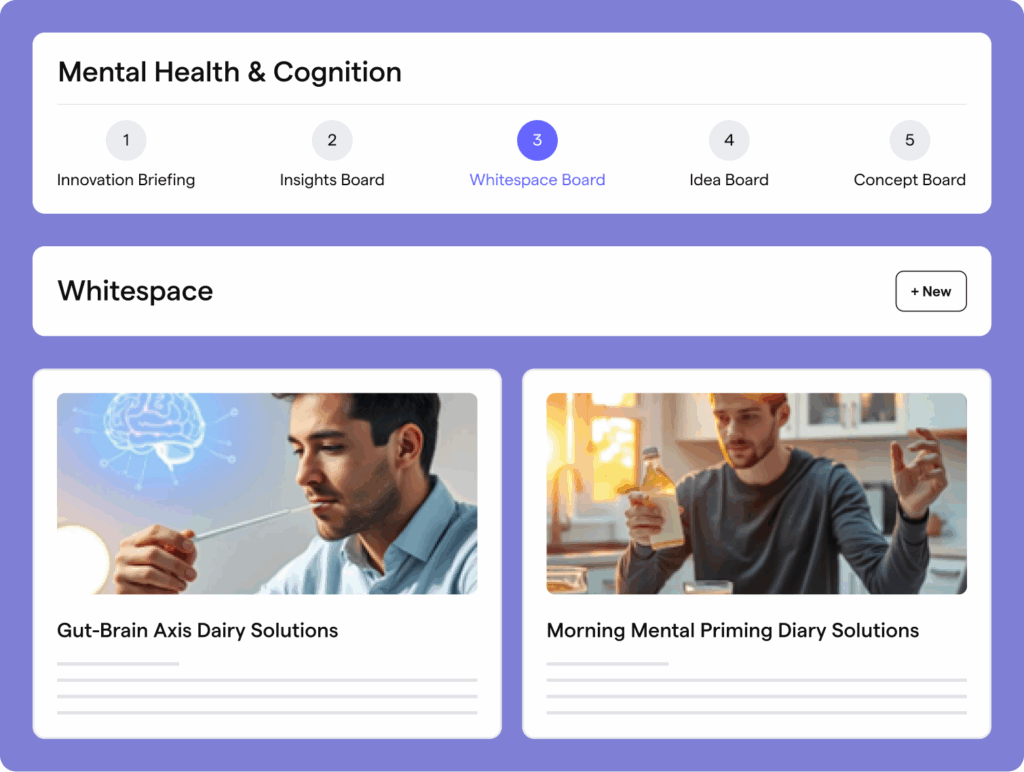
The best way to unlock meaningful value from AI is to use agents trained specifically for insight and innovation work. Market Logic’s DeepSights Innovation Studio was built for exactly that – bringing together specially trained AI agents that can synthesize insights across broad and disparate research libraries, spark idea territories, and draft concept directions in seconds.
These tools work in tandem with human teams to accelerate the process of crystalizing new opportunities from the underlying pool of knowledge and unique insights the company has assembled.
Reach out to info@marketlogicsoftware.com to see it in action – see a preview below.
Bring AI into ideation and concept creation, the right way
Alchemy-Rx has been experimenting with and integrating AI in innovation for over five years. We know where it accelerates the work and where it can’t replace strategic thinking, creativity, or commercial judgment.
We help organizations use AI as a true collaborator: to jumpstart ideation, push thinking further, simulate feedback, and co-write early concepts – all while staying grounded in unique insights, brand positioning, and consumer relevance.
Reach out to bo@alchemy-rx.com to learn more.
Let’s build innovation pipelines powered by both human creativity and AI
How we can help
- Market Logic powers the DeepSights™ platform, a specialized AI that helps teams extract insights from existing research, across brand, category, and consumer studies, to spark new ideas and inform better development.
- Alchemy-Rx uses a hybrid AI-human collaborative approach to innovation, helping organizations uncover innovation opportunity areas and fill their innovation funnels with relevant, differentiated ideas.
- Ipsos brings world-class research capabilities, with proven methodologies to uncover deep consumer and category understanding. They offer both AI and human research tools to uncover insights and validate innovation ideas.
Explore the Innovation Reignited series
This article is part of our Innovation Reignited series, a collaboration between Ipsos, Market Logic, and Alchemy-Rx. Stay tuned for more articles, videos and webinars where we’ll highlight common challenges and provide practical advice to generate growth through innovation. We’re jointly commissioning new market research to bring light to the true state of innovation in PG. These results will be shared in a comprehensive report as an exciting crescendo of our series.

Sources:
- IBM. CEO Study, 32nd edition. 2025.
- McKinsey. Global Survey on the State of AI. 2025.
- Barclays. The Barclays Business Prosperity Index. 2025.
- Bain & Company. Why AI Stumbles Without a Solid Data Strategy. 2025.