

Share this article


Active intelligence is AI that works without being asked: it connects market data continuously, detects early signals among consumers and competitors, alerts you when something shifts, and prompts action inside your workflow. Unlike on-demand prompting, which answers only the question you thought to ask, it closes the gap between insight and action.
There is a hidden assumption in the way most teams use AI: that you already know the right question to ask. On-demand tools wait for a prompt, answer it, and fall silent. Everything you did not think to ask about, the shift you have not noticed, or the problem building in one region, stays out of view.
Passive search vs active intelligence
For most of its history, company knowledge has been passive. It sits in presentations and databases, waiting for someone to retrieve it. Prompting an AI is a faster way to retrieve it, but it is still a response to a question. You ask, it answers, the exchange ends.
Active intelligence works differently. It is a form of specialized AI for market intelligence that connects market data continuously, detects early signals among consumers and competitors, alerts users when something shifts, and prompts action inside business workflows. It does not stop, and it does not wait. The work of knowing what to look for moves from the person to the system, which closes the gap between discovering an insight and acting on it. This is what Market Logic Software built DeepSights to deliver.
The shift is from retrieval to orchestration, and it is what proactive market intelligence looks like in practice. A passive system waits to be queried. An active one runs and links tasks continuously: spotting a signal, alerting the right people, prompting the next step inside the workflow where the work actually happens, and testing an idea against a modelled customer, using synthetic personas, before any money is spent.
What active intelligence looks like day to day
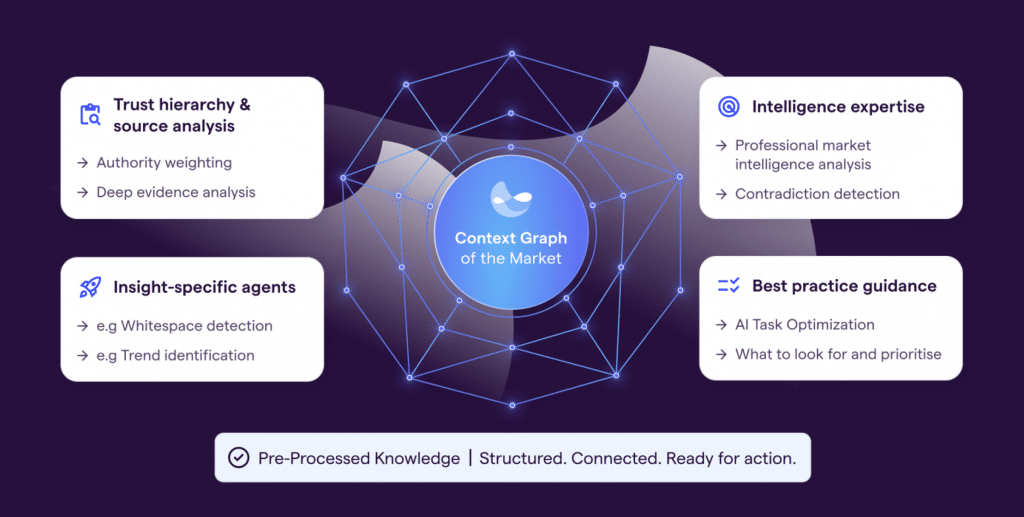
Active intelligence depends on components that work continuously rather than only on request. Some run on a schedule once set up, monitoring a category, watching a competitor, or following a trend. Others are available at any time and are triggered by a person or another system when needed.
A useful way to judge any system is to ask what it does without being prompted:
- Can it create relationships across your whole knowledge base on its own?
- Can it tell when new information changes an existing trend or reveals a new one?
- Does it alert the right people when something moves, rather than simply waiting to be asked?
- Does it help you decide where to spend a limited research budget and build on past work rather than repeat it?
A general tool answers none of these. It only ever responds.
A concrete example shows the value. A team reviews a category and, alongside the answer to the question it asked, the system notes on its own that the number of products on the market is climbing while consumer interest has barely moved, a sign of saturation worth heeding. Nobody asked for that warning. A tool that only answers questions would never have raised it, and the team would have carried on unaware.
Adoption tends to follow, because people trust a system that brings intelligence to them rather than making them go and find it. At eBay, opening DeepSights to more than 2,200 employees in the first year lifted usage by 200 per cent.
The pay-off is clearest when it is least expected. Fonterra, the world’s largest dairy exporter, is using DeepSights Radar to bring in market signals that stretch well beyond short-term demand, including emerging science and technology patents, to spot opportunities for long-term growth. That is the difference between reacting to a market and getting ahead of it.
Why active, agentic intelligence is possible now
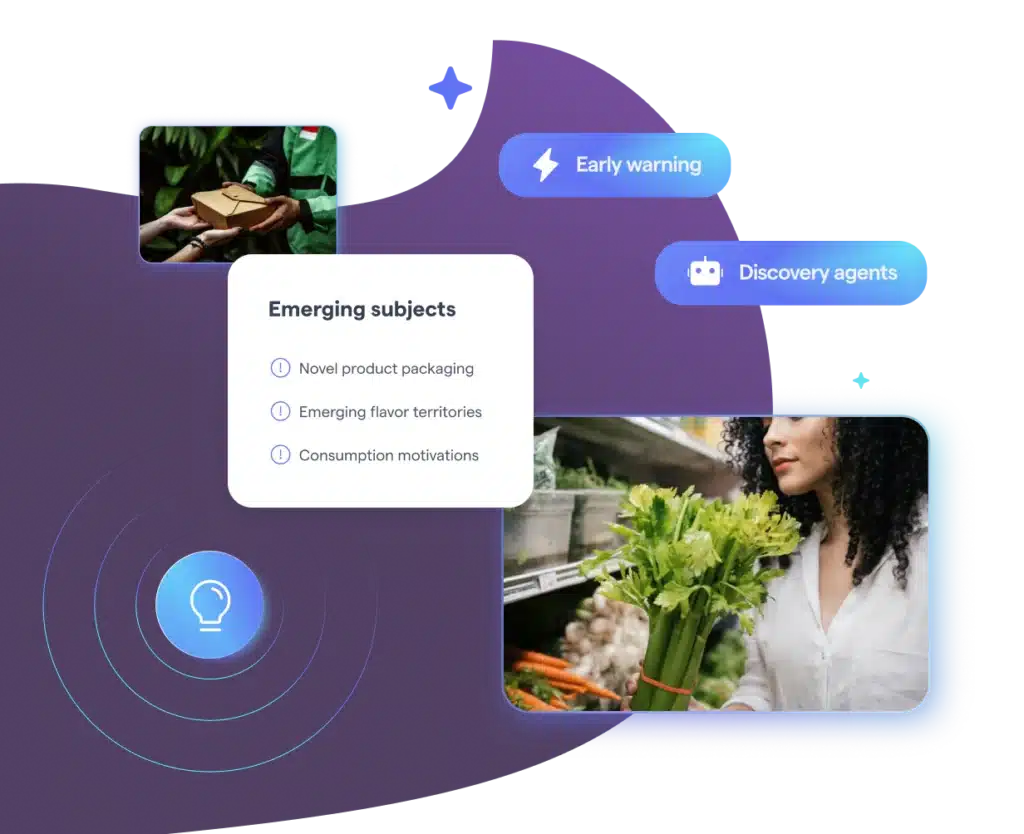
This is a recent development. Agentic AI can now analyse and bring together knowledge across systems, teams and formats on a continuous basis and at scale. That allows people and machines to identify opportunities and risks earlier, to develop ideas more quickly and, with DeepSights Innovate, to test them against modelled customers before committing money.
The practical test for any leader is simple. Does the system tell you things you did not ask about, in time to act on them? If it only ever answers the questions you already knew to ask, it is a faster library, not an early-warning system, and the market will keep moving in the blind spots it cannot see.
Organizations that adopt this approach move first, learn faster, and outperform those that do not. Those still waiting to ask the right question are, by definition, a step behind.
Book a proof session
Bring a live category question and see what the system surfaces that no one thought to ask, then decide whether a faster library is really enough.
Frequently asked questions
What is active intelligence in market research?
How is active intelligence different from agentic AI prompting?
What can active intelligence detect that on-demand AI cannot?
How does active intelligence help teams act faster?