

Share this article


As a product, strategy, or R&D leader, you already know the problem: customers change faster than roadmaps do. But most “customer understanding” still arrives like a weather report delivered by carrier pigeon. By the time the study is done, the debate has moved on, and the next sprint is already half-baked.
That wide gap between knowledge and action is why synthetic personas and agentic AI are getting so much attention right now. In fact, Capgemini reports that 82% of organizations plan to integrate AI agents within the next three years. The momentum is real, but the important question is practical: how do you use these tools to make better decisions without drifting into guesswork?
This article breaks down what synthetic personas and agentic AI are, where they fit in modern innovation workflows, powered by a purpose-built consumer insights platform. Lastly, it looks at how to use them to make consumer insights more continuous, more accessible, and more useful — especially in those messy early stages when teams need direction, not perfection.
From static personas to “always-on” consumer understanding
Traditional personas are often created with good intent and then quietly fossilize. A deck gets circulated, a few quotes get repeated, and the persona becomes a mascot. The market moves, behaviors shift, new competitors arrive, and the persona stays frozen in time.
Synthetic personas aim to solve that by making personas dynamic and queryable. Instead of a static profile, you get an interactive representation of a segment that can be refreshed, interrogated, and used in workflows. Not as a replacement for real research, but as a way to keep your consumer insights “warm” between studies and make existing knowledge easier to apply.
This direction aligns with broader commentary on where research in organizations is going: more specialized AI tools, designed for specific research tasks, rather than generic chatbots trying to do everything. As seen in the Harvard Business Review’s article on AI tools that are transforming market research, generative (gen) AI is already transforming the $140 billion global market-research industry by enabling the creation of synthetic personas and digital twins, which simulate consumer responses and behaviors.

What synthetic personas are (and what they are not)
A synthetic persona is an AI-powered model of a customer segment, built from available evidence (your research repository, segmentation work, trackers, concept tests, qual summaries, category reports, and more). Think of it as a “compiled” version of what your organization already knows, made interactive.
They are not magical mind readers. They do not replace talking to customers. They do not eliminate the need for validation. What they can do well is:
- Make existing consumer insights easier to access and apply
- Help teams pressure-test assumptions earlier
- Speed up iteration before you spend money on studies or build irreversible product decisions
This is where agentic AI enters the scene.
What agentic AI adds to consumer insights: initiative, not just answers
Generative AI can summarize, rewrite, and respond. Agentic AI can pursue a goal across steps. Instead of answering a single prompt, it can run a workflow: gather relevant inputs, compare evidence, surface contradictions, generate options, and refine outputs based on criteria.
For insights and innovation teams, that means you can move from “ask a question” to “complete a task.”
A practical example: rather than prompting, “What do we know about premium shoppers?”, an agentic workflow might:
- Pull relevant studies and trackers
- Identify patterns and outliers
- Compare regional differences
- Highlight where evidence is strong vs thin
- Output implications for packaging, messaging, and pricing
That kind of multi-step work is why many teams are treating agentic AI as the next layer on top of their knowledge base. Market Logic’s overview of this shift AI agents: The next big shift in AI. Here’s what you need to know, is worth a skim.
Faster concept testing for consumer insights with Persona Agents, without pretending it’s the final truth
Early-stage innovation is where teams need speed most, but it’s also where certainty is lowest. A concept is still a sketch. A message is still rough language. And a lot of decisions are just debates.
Synthetic personas can help you move faster by giving you a consistent way to ask: “How would this land for this segment, and why?”
Used responsibly and powered by the right consumer insights platform, they’re great for directional feedback, such as:
- Initial message framing (what feels credible, what feels tone-deaf)
- Feature prioritization hypotheses (what matters most and what’s “nice-to-have”)
- Packaging and naming exploration
- Common objections and adoption barriers
- Alternative narratives (how different segments might interpret the same claim)
This is where the secondary keyword consumer insights solution becomes less of a buzz phrase and more of a real requirement. You don’t just need insights. You need a workflow that helps you make decisions earlier, with guardrails.
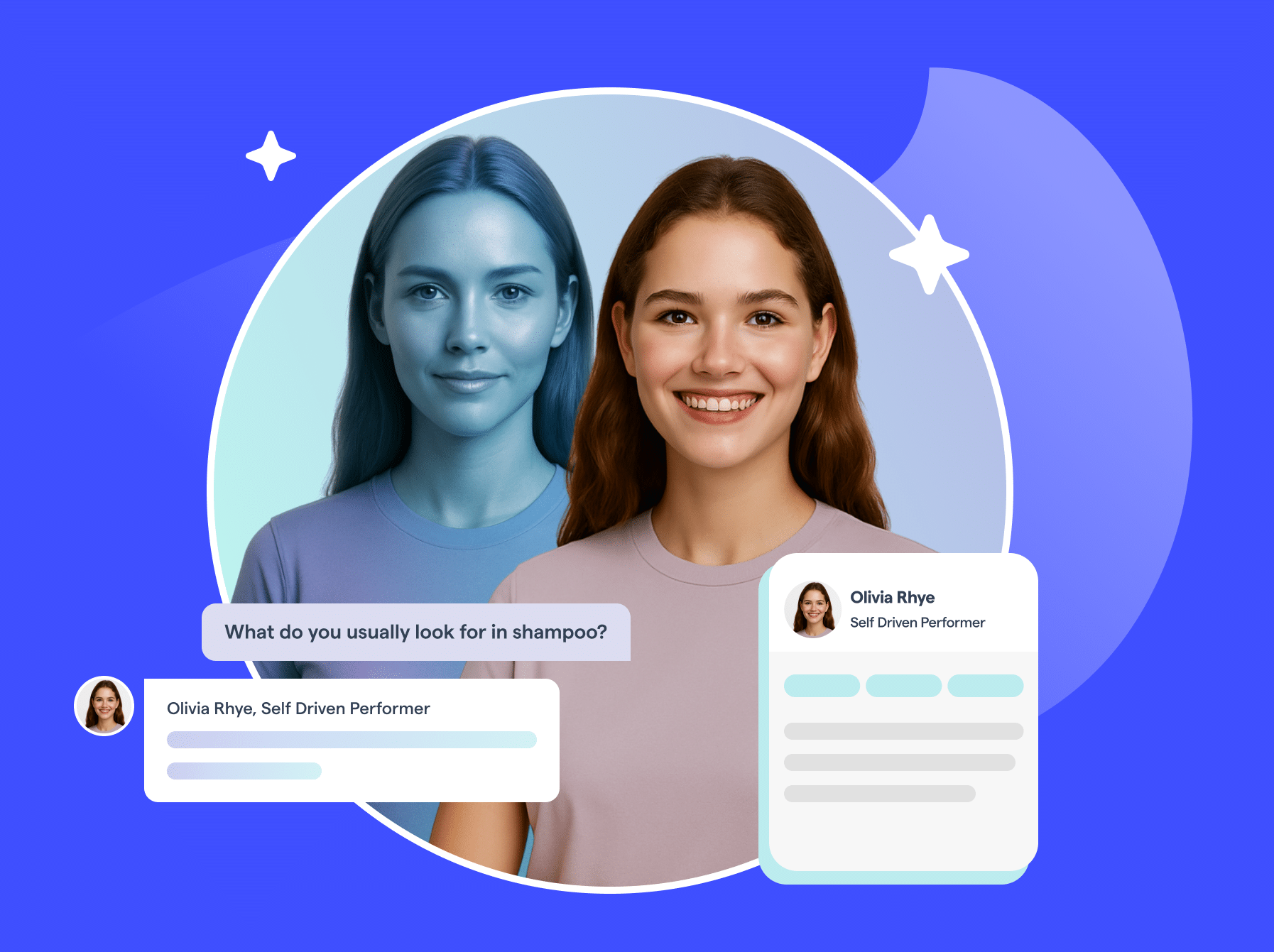
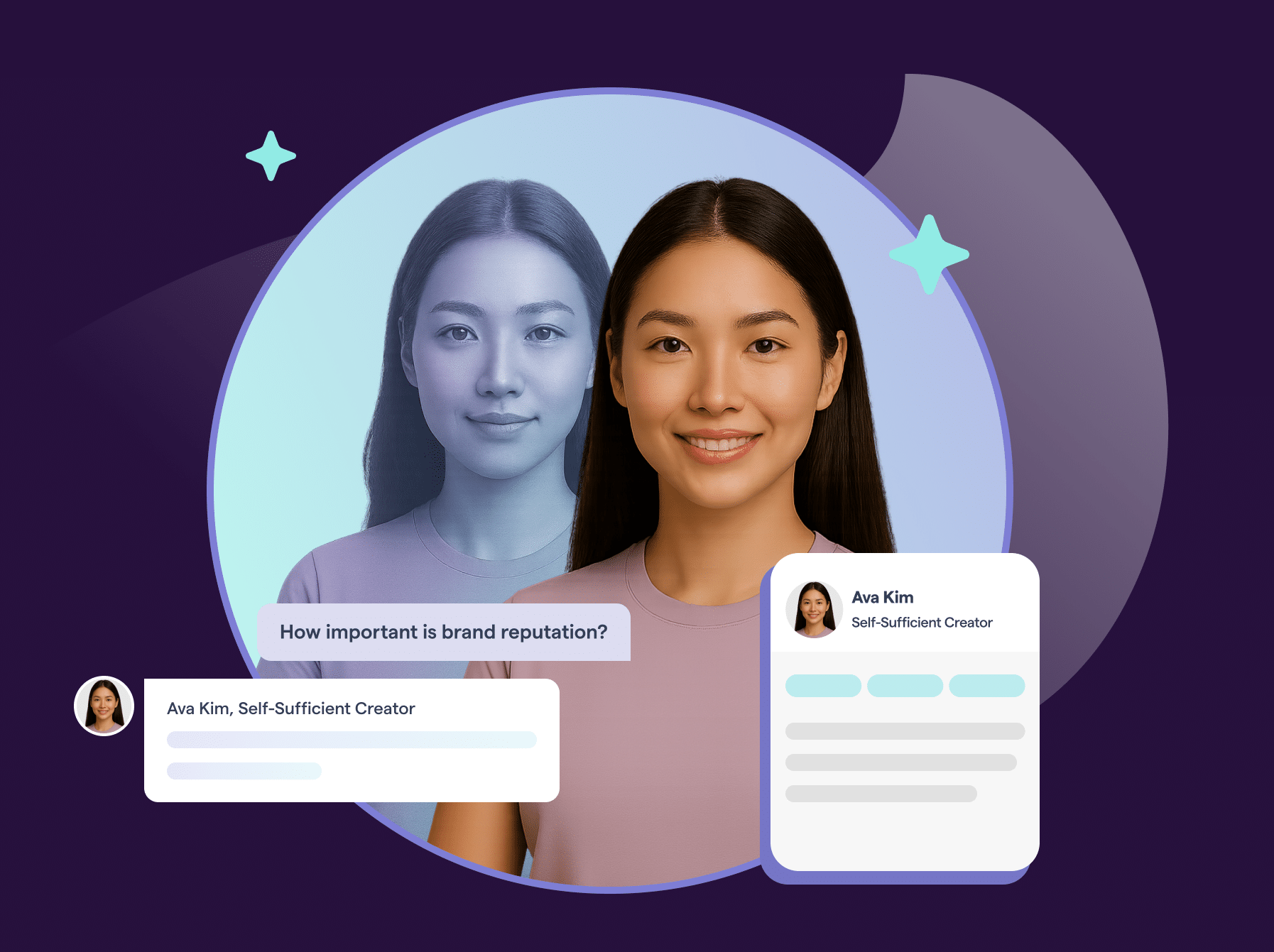
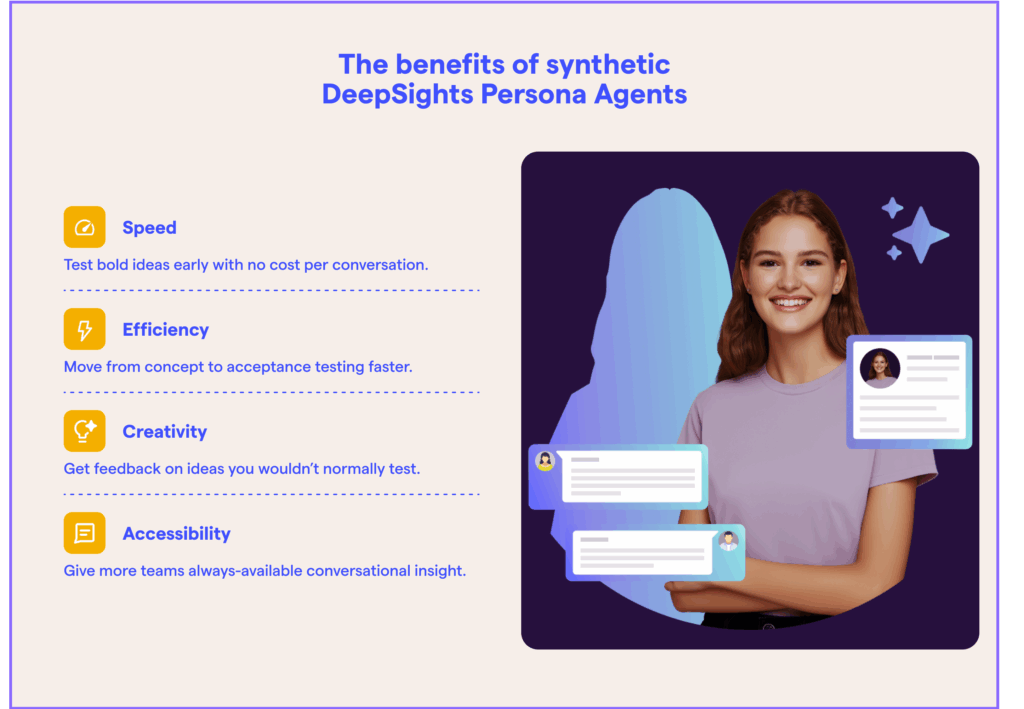
Market Logic’s DeepSights Persona Agents are designed for exactly this kind of interaction. They are synthetic, AI-powered persona agents that enable real-time, natural language interactions, allowing marketing, insights, and product teams to explore and test ideas at scale. By simulating customer feedback through synthetic personas built from your own data, DeepSights AI Persona Agents help ensure a closer product-market fit before investing in live customer research.
Persona Agents explore motivations at scale, not just demographics
A common failure mode of personas is over-indexing on who someone is, and under-explaining why they act. Synthetic personas are most useful when they help teams explore motivations, tradeoffs, and context.
That means asking better questions:
- What “job” is the product really hired to do?
- What emotional payoff is the segment seeking?
- What compromises are they willing to make (price, convenience, quality, sustainability)?
- What triggers switching behavior?
- What does success look like in their own words?
When synthetic personas are grounded in your organization’s research evidence, they can do a surprisingly good job of surfacing these patterns and linking them back to sources. That’s a big deal for Product and R&D leaders who need to defend decisions across stakeholders, not just make them.
Scenario modeling: turning “what if?” into a repeatable workflow for consumer insights
Agentic AI becomes especially valuable when you want to explore scenarios quickly.
Instead of running one-off brainstorming sessions, you can set up repeatable prompts and workflows that explore:
- New competitor entry and expected consumer reaction
- Price moves and perceived value thresholds
- Messaging shifts across different channels
- Feature removals (what breaks trust vs what barely matters)
- Economic or cultural shifts and their impact on demand
This is also where leveraging a consumer insights platform matters. Scenario modeling is only as good as the evidence you feed it, and the transparency you can maintain about what the AI used to reach conclusions.
Trust is the whole game: why it’s risky to use general AI as consumer insights platform
If synthetic personas are going to influence real product decisions, they have to be trustworthy.
News organizations have published research showing that AI-generated summaries can contain inaccuracies and distortions, which is a warning flare for anyone treating generic AI outputs as decision-ready. As cited by the Forbes Tech Council, 66% of research teams report a dramatic increase in demand for insights in the past year, which is forcing them to find new ways to deliver faster, more relevant intelligence.
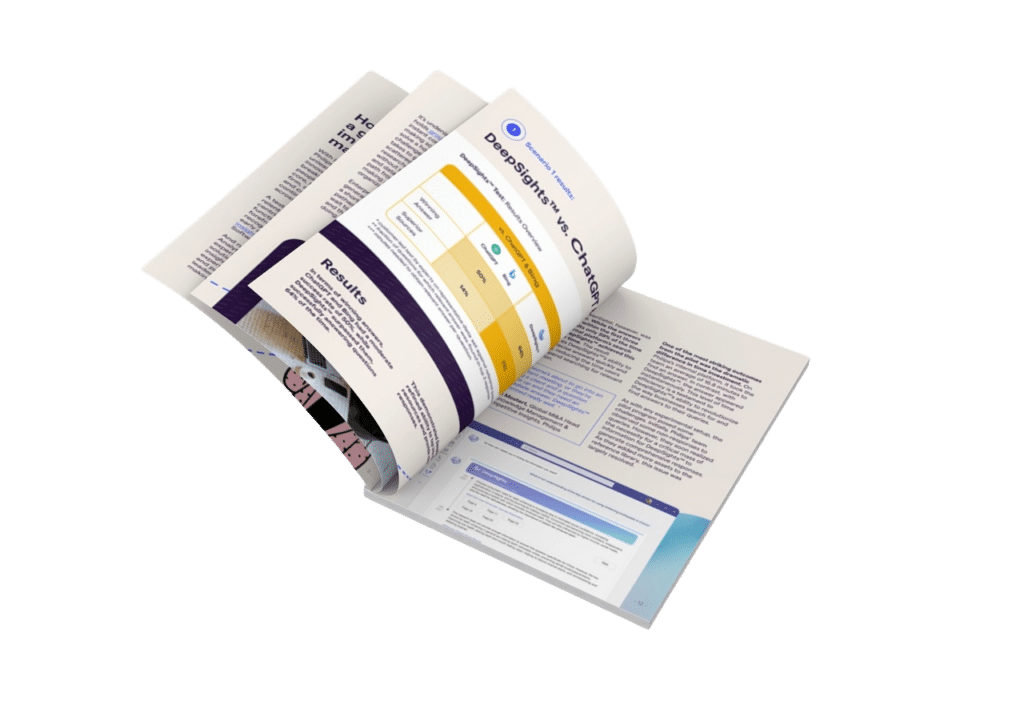
The deeper issue is that general-purpose models do not know your business context, your category nuance, or your internal definitions. They can sound confident while being wrong. For insights teams, “confident and wrong” is the most expensive flavor of wrong. This is why purpose-built consumer insights platforms that ground answers in trusted sources are winning mindshare. Global Healthcare organization Philips, for example, publicly shared a comparison of outputs from general tools versus a system grounded in an insights knowledge base, emphasizing the value of trusted inputs and traceable evidence.
Philips’ study on the performance of generative AI found that a purpose-built AI tool like DeepSights, compared to standard, generic AI tools, produces better results across multiple dimensions, including accuracy, speed, and user satisfaction. Specifically, DeepSights demonstrated a 25% higher accuracy rate in predicting consumer behavior, a 30% reduction in time to generate insights, and a 20% increase in user satisfaction scores.
Five steps to effectively implement synthetic personas in your consumer insights solution
Here’s the practical sequence that tends to work, especially for Product and Strategy leaders who want impact without chaos:
- Centralize what you already know with the right consumer insights platform: If your research is scattered across drives, inboxes, and slide decks, synthetic personas will inherit that fragmentation. Start by treating knowledge as an asset, not an archive.
- Define what “good” looks like: Be explicit about what a persona should do in your organization: concept feedback, segment clarification, messaging guardrails, innovation prompts, early risk detection.
- Build in transparency: Require evidence traces. Require citations. Require “confidence markers” or at least clear signals about where the data is strong vs weak.
- Keep humans in the loop: Use synthetic personas to accelerate thinking, not to outsource judgment. Human expertise is still the steering wheel.
- Measure impact like a product: Track cycle time, reuse, duplicate research avoided, and stakeholder satisfaction.
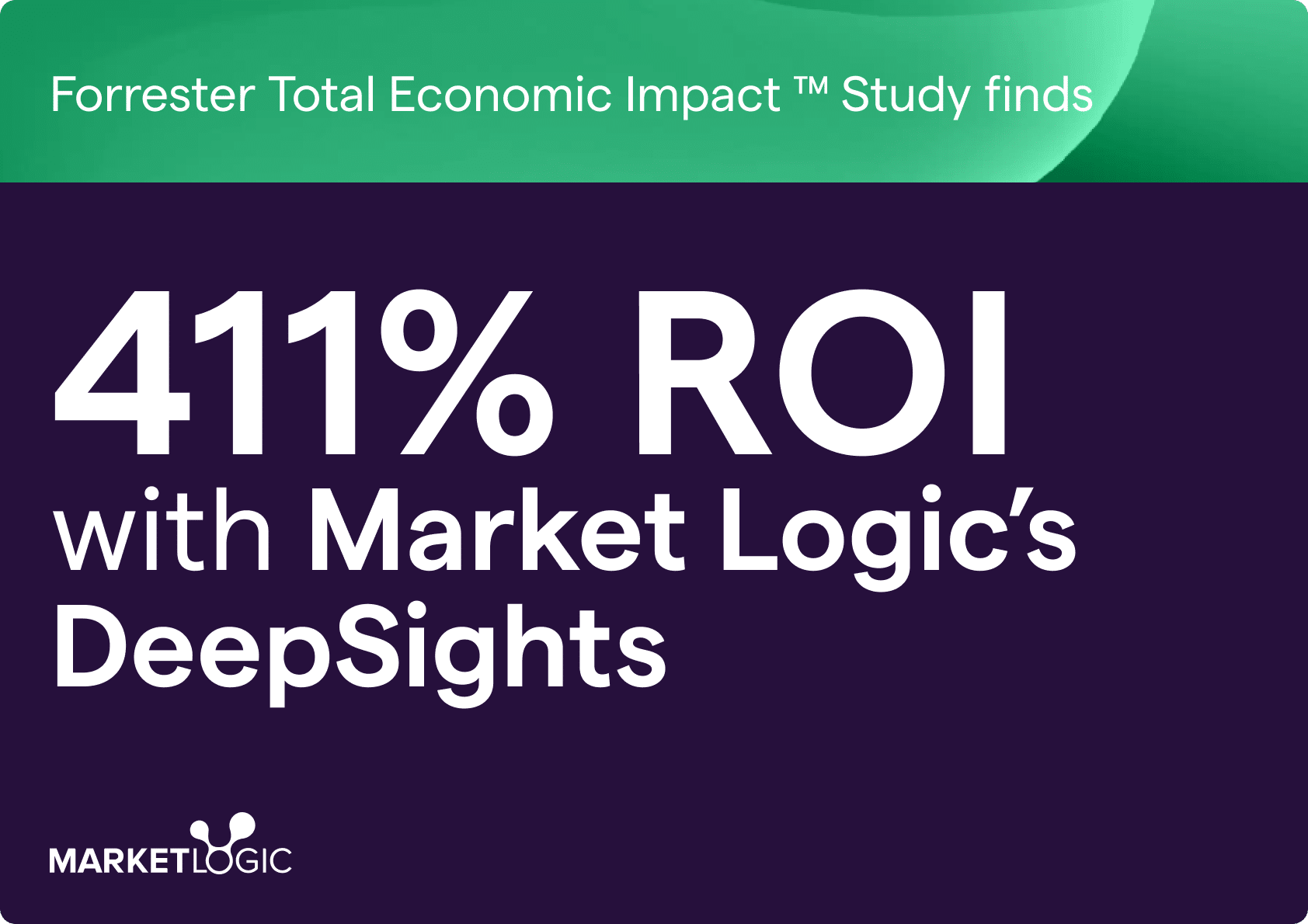
Organizations that operationalize these steps with the help of a suitable consumer insights solution often see measurable efficiency gains. For example, Market Logic’s Forrester Total Economic Impact summary reports outcomes like reduced time spent responding to insight requests and reduced duplicated research, translating into significant ROI in the composite study, with some organizations showing 411% increase in their ROI.
Where Market Logic fits in the future of consumer insights solutions
- Market Logic’s approach is built around grounding AI in an organization’s trusted knowledge base, then making that knowledge usable through tools designed for insights and innovation workflows.
- Market Logic’s guide is a helpful starting point: AI Agents: The next big shift in AI is a helpful starting point. It outlines the A-Z of agentic AI, providing valuable insights into how AI agents are revolutionizing the way businesses interact with data and customers. From enhancing customer experiences to driving operational efficiencies, this guide offers a comprehensive overview of the transformative potential of AI agents.
- Market Logic’s purpose-built consumer insights solution DeepSights™, is an award-winning AI assistant, purpose-built for trusted market and consumer insights, designed to pull answers from your knowledge base rather than the open internet.
For teams in regulated or high-stakes environments, such as healthcare, finance, and legal sectors, this ‘trusted-first’ approach is often the difference between AI being a novelty and AI being usable. In these industries, the stakes are incredibly high, and the margin for error is minimal. Therefore, having AI tools and consumer insights platforms that prioritize trust and reliability is crucial.

By ensuring that AI systems are transparent, secure, and compliant with industry regulations, organizations can confidently integrate AI into their workflows. This not only enhances operational efficiency but also builds trust with stakeholders, clients, and regulatory bodies, making AI a valuable and indispensable tool rather than just a technological curiosity.
In a consumer insights solution, speed matters, but grounded speed wins
Synthetic personas and agentic AI are not about replacing knowledge and research. They’re about making your existing, trusted consumer insights more available, more actionable, and more connected to the decisions Product and Strategy teams make every day — helping build your innovation pipeline quicker and at a fraction of the cost.
In other words, this is the future of consumer insights solutions: not more dashboards, not more decks, but AI-powered systems that help teams ask better questions, iterate faster, and stay anchored in evidence.
Ready to see how a trusted, award-winning consumer insights platform can make synthetic personas practical for your team? Explore DeepSights™ and request a demo to see how always-on consumer understanding can work inside your organization.