Share this article


When a VP of Insights or an AI leader asks whether the team should build a market intelligence AI in-house, the instinct to say yes is understandable. The first version is a tractable engineering problem. The real cost is everything that comes after it.
This post answers the build-vs-buy question for market and consumer intelligence AI: what building it actually involves, where costs accumulate, and what a capable team should weigh before committing.
The build vs buy AI for market research decision is not about the first version. For most enterprises, source ingestion, evidence classification, a trust hierarchy, access governance, and task-specific insight agents are each a serious engineering program. Models, sources, and business needs keep changing, so the commitment never ends. The hardest problem is not the code but encoding how market research works. A specialist layer, connected through an open standard, frees engineering teams for work only their business can do.
What building a market intelligence AI actually involves
The scope of a market and consumer intelligence AI is easy to underestimate when you approach it as a software problem. It is not a single API call to a large language model. A functional system requires several distinct engineering programs running in parallel.
Source ingestion and quality control: the system must connect to research repositories, third-party data providers, news feeds, and internal knowledge stores. Each source has a different format, update cadence, and reliability profile. Ingestion is not a one-time task.
Evidence classification: raw content needs to be read, understood, and tagged at the level of individual findings. A tracking study result about brand preference carries different weight and different handling requirements than a focus group quote or a trend signal from a news feed. The AI needs to distinguish between them to answer questions well.
A source trust hierarchy: different sources carry different authority. A commissioned quantitative study should carry more weight than an analyst blog post. Encoding that hierarchy correctly, and maintaining it as sources are added or retired, is a domain judgment problem, not a coding problem.
Access governance: in an enterprise, not every user should see every source. Research syndication agreements, regional data rules, and confidentiality requirements all constrain what the system can surface to whom.
Task-specific agents: question answering, trend monitoring, competitive tracking, and innovation screening each require different reasoning patterns. A single general assistant handles none of them well enough for high-stakes decisions. For why confidently wrong answers are a business risk, see the hidden cost of confidently wrong AI.
Each of these represents months of engineering work. Together they represent a platform, not a feature. This is the scope that a build decision commits to from day one. For more on why specialized AI for market intelligence differs fundamentally from general-purpose tools, see the overview of specialized AI for market intelligence and insights.
Why the domain expertise is harder than the code
Experienced AI engineers are easier to find than people who understand both AI and how market research actually works. The trust hierarchy described above is not a configuration file a team can fill in over a sprint. It reflects years of decisions about which sources are reliable for which purposes, how to cross-reference conflicting findings, and how to weight recency against sample quality. General-purpose assistants such as Microsoft Copilot do not bring that layer with them; here is where they fall short for market research.
That expertise does not arrive with an engineering hire. It accumulates. And because the market research field keeps changing, with new source types, new methodologies, and new analytical questions, the expertise must keep up alongside it.
A specialist market intelligence platform develops that domain understanding across many organizations over many years. An in-house build starts from nothing on both counts.
The build is never finished
The most underestimated cost is not the initial build. It is the ongoing commitment.
Large language models change. When a foundation model is updated or replaced, prompting strategies, evaluation benchmarks, and integration layers all need revisiting. The sources the system connects to change: data providers update their formats, alter access terms, or exit the market. New source types emerge.
The business changes too. New markets, new product categories, and new competitive threats each require new reasoning capabilities. What the insights team needs from the AI in year one is not what it needs in year three.
Every one of these changes requires engineering time. A one-time project becomes a standing annual program. The question is not whether that commitment is affordable in year one. It is whether it represents the best use of that team in years two, three, and beyond.
What the build costs in engineering opportunity
AI engineering talent is scarce. At most large enterprises, the number of engineers who can design, build, and maintain a production AI system is small relative to the number of problems that need solving. When that team is committed to market intelligence infrastructure, it is not available for the work only the business can do: building models on proprietary first-party data, automating internal workflows, or creating competitive advantages from assets no vendor can replicate.
General insight infrastructure is a shared problem across the industry. A specialist vendor solves it once for many organizations and distributes the cost of continuous improvement. An in-house team solves it alone, repeatedly, without the benefit of cross-organization learning.
The question to bring back to leadership is direct: what would we stop building, year after year, to maintain this?
Questions to ask before you decide
A capable enterprise team can build a market intelligence AI. The decision becomes defensible when the answer to most of the following questions is yes.
- Does the organization have deep in-house expertise in market research methodology, not just AI engineering?
- Is the team prepared to sustain the platform for three or more years, not just ship version one?
- Is the scope bounded enough that a small, dedicated team can keep the system current without becoming a standing department?
- Has the organization evaluated whether a specialist layer connected via open standard, such as MCP, would deliver the same capability with significantly less engineering overhead?
- Is building this system more valuable than the other work that team would otherwise do?
If several answers are uncertain or no, the build cost will likely exceed the buy cost within two years, even before opportunity cost is included.
When building in-house still makes sense
Building in-house is the right decision for some organizations, particularly those with existing domain expertise on staff, a long-term platform strategy, and the engineering capacity to sustain a standing program. This post addresses the market and consumer intelligence use case specifically. It does not apply to AI for internal analytics, operational AI, or AI tooling for other business functions, where the tradeoffs differ. No quantified cost comparisons are provided here because the figures depend on organizational context. The argument is structural.
How a specialist market intelligence layer fits the AI you already use
DeepSights by Market Logic Software is purpose-built for market and consumer intelligence. Its intelligence engine handles source ingestion, evidence classification, the source trust hierarchy, and access governance as core platform capabilities.
More than 100 of the world’s leading brands rely on DeepSights to power their most important market decisions, with over 100,000 business users across the globe. Customers include Mars, Novartis, and eBay.
Organizations that deploy DeepSights report a 27% reduction in market research expenditure and 55%+ time saved on research and discovery, based on the Forrester Total Economic Impact study. As one project leader for customer analytics at a European retailer put it: “The reputation of the insights team has dramatically increased because of the speed and the depth of knowledge we can send to the rest of our organization.” (Source: Forrester Total Economic Impact Study, Market Logic DeepSights)
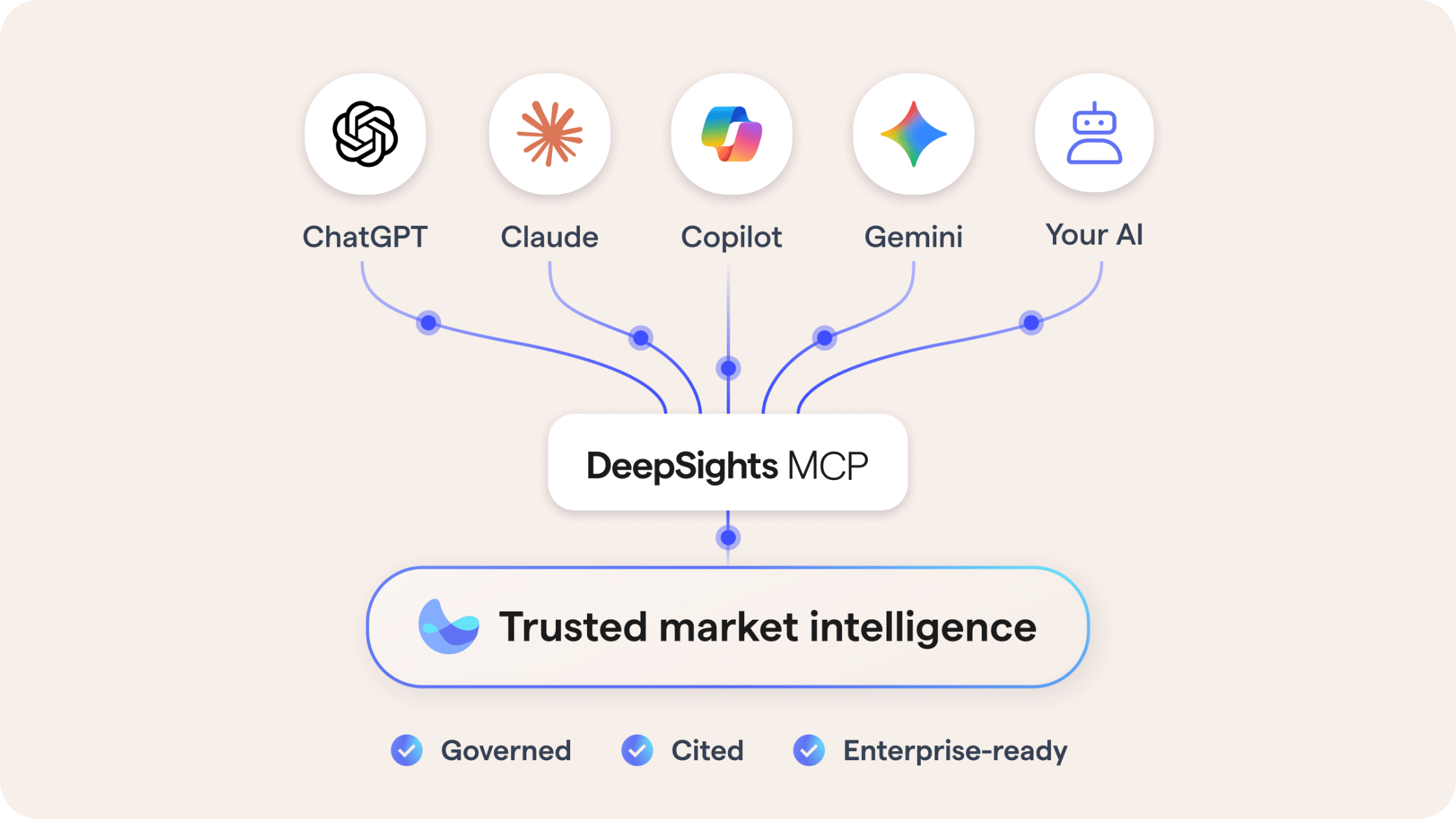
The platform connects to Microsoft Copilot and other AI tools through the Model Context Protocol (MCP), an open standard now widely adopted across the enterprise AI industry. When Copilot needs market evidence, it calls DeepSights, which returns cited, permission-aware findings. There is no rebuild of existing AI workflows and no lock-in, because the standard is not tied to any single vendor. Engineering teams stay focused on the competitive work that no specialist can do for them.
For more detail on how the connection works, see DeepSights MCP by Market Logic Software.
The decision most enterprises get wrong
Building a market and consumer intelligence AI in-house is a defensible choice for a small number of organizations. For most, the ongoing cost in engineering time, domain expertise, and opportunity exceeds the cost of a specialist layer that connects cleanly to the AI tools the business already runs.
If your team is working through that decision, our professional services team can help you map your current AI setup and identify where a specialist market intelligence layer adds the most value.
Frequently asked questions
When should you build vs. buy AI tools for market intelligence?
How do you evaluate the true cost of building market intelligence AI in-house?
What does a market intelligence AI actually need to do that generic AI cannot?
How does a specialist market intelligence layer connect to Microsoft Copilot?
What should you look for in market intelligence software before making a build-vs-buy decision?