

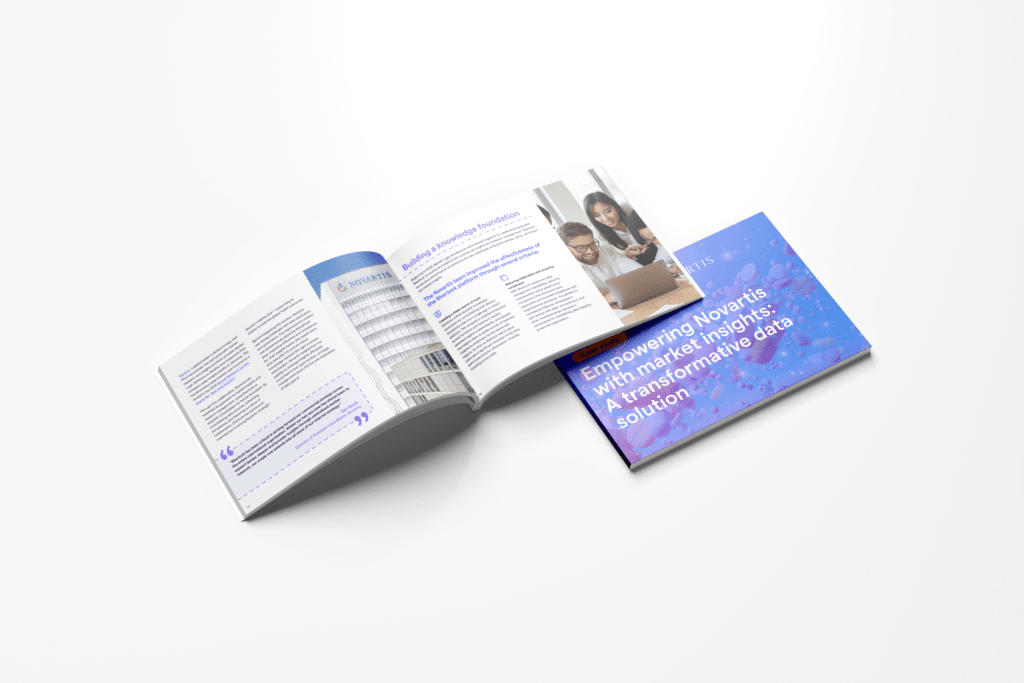
Novartis, a global leader in biotechnology and pharmaceuticals, has partnered with Market Logic Software to develop and implement Sherlock, a transformative data solution designed to centralize and optimize insights management across the company.
This collaboration was honored as a finalist in the 2024 Market Research Society Awards for “Best Data Solution ”.
Through this collaboration, Novartis has redefined its approach to market insights and research management, using Sherlock to establish a foundation for future innovation. By consolidating data sources, enhancing compliance, and fostering a culture of collaboration, Sherlock has become an essential tool in driving Novartis’ strategic decision-making and – supporting its mission to improve global health outcomes.
Before integrating this solution, Novartis was facing challenges with data duplication and governance. The organization’s content was spread across disparate SharePoint sites, impacting efficiency and compliance. For their insights teams, this meant extra time and effort to ensure critical knowledge reached the right business stakeholders. Novartis realized that the inability to leverage insights efficiently could lead to lost opportunities, strategic misalignment down the line and duplication of data spend.
Sherlock has been critical in driving forward our commercial strategy across the entire international organization. Whilst our key use case has always been to support better, deeper and broader insights through centralized market research, our scope now extends into all areas of our internal strategy.”
-Ian Hook
Director of Business Operations, Novartis

Building a knowledge foundation
Beginning in 2020, Market Logic and Novartis have worked together to create and implement Sherlock: an end-to-end platform for commercial insights and research management. Sherlock serves as a central hub to revolutionize the way employees at Novartis access, utilize, and share key market insights.
The Novartis team improved the effectiveness of the Sherlock platform through several criteria:
1. Creating a single source of truth
Sherlock unified Novartis’ knowledge ecosystem by consolidating their distinct SharePoint sites into a single sign-on (SSO) platform. This integration enabled employees across functions and regions to access essential insights independently and allowed the insights team to widen access to essential insights for employees across teams and regions. As soon as Sherlock was in place, users saw a significant reduction in the time spent searching for information, thereby boosting productivity.
2. Reducing duplication and ensuring compliance
With Sherlock’s advanced data management capabilities, Novartis implemented robust governance frameworks that minimized data duplication and ensured compliance with organizational standards. The platform’s compliance features, developed in partnership with legal, procurement, and other functional areas, became a cornerstone for maintaining data integrity across the organization.
3. Creation of “Knowledge Zones”
Sherlock introduced “Knowledge Zones,” which were curated microsites tailored to specific brands or drugs. These zones transformed Sherlock from a mere repository into an interactive lnsights hub, fostering better knowledge sharing and improving onboarding speed due to its intuitive user experience. In just one year, Novartis teams launched over 25 Knowledge Zones focused on key topics such as Brands and Therapeutic areas.
4. Seamless supplier integration
Sherlock streamlined the process of integrating external suppliers, allowing them to upload data directly to the platform. This integration reduced the burden on Novartis Insights associates, freeing up their time to focus on strategic activities rather than routine data collection.
5. Unprecedented user engagement
Sherlock’s impact on business user engagement was profound. In 2023, the platform’s growth rate reached 640% more users than at its initial launch. Today, Sherlock has surpassed 7,500 unique users. This surge underscored Sherlock’s value, as it became an indispensable tool for driving innovation and enabling a managed knowledge foundation across Novartis.
Highlights
+640%
user growth since the platform launch
+7500
unique users accessed Sherlock in one year
Accelerating the business with Al for insights
Sherlock’s implementation at Novartis has not only streamlined data management and improved compliance but has also laid the groundwork for long-term organizational benefits. In July 2024, Novartis integrated DeepSights™ – an award-winning Al-powered generative (gen) Al tool for consumer insights – into their Sherlock platform.
In collaboration with Market Logic, Novartis worked closely with their legal and risks teams to ensure that their solution had high data reliability from its generated insights, and that the team itself had processes in place to prevent the misuse of such insights.
The Novartis business operations team also took time to develop a business case and value proposition before approaching the procurement team. Specifically, they outlined how DeepSights would reduce primary market research spend, which they ultimately achieved with a 56% reduction. They also created different value propositions when approaching the legal and leadership teams.
Moreover, the DeepSights solution, as a purpose-built tool for market research and insights, takes the following steps to ensure the highest level of compliance:
- lntroduces user controls to ensure what is uploaded to the platform
- Modeled using retrieval-augmented generation (RAG) to pull relevant insights from Sherlock
- Utilizes a self-validation loop to verify responses before they are displayed
- Provides full citations and document references to ensure transparency
- lncludes “Watch Outs” when needed, a DeepSights-specific feature that highlights potential inconsistencies or contextual limitations within an answer’s sources.
Savings from implementing DeepSights
$30 million
annual research spend reduction
2 hours
per major research query saved by Novartis employees
With the addition of DeepSights’ generative AI, users are able to get answers faster and more reliably than ever, saving an average of 2 hours per question and millions through reduced duplication of spend. The solution is a key part of our strategic differentiation and has received positive feedback from across the company.“
-Ian Hook
Director of Business Operations, Novartis

Use case: How DeepSights can leverage existing research for better decision making
A team at Novartis wanted to determine whether patients preferred blister or bottle packaging for a specific drug.
Team A decided to conduct a new survey. This project cost between $50,000-100,000, took place over three months, and drew conclusions from the responses of 50 patients.
Team B had access to DeepSights and Sherlock. They opted to utilize these tools rather than conducting new research and asked DeepSights to summarize insights drawn from the large amount of research already residing in the Sherlock system.
As a result, it took Team B just three weeks, to gather insights from the input of 6,700 patients while incurring zero external costs.
Change management: Driving adoption and value
After the initial integration, Novartis’ attention turned to adoption. They approached their change management efforts with a “test and learn mentality”, with the goal of ensuring that Novartis employees used Sherlock and DeepSights as their primary knowledge resource.
Three key platform adoption factors :
1. Awareness: Users had an understanding of what Sherlock and DeepSights were and how to access them.
2. Capabilities: Users had the training and skills to ensure effective usage.
3. Value: Users saw the tangible benefits in using these tools.
Adoption required some specific actions, such as gathering user feedback or running trainings for employees. But it also required a certain shift, including seeking out and obtaining executive buy-ins, and encouraging a culture of knowledge sharing throughout Novartis.
Tracking success through behavioral science
The Novartis team applied two behavioral science principles to determine which was more effective in driving DeepSights usage.
- First, was the “authority principle”, which contends that a person is more likely to take an action when the request comes from an authority figure.
- The second was the “availability bias”, which emphasizes the historical pain point (the difficulty of surfacing insights across many knowledge repositories}, and then introducing the solution (DeepSights integration).
In testing these two principles, they found that the authority principle was far more persuasive in driving engagement.
The team saw spikes in Sherlock logins correlated with “push communication”, or emails from senior leaders endorsing the platform.
Ensuring sustainability and continuous improvement
The integration of Market Logic’s generative Al solution, DeepSights, is already enhancing Sherlock’s ability to provide rapid, validated answers to business queries, further driving efficiencies. Building on this success, the Novartis change management team are implementing policies to improve the continued viability of these tools.
For instance, they are now mandating that their contracted research vendors have to upload the content into Sherlock, thus guaranteeing that new, useful content is accessible to their insights teams.
The Novartis change management team continually solicits feedback from initial platform users and integrates that feedback into building the personas and value propositions they share across teams. These value propositions include direct usage anecdotes backed by quantitative data.
Lastly, they continually used senior stakeholders or sponsors to drive engagement, from featuring them in platform videos, promoting awards, or announcing new features about Sherlock and DeepSights.

Harnessing an Al-enabled knowledge management model
How much it costs you to get knowledge is not the value of knowledge. The value of knowledge is what you get when you apply it.“
-Ian Hook
Director of Business Operations, Novartis
A robust and trusted knowledge management (KM) foundation is essential for any AI integration to fully add value to the business. In evaluating and implementing DeepSights, Novartis found that an AI solution targeted to the specific needs of increasing usage of consumer insights proved far more impactful than promoting non‑specific Large Language Models (LLMs) or generalized AI tools.
The successful rollout of AI-enabled knowledge management is as much about people as it is about technology. Consistent platform trainings, transparent feedback cycles, and leadership buy-in were all critical to the adoption of DeepSights at Novartis.
The Novartis journey demonstrates how AI and knowledge management, when integrated strategically, can drive significant business value. By focusing on a structured KM foundation, targeted AI applications, and robust change management, Novartis has created a system that is scalable, compliant, and impactful.
Novartis insights team’s approach serves as a model for organizations looking to leverage Al in knowledge management, proving that the key to success is a combination of data governance, use case-driven strategy, and user enablement.
Since its effective launch and implementation, Sherlock continues to deliver significant business benefits, including enabling self-service access to trusted data, reducing costs, improving resilience against organizational knowledge loss, and accelerating onboarding processes.
By providing accurate, curated insights, Sherlock empowers Novartis employees to work smarter and more collaboratively. In this way, it helps everyone in the organization contribute to the company’s mission to improve and extend people’s lives.
To learn more about DeepSights and how Market Logic has partnered with other global Pharma leaders in driving success with Al-powered insights, visit marketlogicsoftware.com.
Dive in deeper. Watch the webinar with Novartis
Listen to Lorenza Geronimo, Knowledge Management Change Lead, share how organizations can successfully roll out AI‑powered insights systems at scale — and why effective change management is essential for long‑term enterprise success. Learn how thoughtful planning, pre‑launch activation, and post‑launch benchmarking can drive adoption, engagement, and real behavioral change across complex organizations.
Gain firsthand perspectives on the fundamentals needed to build awareness around new AI solutions, how to develop AI capability across different business functions, and practical tips for sustaining usage after deployment. This session offers a clear, actionable look at what it takes to embed AI into consumer insights and market research workflows for maximum impact.