

Share this article


For a new generation of business leaders, AI is rapidly becoming the single most powerful enabler of business transformation. Its capacity to process vast data sets, detect patterns invisible to the human eye, and automate cognitive tasks promises to accelerate the pace of innovation across industries. For executives in global consumer businesses, it represents both an unprecedented opportunity and a profound test of strategic leadership.
Because while AI can help companies innovate faster and better, it cannot — on its own —become the organization’s Chief Innovator. Successful innovation for consumers will always demand human curiosity and judgment to steer. Increasingly, achieving the right balance between human and AI will be critical. The companies that win in the coming decade will be those that understand how to harness AI as a collaborator, not a substitute, in the pursuit of growth.
The mirage of the AI silver bullet
The current narrative surrounding AI often risks oversimplification. Tools that generate content, summarize reports, or predict consumer trends are extraordinary — but they are not, in themselves, a strategy for innovation. Many organizations are discovering that installing AI systems without a clear framework for how they fit into the broader innovation process leads to limited or misdirected outcomes.
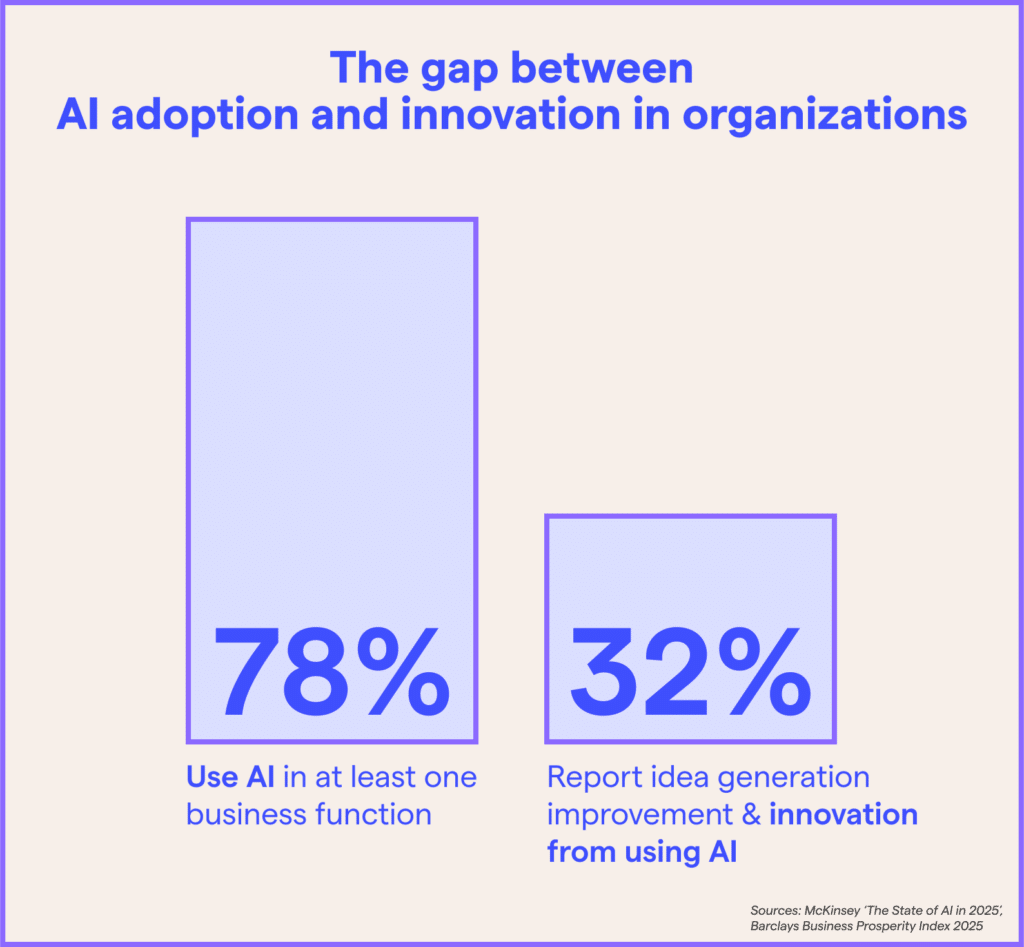
Indeed, a recent report by McKinsey & Company on the state of AI found that 78 % of organisations say their companies use AI in at least one business function, up from 72 % in early 2024. Yet despite this high‑level adoption, the evidence of strategic impact remains uneven. One UK business survey by Barclays showed that only 32 % of firms tracking AI adoption report improved idea generation and innovation.
However, the gap between outcomes and potential should not be put down to a lack of raw technical capability. To build a successful innovation pipeline with AI, executives need to understand both AI’s strengths and its boundaries.
AI can supercharge data analysis, idea generation, and scenario modelling — but strong human oversight needs to control the source material that feeds these tools. Conclusions built on poor information come at the risk of being no better than a best guess, no matter whether these are being processed or human or artificial intelligence.
Insights drive successful innovation
Innovation has always been rooted in anticipating consumer wants, needs, and behaviours — sometimes even before consumers themselves articulate them.
Over the past thirty years and more, leading brands have invested in building insights teams that are disciplined in blending market, consumer, and competitive insights to create a 360 understanding of how those preferences and motivations are evolving.
Traditionally, this process required a mosaic of inputs: market research, trend tracking, expert interpretation, and commercial judgment. Today, however, insights teams are frequently overwhelmed by the sheer volume of data they are being asked to pull into their analysis. From social media listening to device tagging, the pressure is on to assimilate a wider range of information that is generating fresh data points exponentially. It’s no wonder many teams are looking to re-architect the way in which they operate and take advantage of technology to accelerate and scale insights discovery.
How AI can drive better insights
AI is transforming the way insights are generated and applied within innovation teams. The possibilities for consumer business innovation are compelling.
Integration of diverse data sources: AI systems can ingest and connect structured and unstructured data—from sales figures to brand trackers, consumer forums, ethnographic studies, and more—at a scale beyond any human team. This creates a more comprehensive and interconnected foundation for decision‑making.
Uncovering connections within data: Where human researchers once spent weeks triangulating findings from separate studies, AI can surface patterns and correlations across domains in hours. This doesn’t eliminate the researcher’s role; it repositions them as interpreters, testing which of those connections are causally meaningful rather than coincidental.
Distilling knowledge into insight: LLMs and other analytic tools can synthesise and summarise findings into accessible formats — visual maps, thematic clusters, or natural‑language summaries — that enable faster comprehension across functions. The more sophisticated systems do not merely compress information; they highlight what is genuinely new or contradictory, prompting teams to ask sharper questions.
Reducing duplication and building cumulative intelligence: One chronic inefficiency in large organisations is research duplication or fragmentation across divisions. With AI, firms can scan past and current research to ensure new studies build on existing findings rather than wasting funds on repeating the same projects. Perhaps even more compelling for businesses is the ability for AI to surface enough data from the existing pool of knowledge to answer current questions without the need to commission fresh research at all.
Stimulating creativity and enthusiasm. By generating early‑stage idea territories, metaphors or consumer archetypes, AI tools can help spark excitement among teams and open new avenues for exploration. In the ideation phase, AI can act as a creative accelerator — generating multiple variations on a concept that human teams then evaluate, refine, and contextualise. This iterative process of “machine suggestion, human selection” can dramatically compress the innovation cycle while maintaining creative quality.
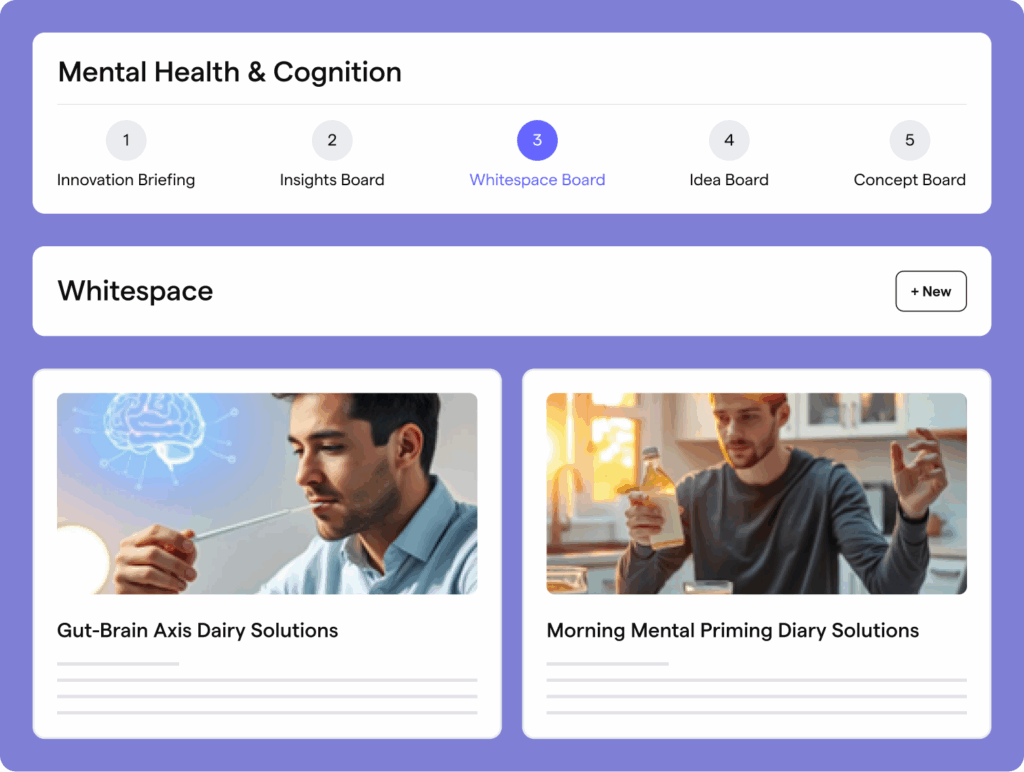
Within the DeepSights Innovation Studio, for example, teams of specially trained AI agents can be called on to provide whitespace descriptions, product innovation ideas, and illustrative concepts in an instant. Working in tandem with innovation teams, they facilitate the process of crystallizing new opportunities from the underlying pool of knowledge and unique insights the company has assembled.
Deepening customer understanding. Synthetic agents representing target consumers are emerging as a new frontier. By turning static buyer profile reports into digital personas, innovation teams can simulate likely market reactions to new propositions, giving them a head start before testing with real audiences. This unlimited approach promotes even deeper customer-centric workflows by providing access to customer considerations at every step and allowing for rapid refinement of concepts before initiating tests with human consumers. As a result, budgets can concentrate more costly human research on highly developed ideas that have a better chance of success.
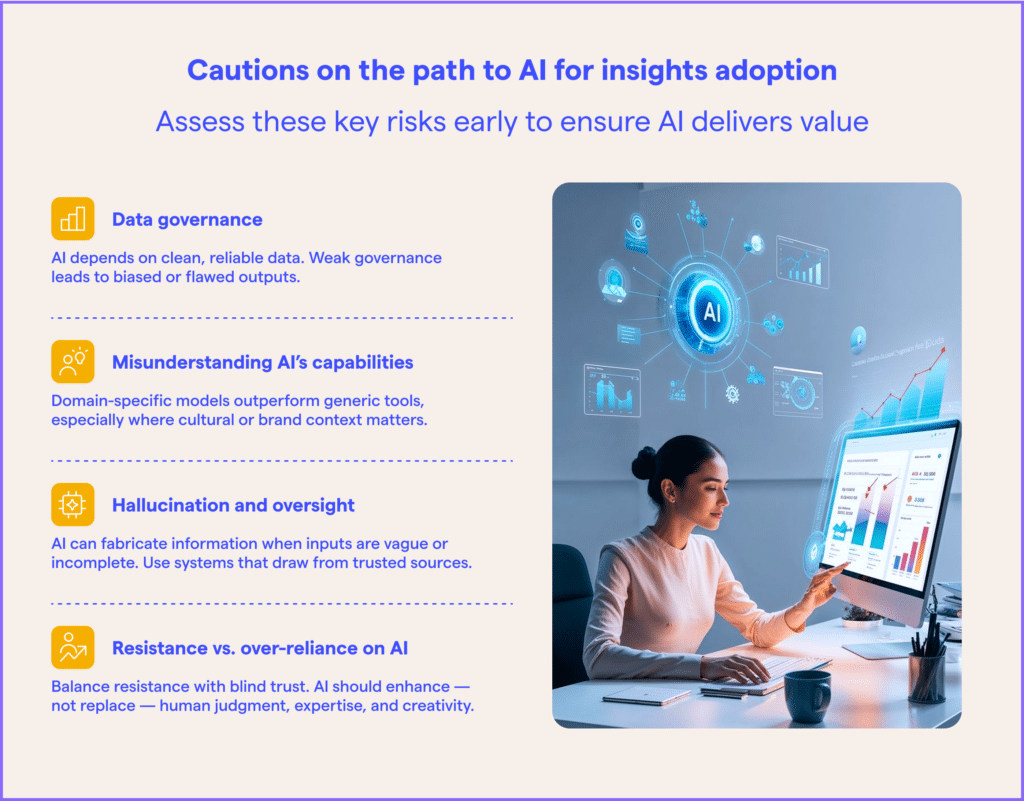
Cautions on the path to AI adoption
Despite its potential, adopting AI for innovation comes with serious caveats that leaders must address early.
Data governance. The quality of AI output depends entirely on the integrity of the input. Without strong data governance, companies risk building insights on flawed or biased foundations. Executives should treat data infrastructure as a strategic asset, not a back‑office function.
Misinterpretation of AI’s capability. AI is not a single, monolithic technology. Specialised models trained for specific contexts consistently outperform generic tools. Understanding the distinction between domain‑specific and general‑purpose AI is critical—particularly in areas requiring contextual understanding of consumer behaviour, brand language, and cultural meaning. When dealing with insights analysis, there is more value in an AI system flagging that there is no information currently available or highlighting conflicting data points across reports than there is in an AI drafting a confident response that has no substance behind it.
Hallucination and oversight. AI models can still fabricate or distort information. This risk rises when prompts are vague, data is incomplete, or outputs are accepted uncritically. Insist on AI that will draw only on trusted sources and provide clear links to all datapoints cited in summaries. This transparency is essential to build trust and, more importantly, allows human users to double-check the full context of the original reference.
Balancing resistance and over‑reliance. Many organisations initially faced human resistance to AI integration, fearing job loss or devaluation of expertise. According to one UK report, 35 % of businesses cited “lack of expertise” as their top barrier to AI adoption. techuk.org Conversely, the inverse risk looms: overconfidence in the technology. Blind reliance on AI can suppress critical thinking and creativity — the very traits that differentiate human innovators.
A new human and AI collaboration framework
A productive innovation ecosystem will not rely on AI or humans exclusively, but on their complementary strengths.
AI agents can continuously monitor data streams, scanning for trends and anomalies, producing real‑time analyses. Human expertise is still required to instruct them on how to approach a problem. Once operational, however, these agents can operate around the clock, building an always-on intelligence layer that is readily available for teams to tap into whenever the business cycle requires strategic exploration, including brand planning.

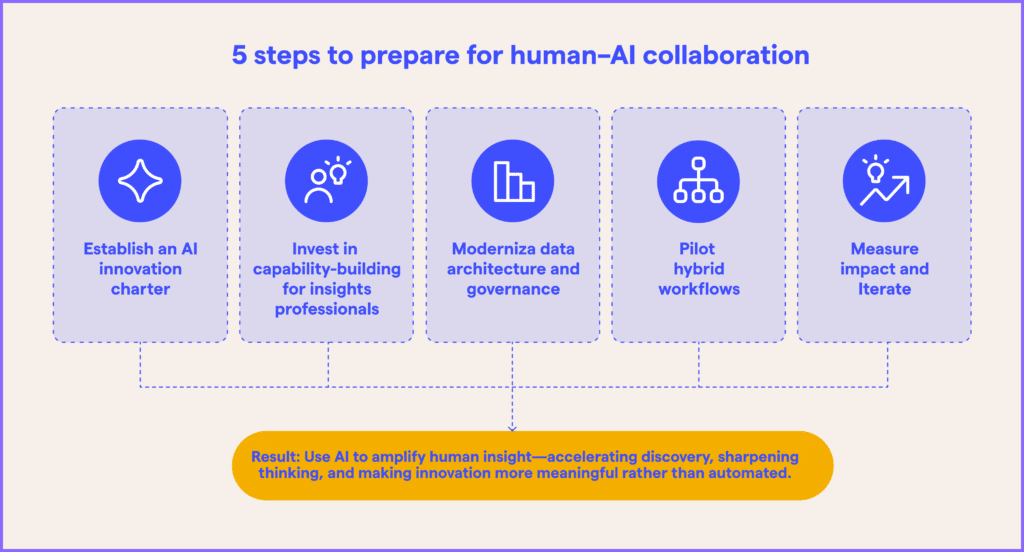
Clearly, AI will not replace human innovation, but it will redefine how innovation happens. To prepare for that future, companies can take several practical steps now:
1. Establish an AI innovation charter. Define clearly how AI will be used across your innovation lifecycle – where it adds value, how it integrates with existing processes, and what guardrails apply. This creates alignment between marketing, insights, product, and data teams and prevents fragmented experimentation. With over three‑quarters of firms actively using AI in at least one business function (78 %), it is timely to formalise that integration into strategic practice — McKinsey shared in their 2025 insights on the state of AI report.
2. Invest in capability‑building for insight professionals. Innovation leaders need teams that understand how to work with AI — how to frame effective prompts, evaluate machine outputs, and spot biases or errors. Upskilling should focus as much on analytical judgement as on technical training.
3. Modernize data architecture and governance. AI’s performance hinges on data quality. Consolidate and clean historical research assets, unify data sources, and establish metadata standards that make past insights discoverable. Treat every research output as a data point feeding future learning.
4. Pilot hybrid workflows. Encourage teams to test combined human‑AI processes on real innovation challenges. For example, use AI to draft concept territories or cluster consumer feedback, then have cross‑functional groups validate and refine the outcomes. Small‑scale pilots can reveal both efficiencies and pitfalls before broader rollout.
5. Measure impact and iterate. Establish KPIs for how AI is improving the innovation process: speed to insight, reduction of duplication, and idea‑to‑market conversion rates. Use these metrics to refine your approach. The goal is not to deploy AI for its own sake, but to enhance the creative and commercial effectiveness of the innovation pipeline.
Human leaders remain central to AI-powered innovation
AI may be the most powerful innovation tool of this century, but it is still a tool. The spark of innovation — seeing connections others miss, framing problems in new ways, daring to imagine alternative futures — remains a uniquely human capacity.
Leaders who recognise this will avoid the trap of technological determinism. Instead, they will build organisations where AI amplifies human intelligence, where data fuels imagination rather than replacing it, and where innovation becomes both faster and more meaningful.
Market Logic brings you transformative capabilities in one comprehensive platform that elevates how your teams achieve success and business growth with its trusted, award-winning solution, DeepSights. DeepSights is designed to enhance the way your organization captures insights, turning it into actionable intelligence that fuels innovation. Request a demo today to learn more.