



Share this article


Innovation gaps exposed at the turn of the year
2026 growth targets are fast approaching. As business strategy and finance teams lock in next year’s plans, leaders are asking a critical question: Do we have the innovation pipeline to deliver this?
For many, the answer won’t come until it’s too late. What once seemed like a full pipeline often reveals itself to be filled with low-risk renovations and underdeveloped ideas. And when the planning cycle rolls, the third year of the pipeline is glaringly empty.
That realization sparks a familiar scramble: teams rush to find anything that can launch fast enough to impact the next 12-18 months. But these stopgap solutions rarely deliver meaningful, sustained growth and expose a deeper issue: an underpowered innovation engine.
39% of executives identified innovation as the highest ranking strategic factor for generating growth1. And 1/3 of business leaders say innovation will be much more important to the growth strategy over the next 3 years.3
Yet, too few have built the pipelines to deliver it. The time to fix it isn’t next year. It’s now.

Think you have enough ideas for your funnel? Think again.
If you’re only betting on a handful of ideas, you’re underestimating what it takes to grow.
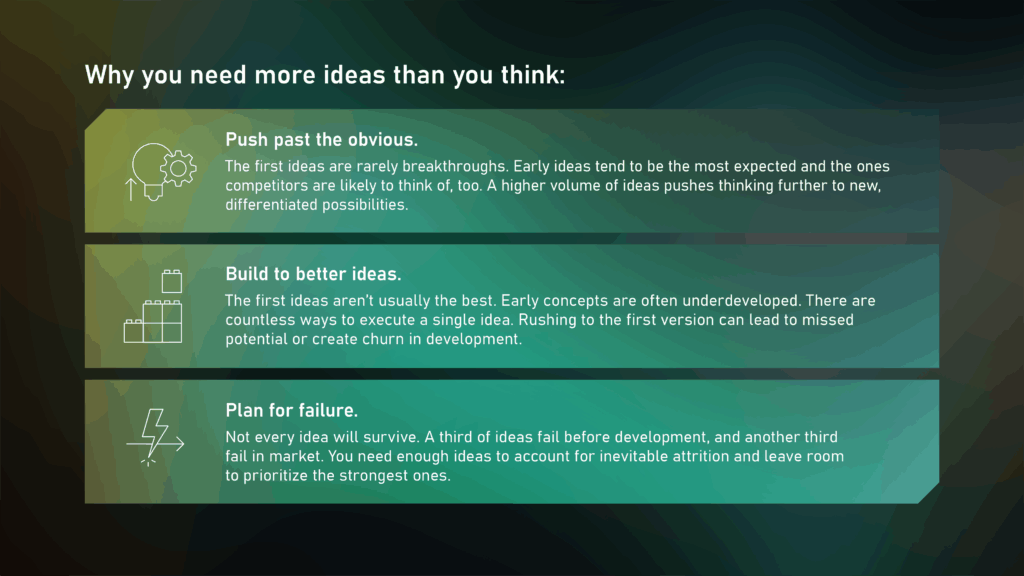
Why you need more ideas than you think:
- Push past the obvious. The first ideas are rarely breakthroughs. Early ideas tend to be the most expected and the ones competitors are likely to think of, too. A higher volume of ideas pushes thinking further to new, differentiated possibilities.
- Build to better ideas. The first ideas aren’t usually the best.Early concepts are often underdeveloped. There are countless ways to execute a single idea. Rushing to the first version can lead to missed potential or create churn in development.
- Plan for failure. Not every idea will survive. Anecdotal evidence suggests that a third of ideas fail before development, and another third fail in market. You need enough ideas to account for inevitable attrition and leave room to prioritize the strongest ones.
Innovators need to generate a wide range of ideas, and a lot of them. Of course, it’s not just about quantity; quality is equally as important. Ruthless prioritization determines which ideas move forward. A surplus of high-potential concepts is needed to withstand natural fallout due to feasibility challenges, failed validation, etc.
Kill the weak ones, and help the great ones thrive
High performing companies need to be killing off mediocre and bad ideas as they progress through the funnel, so resources can coalesce around the winners.
Strong idea management is just as critical as idea generation. Failure in the innovation funnel isn’t just acceptable, it’s essential. And success doesn’t happen easily.
- Ideas will fail. That’s not a flaw — it’s probability. Expect it. Encourage it. The best funnels are built to absorb loss and learn from it.
- Kill weak ideas early. Don’t let sunk costs or a lack of better options drag ideas out for too long. Failure in the funnel is far better than failure in market.
- Prioritize great ideas unfairly. Resources are finite. Spreading investment equally can lead to mediocrity. High-potential ideas deserve more focus and funding.
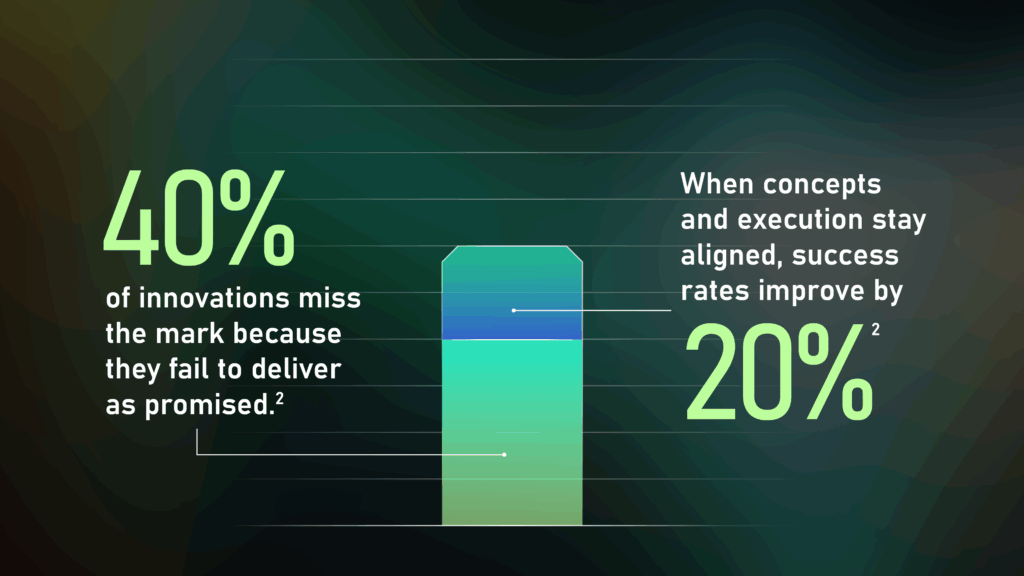
Even highly differentiated concepts can lose their edge through development – diluted by cost constraints, time pressure, or operational trade-offs. According to Ipsos’ findings,
- 40% of innovations miss the mark because they fail to deliver as promised.2
- When concepts and execution stay aligned, success rates improve by 20%.2
Great ideas need protection and priority. They must be nurtured to survive the journey from idea to launch and succeed in market.
Renovation alone isn’t enough for the funnel
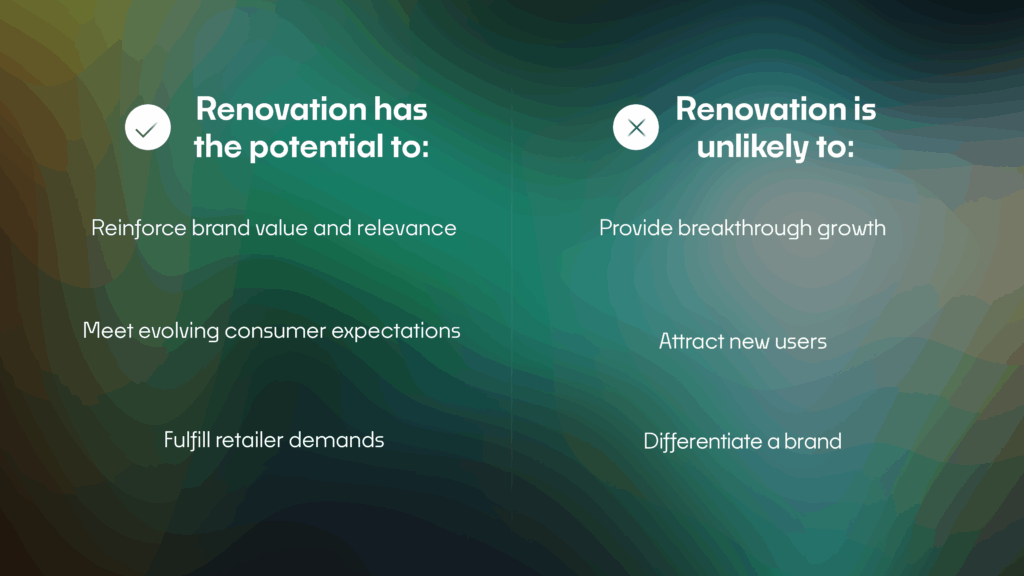
Renovation is a vital part of any innovation pipeline. When done well, it reinforces brand value, refreshes relevance, meets evolving consumer expectations, and fulfills retailer demands.
However, renovation doesn’t provide breakthrough growth or attract new users the way true innovation can. Incremental improvements won’t differentiate a brand in a crowded, commoditized market.
When renovation becomes the default, rather than a deliberate choice, it signals a problem. Renovation is often chosen for the wrong reasons: it’s faster, cheaper, and safer. It fits neatly into existing operations.
Bolder innovations take longer. They demand more resources. They may even challenge existing business models. But they offer something renovation can’t: real upside — and lasting differentiation.
The paradoxical combination of rigor and creativity
Many organizations lack the structure to manage innovation effectively. Others over-engineer it, creating bureaucracy that kills agility and stifles creativity.
Innovation doesn’t thrive in chaos. Nor does it flourish in rigid process. Striking the right balance means:
- Clear targets: How much growth do you need from innovation? In which segments, categories, or brands? Over-ambitious goals can overwhelm teams, while under-ambitious ones leave growth on the table. Clear targets give direction and accountability.
- Defined hurdle rates: What success metrics are required at each project milestone? Too challenging and nothing will pass, too easy can lead to resource waste. Hurdle rates aren’t one-size-fits-all, but they help with objective prioritization.
- Disciplined management: How are ideas prioritized, progressed, and resourced? Who decides, and when? Rigid templates, overprocessing, and unclear decision rights can paralyze early-stage ideas. On the other hand, a lack of structure leads to stalled projects and missed opportunities.
- Culture and Accountability: Who owns innovation and do they have the right skills? Who generates ideas and moves them forward? Teams need room to explore—but they need training in the right methods and mindsets. Leaders can set expectations, shape the company’s approach to innovation, and build teams to deliver.
Raising the bar: 5 practical steps
If your organization is serious about using innovation to meet future growth goals, here’s where to start:
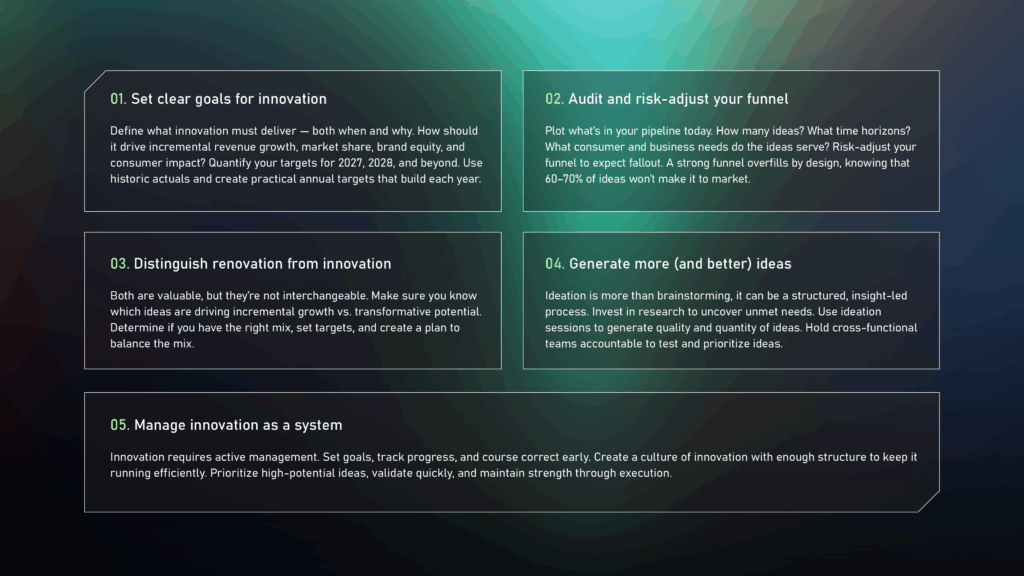
1. Set clear goals for innovation
Define what innovation must deliver — both when and why. How should it drive incremental revenue growth, market share, brand equity, and consumer impact? Quantify your targets for 2027, 2028, and beyond. Use historic actuals and create practical annual targets that build each year.
2. Audit and risk-adjust your funnel
Plot what’s in your pipeline today. How many ideas? What time horizons? What consumer and business needs do the ideas serve? Risk-adjust your funnel to expect fallout. A strong funnel overfills by design, knowing that 60–70% of ideas won’t make it to market.
3. Distinguish renovation from innovation
Both are valuable, but they’re not interchangeable. Make sure you know which ideas are driving incremental growth vs. transformative potential. Determine if you have the right mix, set targets, and create a plan to balance the mix.
4. Generate more (and better) ideas
Ideation is more than brainstorming, it can be a structured, insight-led process. Invest in research to uncover unmet needs. Use ideation sessions to generate quality and quantity of ideas. Hold cross-functional teams accountable to test and prioritize ideas.
5. Manage innovation as a system
Innovation requires active management. Set goals, track progress, and course correct early. Create a culture of innovation with enough structure to keep it running efficiently. Prioritize high-potential ideas, validate quickly, and maintain strength through execution.
A call to action: Test the strength of your funnel
Are you confident your current funnel can deliver on your business goals for 2026, 2027, or 2028?
For many leaders, the answer is: not really.
That’s why we’re offering a complementary assessment of your innovation funnel. Reach out to hello@alchemy-rx.com for more info.
- Evaluate its ability to contribute to corporate objectives
- Identify idea quantity and quality gaps
- Recommend research and insight gaps to fuel new ideas
- Assess the balance of rigor and flexibility in the funnel process

How we can help
- Ipsos brings world-class research capabilities, with proven methodologies to uncover deep consumer and category understanding.
- Market Logic powers the DeepSights™ platform — helping organizations extract insight from existing data and research, to feed ideation & guide development.
- Alchemy-Rx helps organizations fill their innovation funnels with high potential ideas, and manage their innovation funnels effectively for ambitious growth.
Stop scrambling. Start systematizing.
Let’s build the funnel your growth strategy deserves.
Discover the rest of our innovation series:

Sources
- Ipsos. Survey of C-Suite Leaders, October 2025.
- McKinsey. Strategic Growth and Innovation Survey. 2024.
- Ipsos. Concept Testing Database. 2025.