



Share this article


As Chief Financial Officer (CFO) in your organization, you control the innovation budget, deciding where to invest for maximum return. But these decisions are rarely straightforward. As you are well aware, innovation outcomes are hard to quantify, timelines are long, and the link between research spend and financial performance is often unclear. Without a direct line of sight to return on investment (ROI), it’s difficult to confidently greenlight or defend innovation investments. So, how can you quantify the impact your product development has on ROI in order to inform your decisions?
The solution lies in treating strategic market insights not as optional inputs, but as core drivers of innovation ROI. A recent study published by the Harvard Business Review found that organizations that excel at leveraging insights outperform their peers across key metrics like profitability, market share, and even the speed of new product development. These leaders reported 77% higher revenues compared to 61% for other organizations. Beyond product development, there’s a broader financial impact of strategic insights — particularly when powered by advanced platforms like DeepSights™. A new Forrester Consulting Total Economic Impact™ study reveals that businesses leveraging this AI-powered insights platform can achieve an astounding 411% ROI in just over three years, demonstrating how a focused investment in the right insights technology can translate directly into significant, measurable business growth, enhanced product innovation, and competitive advantage across your entire organization.
When insights are effectively leveraged and measured, they can provide a clear, defensible path from market understanding to financial return. In this guide, we’ll outline how to connect your organization’s insights to innovation ROI — so you can measure the business impact of innovation investments, and make the case for sustained funding in insights-driven product development.
The strategic imperative: proving innovation’s financial impact
Innovation doesn’t fit neatly into traditional accounting models. Unlike capital or operational expenses or even traditional knowledge management ROI, its returns are uncertain, indirect, and often delayed.
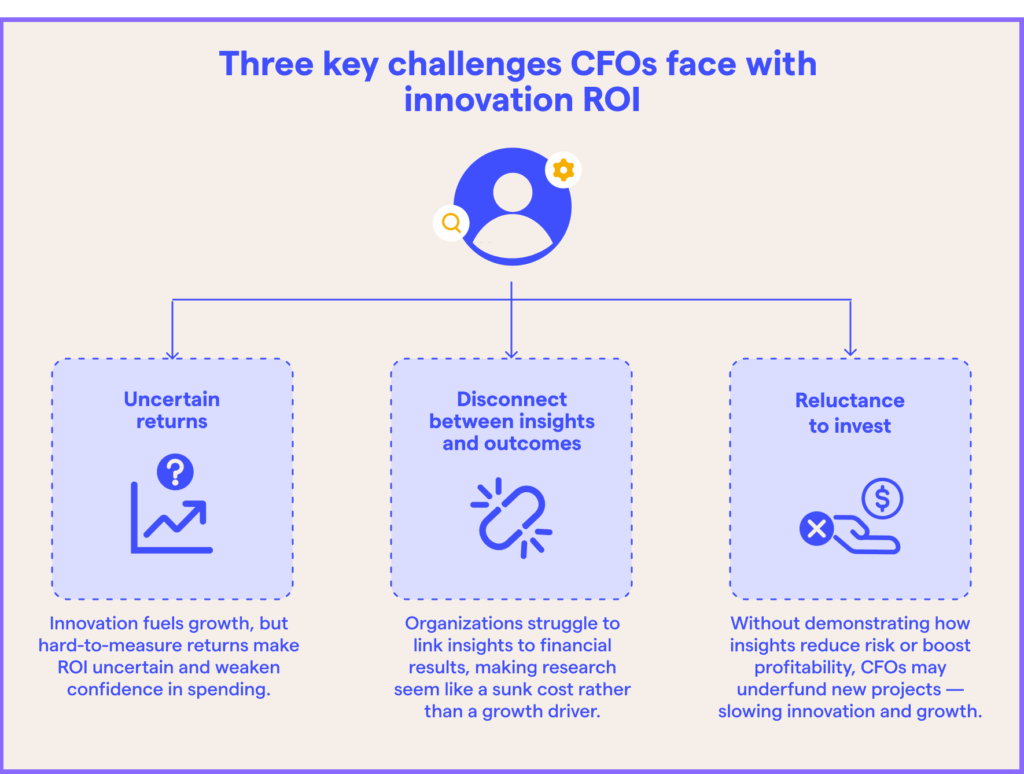
The complexity of proving innovation’s financial impact creates three major hurdles for finance leaders:
- The elusive return on innovation: While innovation drives long-term growth, its returns can be difficult to isolate. Traditional metrics rarely capture the full financial impact of product development or market entry initiatives. The lag between investment and outcome — and the many variables involved — can obscure ROI and erode confidence in innovation spending.
- Disconnect between insights and financial outcomes: Despite heavy investment in market research, many organizations can’t draw a straight line between insights and financial results. Without proof of impact, research is seen as a sunk cost rather than a strategic growth lever. This perception limits the ability to expand or even maintain budgets for intelligence gathering.
- The struggle for confident investment: Without a clear framework to quantify how insights reduce risk or improve profitability, CFOs may underfund high-potential development projects or misallocate resources. This reluctance to invest can slow innovation, limit competitive advantage, and reduce future growth potential.
From market understanding to measurable innovation value, driven by market insights
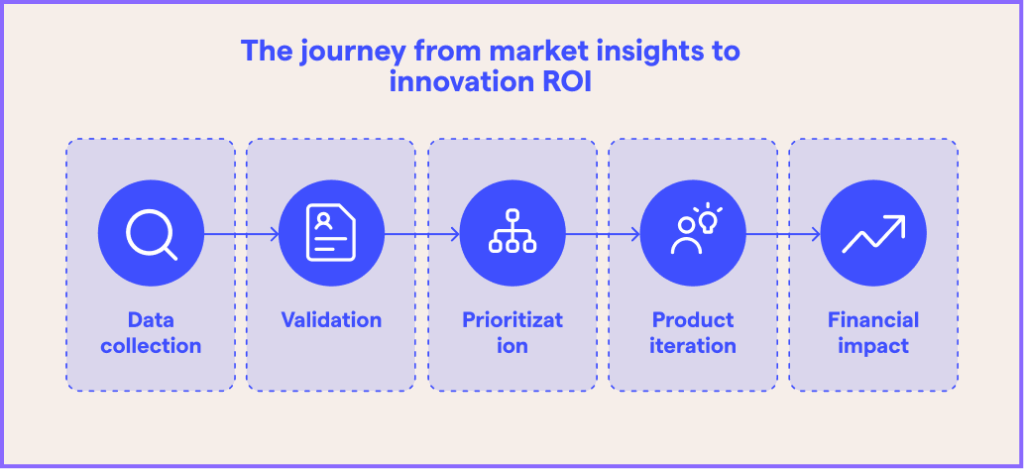
Strategic market insights transform product innovation from a costly gamble into a calculated investment with more predictable returns. Essentially, by applying insights throughout the product lifecycle, organizations like yours can reduce risk, speed time-to-value, and make better use of resources.
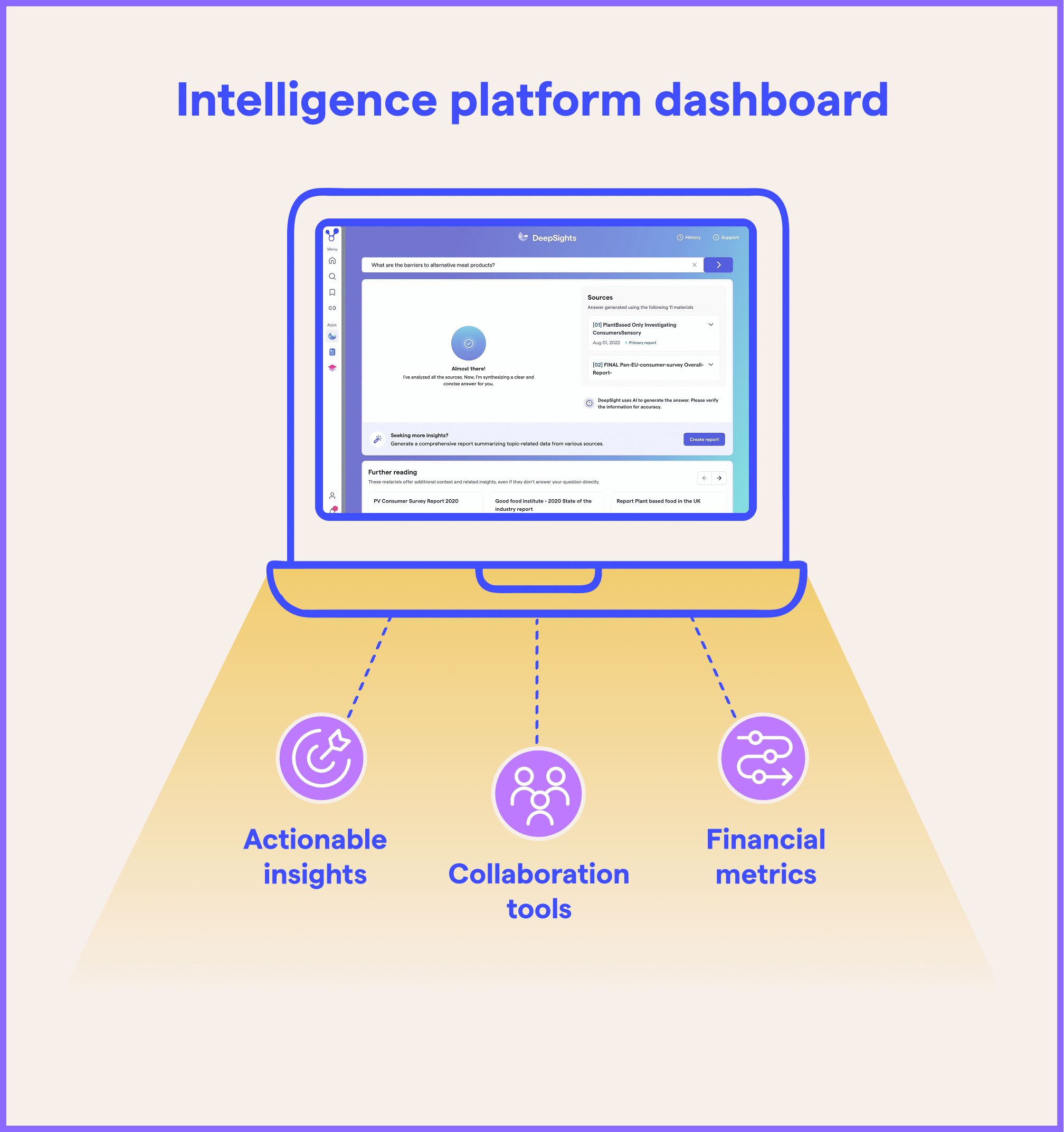
Advanced market intelligence platforms, like DeepSights, play a crucial role in this transformation by organizing, analyzing, and delivering actionable insights directly from your market research data to inform critical business decisions.
Here’s how AI-powered market insights can drive measurable innovation value for your organization:
Validating and prioritizing innovation initiatives to reduce costly mistakes
Market insights act as an early filter, helping teams focus on the most promising innovation ideas before heavy investment. By leveraging customer interviews, surveys, and behavioral analytics, your teams can better identify unmet needs and market gaps signaling real demand. This data-driven validation prioritizes features and products with the highest commercial potential, reducing costly missteps.
For instance, if market research shows strong customer preference for a specific feature, it can directly guide development efforts — avoiding time and budget spent on ideas unlikely to gain traction. Success here can be measured by tracking your concept-to-development conversion rates and early customer interest scores.
Optimizing market entry and growth strategies for improved ROI
Insights inform precise market segmentation, competitive positioning, and launch timing. Using competitive intelligence and customer preference data, your organization can craft ultra-targeted messaging that resonates with specific audience segments.
This focus reduces trial-and-error spending on broad campaigns, leading to faster time-to-market and improved marketing ROI. This might include timing your product launches with consumer demand spikes — helping to boost adoption rates. In this case, key metrics to evaluate efforts would include time-to-market improvements, campaign ROI, and user adoption rates.
Iterating products for sustained ROI to maximize customer lifetime value
Ongoing refinement of product lines based on actionable insights ensures products stay aligned with changing customer needs. This approach extends your product lifecycles, improves retention, and supports premium pricing.
For example, prioritizing feature updates that drive adoption and reduce churn leads to measurable growth. Tracking these outcomes through retention rates, feature usage, and Net Promoter Scores (NPS) helps teams make informed decisions about future improvements. This continuous cycle of insight-driven iteration safeguards your initial investments and drives long-term value.
The role of advanced intelligence platforms in reducing development risks and accelerating time-to-market
The right intelligence platform for the job consolidates and processes vast amounts of market research data — from surveys to sales and competitive reports — making insights instantly accessible and actionable. By automating pattern detection and trend identification that manual analysis might miss, these platforms accelerate insight delivery and reduce the time teams spend on manual research. This enables faster, more accurate decision-making and more agile responses to market changes.
The value for you and your organization translates into measurable improvements, such as shortened research cycle times, faster time-to-market for new products, and reduced operational costs. These benefits can be tracked through metrics like research turnaround time, decision velocity, and cost savings from automation and reduced external consulting fees.
To turn market insights into predictable innovation value, having access to the right intelligence platform is critical. DeepSights centralizes your existing market research, enabling faster synthesis of data and collaborative decision-making.
The recent Forester TEI study, conducted by applying Forrester’s TEI methodology based on in-depth interviews with DeepSights customers who participated in the analysis, found that DeepSights by Market Logic Software delivered $4.4 million in productivity gains and cut insight search time by 75% over three years.
As Dirk Wolf, CEO of Market Logic, stated:
“The Forrester TEI study provides an invaluable framework for tracking the positive benefits and material impact to business performance that our use-case specific Gen AI solution DeepSights has delivered. From significant operational efficiency gains to business growth, we are proud to see our customers share details of tangible business outcomes.”
Ultimately, by streamlining access to validated insights, teams were able to reduce development risks and accelerate time-to-market, supporting measurable ROI across product lifecycles.
Four tips to build a quantifiable link from insights to innovation ROI
Establishing clear connections between market insights and financial outcomes requires structured approaches to measurement and attribution. Therefore, you must focus on creating frameworks that track how specific insights contribute to measurable business results, enabling them to demonstrate the value of intelligence investments and make informed decisions about future resource allocation. This measurement framework should encompass both leading and lagging indicators of innovation success.
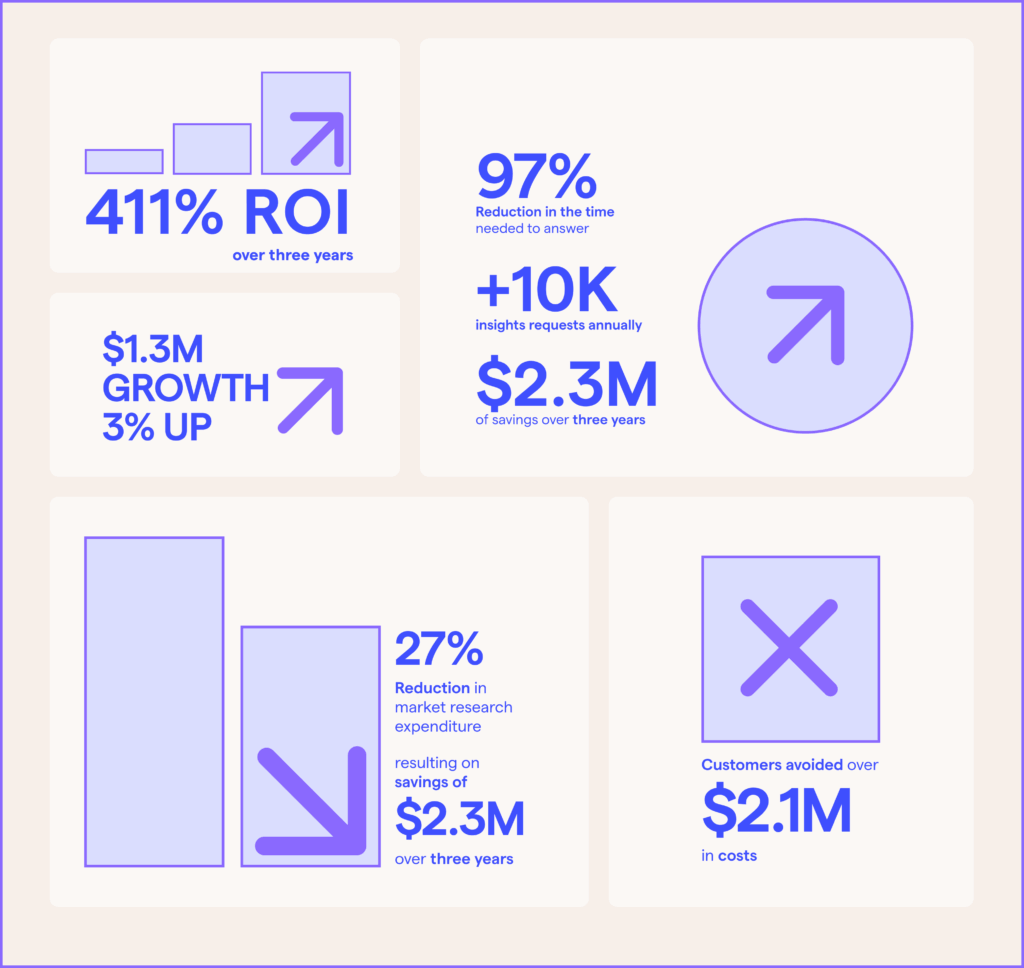
Here’s how you can map insights to financial impact, establish performance benchmarks, and attribute success to build a transparent, accountable case for ongoing investment in insights-driven innovation:
1. Mapping insights to key financial metrics
The foundation of innovation ROI measurement lies in clearly defining how specific insights contribute to quantifiable innovation outcomes. Begin by identifying which innovation metrics each market insight influences, such as revenue growth from new products, cost efficiencies in development, market share gains, or enhanced product adoption rates. Collaborate closely with product, marketing, and finance teams to trace how these insights inform innovation decisions like project prioritization, feature development, pricing, or go-to-market (GTM) strategies.
For example, you can track the revenue lift linked to a new product feature validated by customer research, or measure margin improvements following pricing adjustments driven by competitive intelligence. Making these explicit connections will empower you and your teams to quantify the ROI of market insights within innovation and build a stronger case for ongoing investment.
2. Establishing innovation performance benchmarks
Creating baseline metrics before applying insights-driven initiatives is essential to accurately measure improvement and prove value to your organization’s decision-makers. These benchmarks should capture innovation performance across critical dimensions, such as:
- New product success rates
- Time-to-market
- Development costs
- Customer adoption metrics
By comparing pre-insight and post-insight performance, you can clearly see the tangible impact of market intelligence on innovation ROI. Be sure to track key performance indicators influenced by insights, including product adoption rates, market penetration, feature usage, and customer retention improvements. Consistently tracking these metrics over time builds a comprehensive picture of how insights drive innovation success and sustainable business growth.
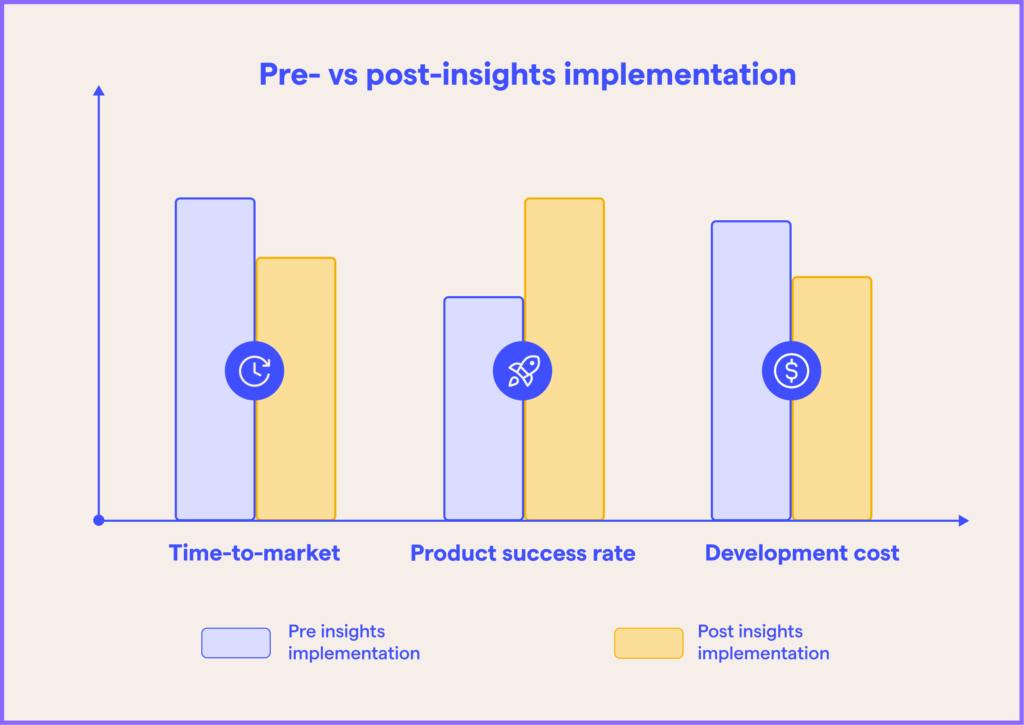
3. Attributing success through clear methodologies
If you want to show how your insights are driving innovation, it takes more than a gut feeling — it requires a structured approach. You can use methods like A/B testing, controlled experiments, or post-launch analysis to connect the dots between your insights and the success of new ideas. These techniques give you the hard evidence to prove the impact of your market intelligence.
These methods can help you separate the influence of your insights from the other variable business impacts — like a sudden market downturn or new competitor entering the market — that may or may affect your success. Transparent reporting is key here, as it ensures you nail down the details of the costs involved in obtaining insights in addition to the decisions they led you to and the measurable results they deliver so you can demonstrate their value to other stakeholders. When you have clear and actionable documentation, you can make more informed decisions for future investments and optimize spending to maximize your innovation ROI.
4. Justifying sustained investment with demonstrable value
When you’re consistently tracking and communicating the financial returns of insights-driven innovation, it creates a compelling case for ongoing and increased investment in market intelligence within your enterprise.
By transforming innovation spending from a perceived cost center into a strategic growth driver, CFOs like yourself can use documented ROI to secure expanded capabilities, advanced analytics platforms, and increased intelligence activities. When you consistently show that your market insights lead to successful innovation, it becomes much easier to make the case for continued investment. It proves that what you’re doing isn’t just helpful — it’s driving real, long-term growth and giving your business a competitive edge.
Establishing a clear connection between insights and innovation ROI requires not just access to the right data, but also actionable intelligence. Innovative AI for insights tech like DeepSights’ API integrates market signals into existing workflows, enabling CFOs and innovation leaders to track how specific insights impact financial metrics. This precise attribution supports transparent reporting and builds confidence in continued investment.
Transforming innovation investment into strategic advantage with DeepSights
As CFO, you have the power to turn innovation from a risky leap of faith into a calculated investment with predictable ROI. The key? Strategic use of market insights.
When you link market intelligence directly to innovation outcomes, you’re not just supporting growth — you’re making it measurable. The journey from innovation uncertainty to measurable financial returns runs directly through strategic market insights. By putting structured measurement, clear attribution, and transparent communication in place, you build trust in innovation spending while optimizing financial impact.
This is your opportunity to lead your organization to new heights — balancing creative exploration with fiscal accountability, and driving a culture where insight-powered innovation fuels long-term, profitable growth. In a fast-paced market where sustaining a competitive edge is vital, leveraging AI-powered market insights may be just the missing link you haven’t considered yet.
Market Logic offers a powerful, all-in-one platform designed to transform how your organization drives innovation and growth. The award-winning DeepSights centralizes your market intelligence, making it easier for teams to extract actionable insights and confidently quantify innovation ROI. Explore how DeepSights can elevate your innovation strategy by requesting a demo today.