


Share this article


Today’s fashion and luxury retailers have access to vast amounts of information, from consumer research and sales data to trend signals and market intelligence, with AI making data more accessible than ever before. In fact, luxury brands currently invest an average of 3.1% of revenue into technology, with AI becoming a key driver of transformation across marketing, personalization, and operations, Bain research found.
But most fashion and luxury insight teams don’t have a data problem — they have an activation challenge. They have access to high-quality research, but find it difficult to access, connect, and act on insights at speed. Research is abundant, but too often it sits across disconnected reports, tools, and teams, making it difficult to surface insights quickly enough to inform critical business decisions.
A recent cross-industry survey on innovation, published by Market Logic, Ipsos and Alchemy-Rx found that organizations are often collecting more information than they can meaningfully use, with 46% of respondents lacking enough insights to develop new ideas, and citing insufficient consumer understanding as a barrier to innovation.
As gen AI advances, the real opportunity is not gathering more data, but turning insight into intelligent, real-time action that drives faster decisions, sharper innovation, and stronger customer relevance.
In a landscape defined by rapid trend cycles and rising expectations for hyper-personalized experiences, competitive advantage doesn’t come from what you know. It comes from how quickly you can connect the dots, surface what matters, and act on it with confidence. It’s about turning complexity into clarity and acting quickly enough to keep pace with competitors.
In this blog post — aimed at Insights leaders in the fashion and luxury retail space — you’ll learn how to democratize data and make it accessible to the business, and unlock the full value of your insights with agentic AI. You’ll also learn how to deliver insights at the speed your business demands to power faster innovation and smarter growth.

Why insights leaders in fashion retail are under pressure and turning to gen AI
Today’s insights teams in fashion retailers and luxury goods face several substantial challenges.
Consumer data is fragmented, inaccessible and underutilized
If you’re an insights or research professional in the fashion and luxury retail space, you’re not lacking data — you’re overwhelmed by it, and working across an ever-expanding mix of sources: market research studies, point-of-sale data, customer reviews, social trends; plus supply chain signals, graphs, dashboards, charts.
Your challenge isn’t access to data — it’s transforming it, at speed and scale, into actionable insights that drive confident decisions.
Quality of insight delivery and speed matter, but it’s difficult to reach for the business
You operate in an environment where every decision can impact your bottom line, and speed matters more than ever. That’s why business stakeholders expect fast, evidence-backed answers — and increasingly, proactive guidance from insights leaders.
While time is of the essence, the complexity of modern retail data and analytics makes it difficult to synthesize information quickly enough to make informed decisions,.
As a result of data bottlenecks, 40% of key business decisions in organizations are taken based on gut feeling and without reference to data, an Insight Platform survey found.
Customers are more demanding than ever before
Customers’ needs are shifting by the minute. Shoppers expect hyper-personalized, seamless experiences, raising the bar for how quickly retailers must respond to new signals.
Boston Consulting Group reports that luxury consumers increasingly expect AI-enhanced experiences, especially around personalization, as brands look to scale “white-glove” services digitally.
Nearly 90% of product and innovation managers say that better access to consumer insights would increase their product launch success rates.

The real cost of insight inaccessibility and data fragmentation
When data is scattered and insight can’t be accessed, connected, or activated quickly, its value diminishes, leading to:
- Time lost searching for or duplicating existing work
- High-value research investments are underutilized
- Cross-category insights remain siloed
- Opportunities — especially fast-moving trends — being missed
Insight creation is strong, but activation is broken
In many fashion and luxury organizations, insights teams operate as centers of excellence—producing high-quality, deeply considered research across categories, from fine jewelry and accessories to beauty, services, and beyond.
But while insight creation is strong, accessing and activating insight remains a challenge for many.
In practice, knowledge is fragmented across both structured and unstructured data sources. Much of this insight:
- Sits in presentations that are difficult to search or interpret: from dashboards and datasets to PowerPoint decks, charts, and visual storytelling
- Lives with individuals, making it easier to email a colleague than query a system
- Remains disconnected across teams, with no intuitive way for the business to explore or reuse it, leading to time spent on meetings
The result is a familiar pattern: repeated questions, duplicated effort, and slower decision-making when speed matters most. This leaves highly skilled insights teams spending too much time searching, formatting, managing, and sharing information — via a series of meetings, for example — rather than driving strategic impact.
The consequences go beyond inefficiency. When knowledge can’t be accessed and applied quickly, innovation pipelines weaken — skewing toward incremental improvements instead of breakthrough growth.
At the same time, the pressure to move faster is increasing. The next wave of competitive advantage in retail will come from organizations that can connect the dots across all available data, quickly and intelligently. McKinsey reports that retailers adopting generative AI are already seeing incremental sales growth of up to 5%, highlighting the tangible impact of faster, more connected decision-making.
Yet despite this potential, many organizations struggle to translate gen AI investment into results. While 82% of executives say innovation is a top priority, 60% admit they are not effective at delivering on it—revealing a clear gap between ambition and execution, as our innovation survey with Ipsos and Alchemy-Rx found.

Why existing AI solutions haven’t worked for fashion retail organizations
Organizations are trying to democratize knowledge access and bridge the innovation gap by deploying gen AI. But using generic AI, they run into the same fundamental limitations:
1. Disconnected insights
Fashion and retail brands rely on unstructured data to understand consumers: charts that reveal behavioral shifts; infographics that illustrate category dynamics; visual frameworks that connect trends, audiences, and opportunities. All these research reports, surveys, competitive analyses, dashboards, and presentations are spread across siloed systems.
And critically, changing the format isn’t a realistic option in fashion and luxury retail, where visual storytelling is essential. It’s how insights resonate with stakeholders, how narratives are built, and how decisions are influenced. Teams may be willing to add more context around visuals, but not to sacrifice the format entirely just to accommodate technology.
General-purpose AI tool lacks the context to understand how data sources connect, or which ones matter most.
2. Loss of context
Insights are only as strong as their context — methodology, sample size, timing, geography, and business relevance. When that context is stripped away, conclusions become unreliable or misleading. Without this intelligence even your most valuable insights will struggle to deliver their full impact.
3. Lack of traceability
Teams can’t easily see where answers come from or validate their credibility, making it harder to trust outputs. As a result, when AI tries to synthesize fragmented, unstructured information, hallucinations increase — not because of user error, but due to structural limitations in general-purpose systems.
For insights teams, this creates a critical trade-off: answers come faster, but confidence in those answers erodes.
To conclude: The challenge of most teams isn’t solved by having access to AI —it’s interpreting insights effectively and making them work for the business at the speed it demands.
Fashion retail insights teams’ journey from static knowledge to active intelligence, powered by agentic AI
Solving the insight activation gap isn’t about adding another dashboard or repository. It requires a shift in how insight is understood, accessed, and delivered across the business — moving from static knowledge management to agentic intelligence.
Here are three must-do’s for Insights and Research leaders in fashion and luxury retail to maximize knowledge output:
1) Make all insight accessible — without changing how your team works
Your content, formats, and workflows aren’t going to change, and they shouldn’t have to. The breakthrough comes from choosing purpose-built AI that adapts to how insights already exist, including structured and unstructured data (presentations, surveys, dashboards, and more) across multiple sources.
That’s why solution selection matters — and why trialing different tools is essential. Look for an agentic AI platform that doesn’t just “store” knowledge, but can interpret it, connect it, and make it usable in minutes.
Unlike generic AI tools, which often pull information from unreliable sources, DeepSights is a purpose-built active intelligence system trained on proprietary data, ensuring that the insights it provides are both accurate and actionable.
It all starts with ensuring that the research is trustworthy. In a side-by-side comparison with other popular AI platforms, DeepSights outperformed tools like ChatGPT and Bing by delivering relevant answers 64% of the time. It also verified sources 71% of the time, a critical feature for industries like retail where decision-makers need to trust the data they are using.
With DeepSights, you can seamlessly and securely access and connect all your knowledge assets and:
- Query structured data in natural language (no SQL required)
- Get instant, evidence-backed answers from trusted sources, and share them across the business in minutes
- Reduce time spent on manual extraction and spreadsheet work
- Combine datasets to build a more complete view of consumers, markets, and performance

2) Insights shift from answering questions to driving insights proactively for the business
Once insight is accessible, the next step is changing how it moves through the organization so that it can inform decision-makers.
Most insight teams are still stuck in reactive workflows. Creative teams working under tight deadlines often find themselves jumping between meetings just to search for the right insights—hunting for the right deck, pulling slides together, and turning it into something shareable when responding to stakeholder requests.
This distracts them from what they do best. DeepSights does the heavy lifting by connecting, synthesizing, and exploring the full breadth of your corporate knowledge and data through an agent-led experience built for insights and marketing teams — so you can focus on what actually matters: making timely, insight-driven business decisions.
An active intelligence partner like DeepSights brings together structured data across your organization into a single trusted intelligence ecosystem with transparency and traceability, so teams can explore, analyze, and validate insights faster, without relying on technical specialists or manual data preparation — without compromising the formats and storytelling formats that land with stakeholders.
Powered by purpose-built agentic AI, DeepSights empowers consumer-centric teams and democratizes access to insights by:
- Centralizing fragmented insight across categories and customer segments in one central, easily searchable repository. Instead of waiting for the business to ask (or emailing the one person who “knows where it is”), the system can interpret business intent and surface what matters fast — directly inside daily workflows.
- Integrating into tools your teams already use (e.g., Google Drive, SharePoint, Microsoft Teams, Google Chat)
- Delivering clear, structured, evidence-based answers in 1:1 and group conversations. What might take two + hours to assemble as a manual summary can be generated in minutes, automatically synthesizing relevant information into a concise, user-friendly one-click report — easy to share across the business.
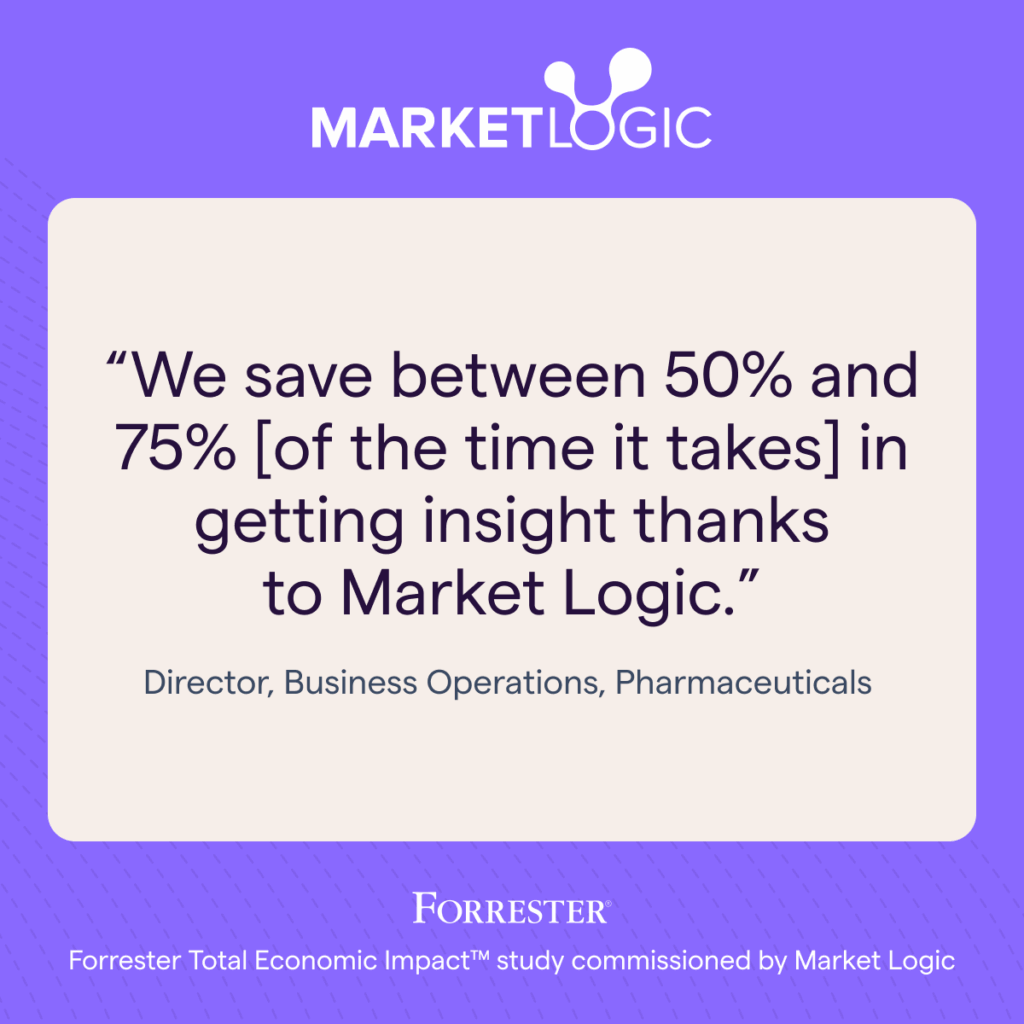
By activating existing research assets and automating insight delivery, DeepSights helps organizations answer thousands of insight requests dramatically faster — reducing insight delivery time by 97%, our Market Logic Forrester TEI study found.
This leads to significant time and cost savings by eliminating manual research bottlenecks. Insights teams can spend less time servicing repeat requests, more time focusing on strategic decision-making and business growth that drive business value.
3) Enable faster idea generation and smarter research investment with agentic AI
Even with strong research investment, many retailers remain insights-starved — 46% of organizations lack the volume of insights needed to fuel innovation, and 40% of initiatives fail to deliver as expected (Innovation Reignited Report).
The problem isn’t effort; it’s that insight isn’t surfaced and applied quickly and consistently enough to build a reliable innovation funnel.
Democratizing access to insights starts with continuous, AI-powered intelligence grounded in trusted data sources. By automatically monitoring market changes, consolidating signals, and identifying emerging trends across multiple domains, agentic AI helps turn insight into intelligent action by:
- Understanding the intent behind questions
- Connecting relevant insights across sources
- Synthesizing them into decision-ready outputs
- Delivering answers instantly — and proactively surfacing what matters as it emerges
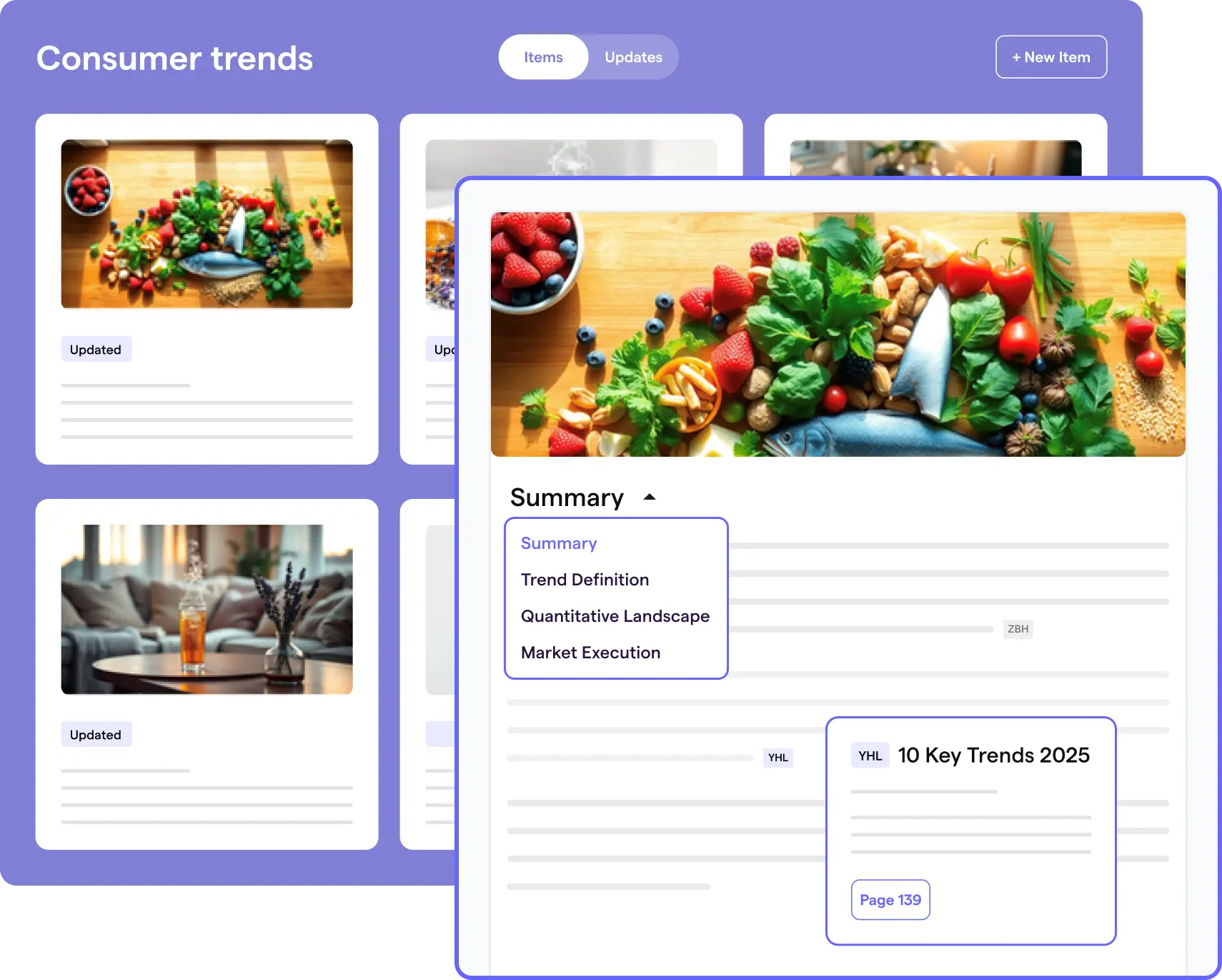
The innovation accelerator comes in the form of AI agents such as DeepSights Consumer Trends Agent, purposely designed to help insights teams drive the business forward with automated access to fresh, trusted, relevant insights with AI automation.
In fashion and luxury retail, that involves:
- Monitoring market changes
- Spotting early shifts in high-value customer behavior
- Connecting trends across categories to reveal new opportunities
- Responding to demand changes as they evolve, not after the moment passes
For deeper customer understanding, insights, business and product teams can leverage AI-powered personas such as DeepSights Personas, grounded in trusted enterprise data. They can explore ideas earlier with various consumer segments via Q&As and panels, test hypotheses faster, and refine concepts before committing budget and time to primary research.
This doesn’t replace human research — it makes AI-human collaboration more effective by:
- Speeding early-stage exploration
- Improving concept clarity before development trade-offs dilute differentiation
- Helping teams focus research investment where it will have the highest impact
Overall, this helps retailers refine the idea-to- product development process and de-risk innovation to help future proof your retail organization.
What active intelligence unlocks for insights leaders in the retail and fashion space
Taken together, these three core shifts move your function from knowledge holding to value creation — helping democratize access to insights, make faster decisions, build a stronger innovation funnel, and increase the ROI of your research and insight investments.
Turning insight into intelligent action for your fashion & luxury business with active intelligence
Fashion and luxury brands are rich in consumer intelligence but poor in insight activation. Valuable research often remains trapped in silos, making it difficult for teams to access trusted answers, identify emerging trends, and act with confidence. The challenge is no longer collecting data—it’s turning intelligence into action.
With advances in gen AI and the rise of agentic intelligence, this is now changing. Insights are no longer static assets — they are understood, surfaced, and delivered in real time, enabling faster, more confident decision-making.
The future of retail belongs to those businesses that can activate insights instantly, powered by agentic AI. Brands are no longer using AI purely for efficiency — they are increasingly using it to scale personalization, accelerate innovation, and protect customer loyalty in a slowing market.
This shift elevates insight teams from reactive support to proactive strategic partners, while capabilities like AI-powered personas enable faster idea generation and more focused research investment.
With DeepSights, this vision becomes reality—transforming fragmented knowledge into connected, decision-ready intelligence that moves at the speed of your business.
Schedule a demo with award-winning active intelligence partner DeepSights to see how a purpose-built insight platform can help your teams turn trusted research into real business impact — faster and at scale.