Share this article


Your company probably already has a market research problem inside its AI tools. It just doesn’t show up in the IT budget. It shows up as licensed reports pasted into chat windows, PDFs uploaded into custom GPTs, and agents quoting web search in an investment case for entering a new market or launching a new snack brand.
These are not signs of careless employees. They are what happens when assistants and agents spread faster than the market evidence behind them. People need market context to do their jobs, and when the governed route is slower, they take the ungoverned one.
The usual instinct is to pull that evidence into the AI stack: sync the research into an index and connect it to every assistant. That instinct recreates the problem it is meant to solve. The governed answer is to consolidate the interface, not the intelligence.
An enterprise MCP connection lets every AI assistant and agent a company runs call one governed market intelligence source when a task needs market evidence. The source checks the user’s permissions and returns cited findings, and the research is never copied into the AI tool. IT governs one connection instead of one integration per agent, and market evidence reaches more decisions without another tool for employees to learn.

Where do your AI agents get market facts today?
In most enterprises, market information comes from three places, and none of them is governed for the job.
- Whatever users paste in. A category manager drops a syndicated report into a chat to summarize it. The answer is useful, but the copy now sits outside the system that controls who may read it. If it goes into a team’s custom GPT, everyone with access to that GPT can now query a report they were never cleared to read.
- The open web. Agents with web search answer market questions with whatever ranks. A vendor blog post and a commissioned quantitative study arrive with the same confidence.
- Point-to-point connectors. A team wires its agent to a research folder. It works for that agent, under that team’s assumptions about permissions, until the folder moves.
The cost rarely surfaces in an IT review. It surfaces later, when a launch plan or investment case rests on evidence nobody can trace: the business cost of confidently wrong AI. Blocking these routes does not fix it. People still need the evidence, so a block only pushes the workaround further out of sight.
Why market evidence needs specialized AI
Market evidence doesn’t sit in one place or speak one language. A single question about a category can touch a commissioned quantitative study, a syndicated panel report, partner data and last week’s competitor news, each with its own method, sample, market and date. Specialized AI is built to connect the dots across them: it understands what each source can and cannot support, weighs evidence by quality and recency, and sees where findings agree, contradict each other or leave a gap.

That is why DeepSights is more than a single place to store research. It reads across everything the insights team governs, makes sense of it the way an experienced market intelligence professional would, and puts it to work: answering with citations and watchouts the person didn’t think to ask about, flagging where a plan contradicts the evidence, and showing what nobody has researched yet. It is the practical case for specialized AI in market intelligence, and it changes the question for IT: not only where research is stored, but how every assistant can reach the AI that understands it.
Why synching research into your AI stack makes governance worse
The common fix is to index research into the enterprise assistant, a search platform or an in-house RAG pipeline, so every agent can reach it. It looks like control. In practice it creates a second copy of content that is permissioned, licensed and constantly changing.
That copy brings three problems:
- Permissions drift. Access rules in the research platform have to be mirrored in the index and kept in sync. Every gap between the two widens access.
- Evidence goes stale. A study is superseded, a source is retired, a license ends. The index keeps serving the old version until someone re-runs the pipeline.
- Trust gets lost in the copy. An index sees text, not provenance. Generic AI cannot tell a validated study from a slide deck that quotes it, so the insights team’s curation does not survive the trip. That is why it pays to ask whether a general assistant can understand your market at all.
Governance is easiest where the evidence already lives. The real question is how every assistant can reach it without moving it.
What MCP changes: call the source, don’t copy it
MCP, the Model Context Protocol, is an open standard that lets AI assistants and agents call other applications during a task. The assistant keeps the conversation and company context. When a question concerns customers, categories or competitors, it calls a specialized market intelligence layer, which checks the user’s permissions, weighs the relevant research and returns cited findings.
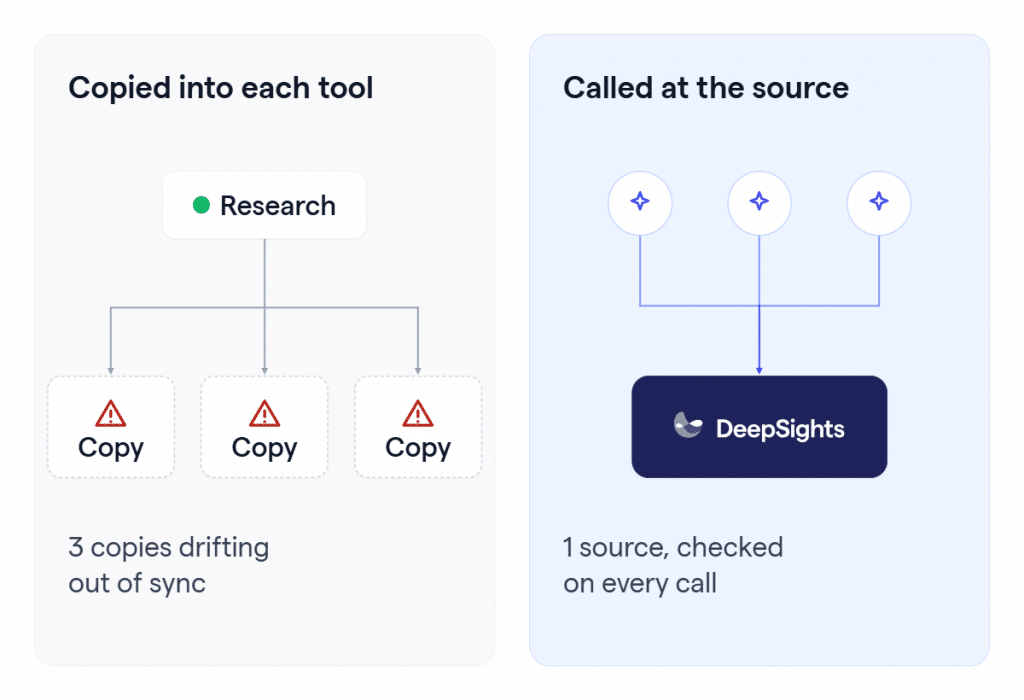
Nothing is copied. Our post on how DeepSights MCP works alongside Microsoft Copilot walks through one assistant. For a CIO, the point is scale: connected once, the same governed source serves every assistant and agent you approve. That is the practical case for specialized AI in market intelligence.
How do you keep an enterprise MCP connection secure and governed?
Treat the connection as an extension of your existing access model, not a new one. MCP is a protocol, so security depends on the implementation. If any condition below fails, the connection widens access instead of extending it.
These are the questions we hear most in security reviews:
- Permission inheritance: is every call tied to a signed-in user, who sees only what they can already access in the source system?
- No copied content: is research kept out of the AI tool, with nothing synced, indexed or exported?
- Standard authentication: does it use an established standard such as OAuth 2.0 and your existing sign-in, without separate credentials?
- Central source governance: can insights and IT decide in one place which sources are available?
- Traceable answers: does every finding link back to its source?
- Certified security management: does the provider hold a recognized certification such as ISO/IEC 27001, with documentation on request?
These extend the governance questions IT leaders face with generative AI to a new kind of connection. Market Logic Software holds ISO/IEC 27001 certification, and its security trust center lets you request security documentation.
What does it take to keep running?
Most of the cost of an AI integration arrives after go-live. Take five agents and three research sources: wired point to point, that is up to fifteen integrations to maintain. Behind one governed layer, it is one.
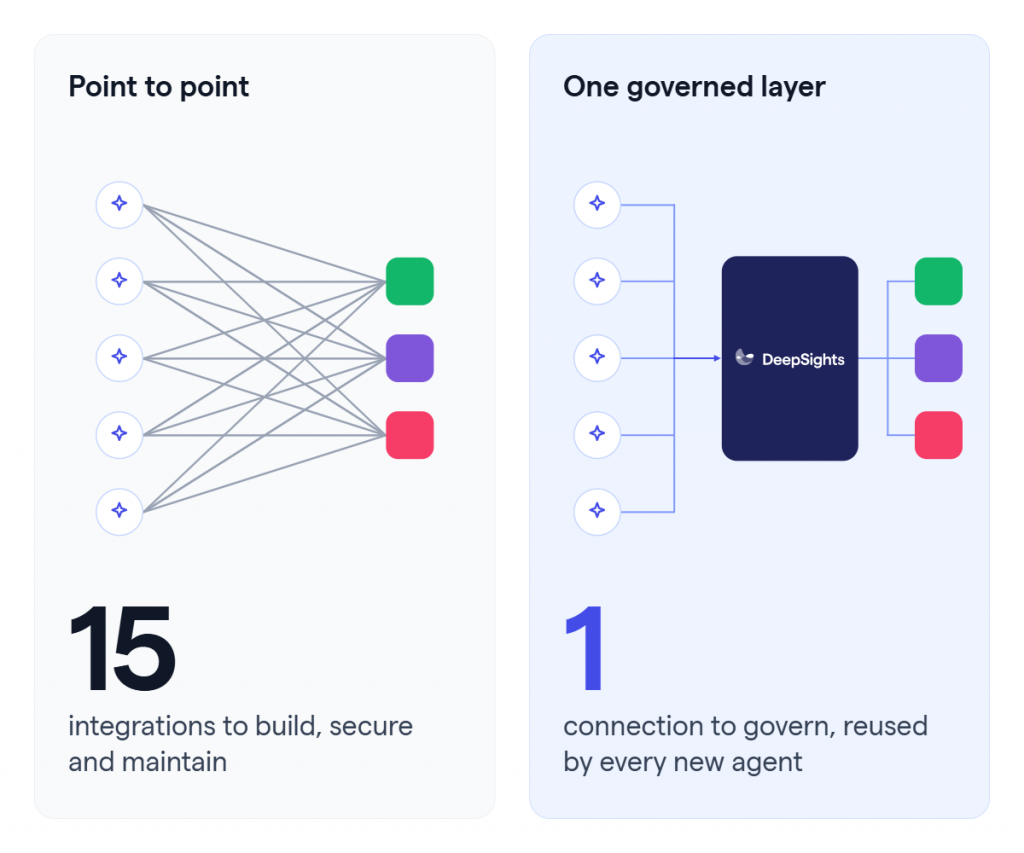
| Day-2 task | Sync or build | One governed MCP connection |
| Add a new agent or AI client | New integration and permission mapping | Register once in an MCP gateway and reuse the connection |
| Add or retire a source | Re-index and check every pipeline | Change it once at the source; every connected AI follows |
| Change a user’s access | Mirror it into each index | Checked on every call against the source |
| Switch AI assistant vendors | Rebuild the connectors | Open standard; the connection moves with you |
| Update the integration | Your engineering team | Provider rolls out updates centrally |
Building a market intelligence layer from scratch turns into a standing engineering commitment rather than a one-off project. A governed connection leaves IT to configure and test it, and leaves insights to decide which sources count as trusted.
From answers to business processes: trusted insights by default
The return on market research depends on how many decisions it shapes, not how many people log in to search it. An MCP connection turns market evidence from a destination people must visit into an input of the processes where decisions are made. DeepSights MCP does this in three modes, each delegating more of the work:
- Ask. A brand manager asks their assistant how Gen Z snacks in Germany and gets cited evidence from internal research, syndicated sources and market signals in the same reply, without leaving the tool.
- Review. An agent checks a plan against existing evidence before it moves on. A launch plan comes back with the evidence that supports it, the findings that contradict it and the gaps nobody has researched yet.
- Orchestrate. Business tools hand work to DeepSights as part of a process. When a new concept reaches a stage-gate, an innovation agent has it tested against personas grounded in the company’s research, and the results feed the gate decision.

Adoption follows. When evidence arrives inside the tools employees are already asked to use, there is no second login and no copying between windows. Fewer reasons to leave a mandated assistant mean fewer reasons to work around it, and both investments gain.
What IT and insights teams still own
An MCP connection moves trusted evidence to where decisions are made. It does not create that evidence or control everything an assistant does. Four jobs stay with you:
- Agree who curates sources. Answer quality depends on what the insights team marks as trusted, so settle that ownership before rollout.
- Instruct agents that can search the web. Add a short instruction to call the trusted market source first and keep its citations.
- Set expectations on wording. The assistant writes the final reply, so phrasing differs from the source platform while the cited sources stay the same.
- Keep a human on high-stakes decisions. Routing market questions to a cited source reduces the risk of wrong claims entering plans, but people still need to check the citations.
How DeepSights MCP by Market Logic Software delivers this
DeepSights MCP connects DeepSights, Market Logic’s market intelligence platform, to the assistants, agents and workflows a company already runs. Market Logic announced general availability on October 7, 2026. Current customer setups include Microsoft Copilot Studio, ChatGPT, Claude, Glean and customer-built agents.
- Same identity, same permissions. Each request is tied to the signed-in user and checked against the same permission model DeepSights uses in its own interface
- Research stays in DeepSights. Content is not copied, synced or indexed into AI tools
- Trusted by design. the curated and validated sources the insights team governs, decides what the AI treats as trustworthy
- Govern once. Insights and IT decide in one place which sources are available, and changes apply to every connected AI
- Hosted and maintained by Market Logic. Nothing is installed in your network, updates roll out centrally, and Market Logic experts help tune agents to call DeepSights at the right moments
Your AI knows your company. DeepSights knows your market.
Olaf Lenzmann, Chief Innovation and Product Officer at Market Logic Software
For architecture, authentication and data protection in detail, read the DeepSights MCP technical and governance brief, or visit the DeepSights MCP product page.
The AI architecture decision for scaling trusted insights
Consolidation is the right instinct where AI tools overlap. Market evidence is not an overlap: it is an input every one of those tools lacks. Before your next AI architecture review, ask three questions:
- Where do our agents get market facts and insights today? Could we trace them back to authoritative sources?
- How many copies of licensed research now sit across our AI tools?
- What does each new agent cost us to connect to trusted sources?
If the answers are uncomfortable, here is the case for your AI steering committee in two sentences:
Our AI agents understand our company but not our market, and today they fill the gap with pasted reports and web search. One governed connection gives every AI assistant and agent cited market evidence under existing permissions, with nothing copied and nothing new for employees to learn. Combining internal knowledge and external market intelligence gives our leaders the golden context for making better, more timely decisions.
Book a personalized demo to see DeepSights MCP answer a market question inside your own AI environment.
Frequently asked questions
What is an enterprise MCP server?
Why not index our research into our enterprise assistant or search platform instead?
Is MCP secure enough for enterprise market research data?
What happens if we switch AI assistants, for example from Copilot to ChatGPT?
How do you govern which sources AI assistants can use through MCP?
What does it take to connect an AI assistant to a market intelligence source through MCP?