

Share this article


In every enterprise insights repository — whether tucked away in PDFs, embedded in dashboards, or buried inside old PowerPoint decks — untapped growth opportunities are waiting to be uncovered.
These frequently come in the form of niche markets: smaller, underserved consumer segments with specific needs that, when identified early, can be extremely lucrative. In fact, these “tiny” niche markets are generating over $50 billion annually, underscoring just how much value can lie beneath the surface.
Yet, despite investing heavily (often well over $500,00) in market research each year, large organizations struggle to unearth these opportunities. This is primarily because they still rely on manual processes or surface-level search functions that can’t connect the dots across fragmented, siloed data sources.
The result? An inability to read between the lines — letting valuable signals from profitable niche markets remain hidden in plain sight. And if you’re leading insights, product strategy, or brand development in a mid-to-large-sized organization, you’ve likely felt this firsthand: all the right data within reach, but no clear way to squeeze fresh value from the research you already have.
In this article, we’ll explore why traditional niche market research analysis methods fall short in extracting these granular insights. You will also learn how AI-powered tools for insights like DeepSights™ can help you spot untapped segments within your existing research assets, ultimately leading you to unlock new revenue streams and achieve a crucial competitive edge.
Why valuable insights remain hidden in your existing research
Enterprises possess a wealth of market knowledge — spanning consumer behavior reports, syndicated studies, survey verbatims, internal dashboards, and competitive intelligence. But all that knowledge is rarely working as hard as it could.
The problem isn’t a lack of data. In fact, it’s the opposite: the sheer volume of data leads to information overload, where valuable, granular insights tend to get overlooked.

More importantly, the issue lies in the fact that most existing research is typically scattered across tools, teams, and formats. Some of it sits in dashboards, some in slides, others in unstructured data stored in SharePoint or buried in inbox threads. This fragmentation makes it difficult to form a cohesive view of the market, let alone surface granular patterns that point to niche demand.
Even when you attempt to consolidate and analyze these assets, you are bound to face real constraints. Manual review is time-consuming, resource-heavy, and prone to human bias. With thousands of pages of research collected over time, spotting faint signals or subtle correlations — especially across unrelated studies — becomes nearly impossible.
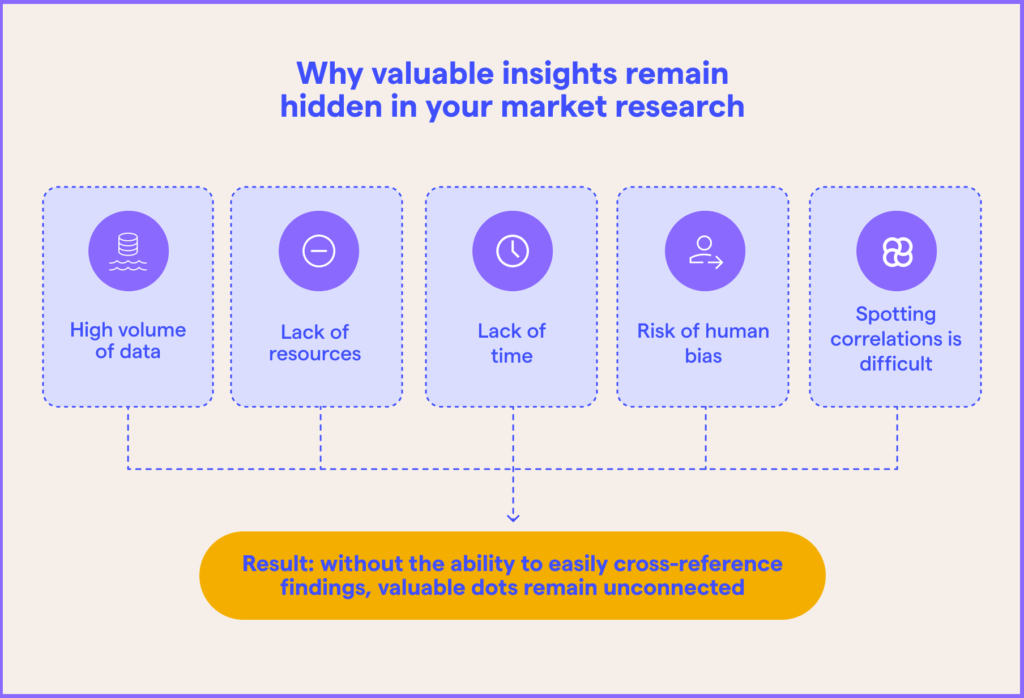
And without the ability to easily cross-reference findings, valuable dots remain unconnected. A slight shift in consumer preference flagged in one study might never be linked to a behavioral trend found in another. This means early signals of emerging niche markets get lost in the shuffle.
In fast-moving industries like CPG and Retail, that delay in niche market research and identification can be costly. Missed insights translate to missed opportunities.
AI-powered knowledge management: The solution for fragmented insights
Traditional research workflows hinder more than just operational efficiency — they impact strategic growth initiatives, too. When insights are scattered, siloed, and stuck in static formats, their value fades away over time. So, what enterprises need is a way to make their existing research dynamic, connected, and ready to be put to use. That’s where AI-powered knowledge management platforms come in.
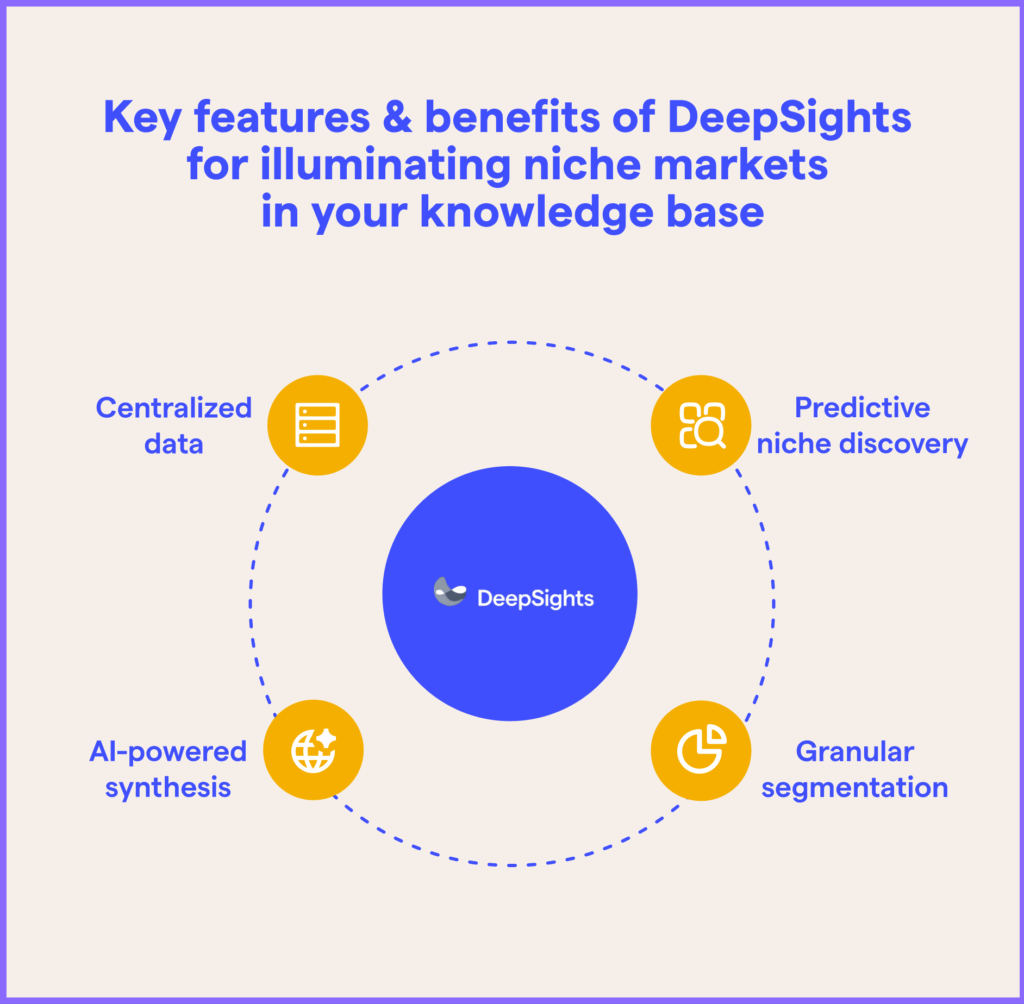
Rather than starting from scratch or commissioning new studies to answer every business question, these systems unlock the full value of what’s already known (just not surfaced yet). They centralize insights from diverse sources — internal reports, syndicated research, newsfeeds, dashboards — into a single, searchable knowledge base. This means what was once fragmented becomes a unified source of easily accessible market information.
But consolidation is just the beginning. The real value lies in AI-powered insights for market intelligence: how AI can rapidly connect and interpret information that would otherwise remain isolated. By analyzing large volumes of structured and unstructured data, AI platforms can shed light on patterns, fill in context, and provide a coherent understanding of market dynamics (without relying on manual synthesis).
The result is a shift from static research archives to a living insights ecosystem, where past work continuously informs present decisions. This foundation is essential for identifying niche market opportunities, which typically require cross-referencing subtle signals from multiple data sources.
DeepSights: Illuminating hidden niche markets within your knowledge base
DeepSights was built for organizations looking to make the most of the proprietary research assets they already own. It provides a more efficient and more effective lens for insights discovery via AI-powered search.
It can retrieve and understand documents, no matter how vast or varied. And it doesn’t stop at summarizing documents. It synthesizes all relevant data to turn the research base into a useful, living insights engine.
Moreover, the platform allows business and insights professionals to pose natural-language questions and receive precise, context-aware answers — sourced from across the company’s internal knowledge assets and trusted external feeds.
That said, where it sets itself apart is in its ability to surface signals that point to underserved, profitable niche markets. The kinds of insights that would be easy to miss in a manual review. Let’s look at how it helps you achieve this.
AI-powered synthesis of disparate data
An AI-powered insights platform is designed to handle the complexity and sprawl of enterprise research repositories. So, whether your insights are buried in PowerPoint presentations, tucked inside PDF reports, or spread across dashboards and survey tools, the platform brings them all into one centralized, AI-ready environment.
It then interprets the organized data using six layers of analysis to pinpoint connections between documents that human analysts might never spot. For example, a passing reference in a brand perception study might align with a trend in social sentiment. Or, a product usage report might echo a finding in a long-forgotten segmentation deck.
Using an AI-powered solution puts these two and two together instantly. It automatically understands insights content and extracts only information that is relevant to the user’s queries.
This synthesis enables you as a business user to move beyond basic keyword search and engage with your research as a living network of intelligence. That shift means you’re no longer chasing isolated facts. You’re building layered consumer understanding that evolves with your business priorities.
And it’s from this connected view that niche market signals begin to emerge — giving you the clarity and lead time needed to shape new revenue-driving strategies before competitors even spot the trend.
Granular segmentation and predictive niche discovery
Beyond broad market trends, AI excels at revealing granular, actionable consumer segments. These are groups that may be small in size but significant in terms of profit potential.
An AI-powered solution that’s purpose-built for insights analyzes shifts in language, sentiment, and topic emphasis across your collective knowledge base to detect early indicators of emerging or unmet needs. These elusive patterns, usually inconspicuous in a manual review, often point to profitable niche markets.
When you’re under pressure to find “what’s next” and continually innovate with AI firepower at your disposal, this kind of early signal detection can yield a first-mover advantage. Instead of reacting late to market movements, you can identify niche demand while it’s still under the radar, allowing you to position yourself ahead of competitors.
A blueprint for enterprise niche market success with DeepSights
Identifying a niche market is only half the equation. The real value comes from being able to act on it quickly, decisively, and with the right internal alignment.
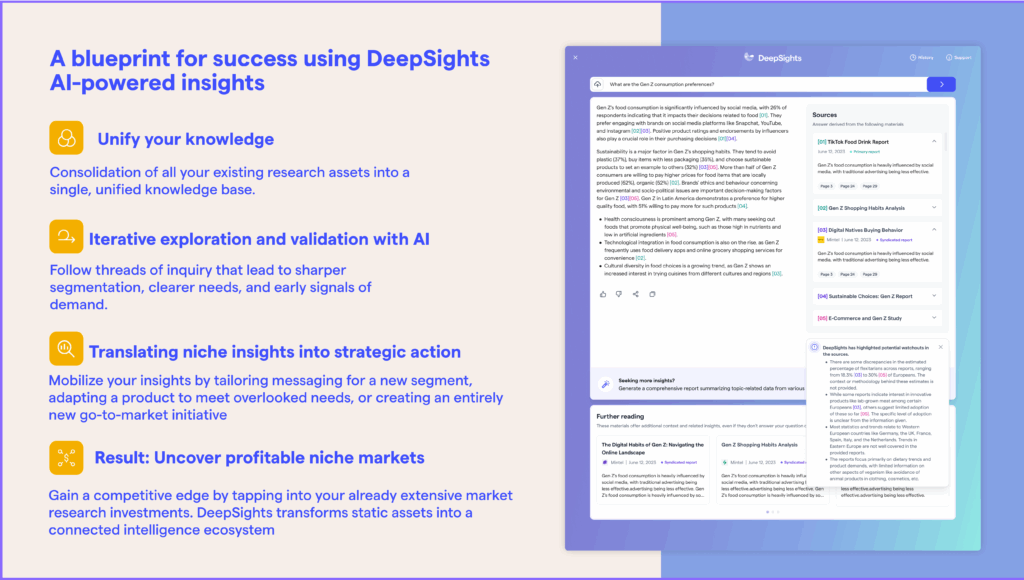
Using an AI-powered insights solution not only helps uncover these pockets of opportunity — it also equips you with the tools to validate, share, and operationalize them. Here is how you can start building your blueprint to success with the help of AI-powered insights.
Unifying your enterprise knowledge base
The first and most critical step toward market success is the consolidation of all your existing research assets into a single, unified knowledge base.
For most organizations, research lives in silos. Insights reports might be stored in shared drives, dashboards in BI tools, and external studies spread across different teams or vendors. This fragmentation slows access and prevents insight teams from seeing the full picture.
An AI-powered insights platform brings all of it together into a readily accessible knowledge base. Once centralized, the content becomes instantly searchable and contextually linked, making it easier for your teams (marketing, strategy, or product) to find what they need, when they need it.
This unified foundation is what enables deeper, more reliable discovery of niche markets hidden within existing assets.
Iterative exploration and validation with AI
With an AI-powered insights solution, you can begin with broad queries and gradually refine them based on emerging patterns. As the platform uncovers connections across different studies or datasets, you can follow threads of inquiry that lead to sharper segmentation, clearer needs, and early signals of demand.
Just as important: every insight is grounded in evidence. AI provides citations and context for every answer it delivers — drawing not only from your own internal research but also from secondary and tertiary sources like syndicated reports, news articles, and analyst publications. This gives you the confidence and traceability you need to validate findings, deepen consumer understanding, and bring stakeholders on board.
Translating niche insights into strategic action
Once you have identified and validated a niche opportunity, the next step is mobilization of those insights.
This may involve a range of activities, such as tailoring messaging for a new segment, adapting a product to meet overlooked needs, or creating an entirely new go-to-market initiative. AI for insights gives you the foundation you need to move quickly across all these initiatives.
By pairing analysis with on-demand reporting features — such as automatically generated PowerPoint slide decks and Word documents — the right AI-powered solution enables business users like you to package and share findings in formats that resonate across the organization.
And because those insights are instantly connected to context, validation, and recommended next steps, your path from uncovering niche market opportunities to acting on them becomes significantly shorter and more scalable.
Uncover niche markets with DeepSights
Scattered insights keep niche opportunities out of sight. But with the right AI-powered approach, your existing research can come together to reveal a steady stream of opportunities you might have otherwise missed.
An AI-first insights platform like DeepSights equips you to uncover profitable niche markets and gain a competitive advantage by tapping into your already extensive market research investments. It transforms static assets into a connected intelligence ecosystem — one that links seemingly unrelated insights and deepens your understanding of how your audience is evolving. With every discovery grounded in evidence from trusted sources, you move faster, validate confidently, and execute with greater precision.
Ultimately, the value of uncovering niche markets isn’t just about spotting gaps — it’s about understanding the people within them. DeepSights helps you build a richer picture of consumer behavior: what motivates them, how their expectations shift, and where your brand can meet them with relevance and speed. When launching into emerging niche markets where generic personas fall short, this is the difference between guessing what your audience wants and knowing with conviction.
With its award-winning solution DeepSights™, Market Logic brings you transformative capabilities in one comprehensive platform that will elevate the way your teams achieve niche-driven business growth. DeepSights’ AI-powered, centralized knowledge management system is designed to enhance the way your business users consolidate and analyze data, turning it into actionable insights.
It’s time to stop overlooking niche markets and start leading them. Request a demo today to learn more.
FAQs
A niche market is a smaller, specialized segment of a broader market that has distinct preferences, needs, or characteristics. These markets are often underserved by mainstream offerings and can present significant growth opportunities for companies that recognize and meet their unique demands via niche market research.
Traditional methods include analyzing consumer behavior, segmentation studies, trend reports, and competitive gaps. However, manual analysis often misses subtle signals and is susceptible to human bias. AI-powered platforms help by synthesizing large volumes of existing niche market research data to reveal specific, underserved segments more efficiently and accurately.
Traditional methods include consumer analysis, segmentation studies, and trend reports. AI-powered platforms enhance this by synthesizing large volumes of data to reveal underserved segments efficiently and accurately.
Look for patterns in existing research that indicate unmet needs or shifting behaviors within a sub-group of your broader audience. This might involve analyzing historical studies, survey verbatims, or external market data. Tools like DeepSights make this process faster by automatically surfacing emerging trends and hidden connections across your knowledge base.
Reading the market involves continuously monitoring consumer sentiment, behavioral shifts, and competitor moves. Identifying niches requires going a layer deeper to tie together seemingly unrelated signals across multiple datasets. AI insights assistants enable this by turning disconnected research into a unified, navigable intelligence network.