


Share this article


Market research agencies are under pressure to rethink how they deliver value. Generative (gen) AI has made basic research tasks faster and easier for clients to do themselves. A brand team can now summarize reports, draft category narratives, compare themes, and produce first-pass analysis with tools they already have access to. That does not make agencies irrelevant, but it does change what clients are willing to pay for.
The agency value proposition can no longer depend only on manual research effort. It needs to come from better decision support, stronger category expertise, trusted data, and the ability to apply AI responsibly inside real client workflows. But enabling this shift successfully requires a synergy between gen AI and human expertise.
How can market research agencies effectively combine gen AI and human expertise to deliver value to their clients in this new AI-driven paradigm?
This topic was the focus of Market Logic’s webinar with a design and marketing agency specializing in category strategy and activation, Melli, “Beyond Research: How Agentic AI is Rewriting the Rules of Commercial Intelligence.” The discussion centered on how AI is reshaping the work done by market research agencies, consultancies, and professional services providers.
Melli’s perspective was especially useful because the agency is already applying AI across category strategy, commercial intelligence, creative activation, and retail execution for major FMCG clients. For Market Logic and Melli, that is where the partnership becomes valuable:
- Market Logic provides the active intelligence infrastructure through purpose-built, market intelligence partner DeepSights.
- Melli brings the category expertise, client context, and commercial judgment needed to turn AI-supported findings into useful recommendations.
That combination creates a stronger model for agencies, helping them move faster without reducing quality, and move from selling research production to delivering decision-ready intelligence. It also gives clients access to AI-powered insight capabilities without requiring them to build everything internally.
We’ve summarized key learnings from our conversation below into five best practices your market research agency can apply using AI insights.
Five practical ways market research agencies can use AI insights to create more value for clients
1. Use gen AI to accelerate synthesis, but keep human experts in control
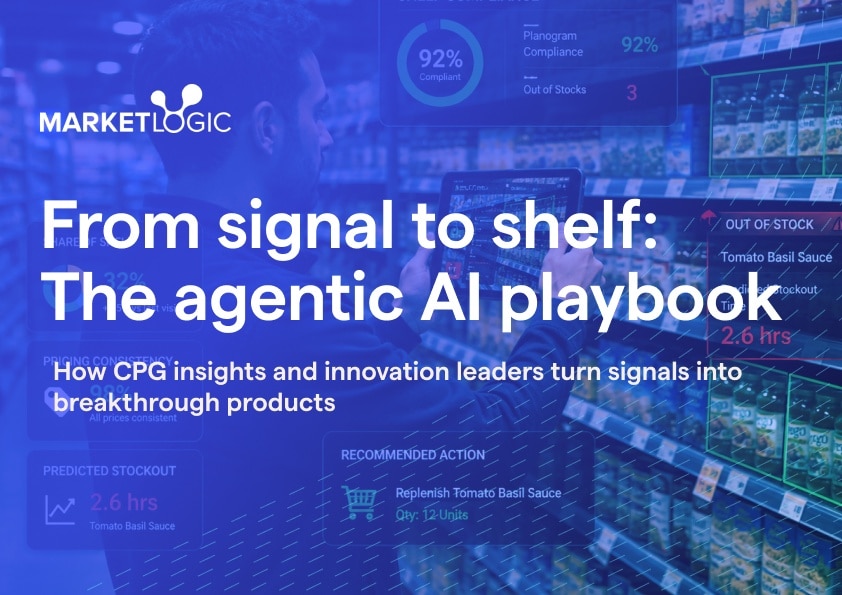
The most immediate use case for AI in market research agencies is faster synthesis — from hours to minutes.
Agencies spend a large amount of time reviewing reports, extracting themes, comparing findings, summarizing prior studies, and turning large volumes of information into usable client outputs.
Gen AI can support this work by helping teams search across repositories, summarize documents, identify recurring themes, and organize evidence around specific business questions.

This is already becoming an expected part of how insights work gets done. Greenbook’s 2025 GRIT Insights Practice Report notes that buyers are evaluating partners differently, suppliers are evolving to stay competitive, and AI and synthetic data are key forces shaping what comes next for market research, insights, and analytics.
In our webinar, Melli described how AI can compress research work that once took weeks into hours or minutes. The warning was clear: speed without expert oversight can create faster low-quality output.
Melli’s model keeps the senior expert in control of the process. The expert decides what data should be included, what questions should be asked, which outputs are credible, and what the client should do next.
Use cases – How agencies can use AI insights to surface insights for better decision-making
Let’s take a couple of real-life examples:
- CPG: A CPG agency working with a pet food brand might use AI to synthesize hundreds of slides across consumer research, veterinary recommendations, retailer feedback, shopper behavior, competitive claims, and category performance. The AI can help surface findings faster. The agency then applies category knowledge to decide which findings should influence the brand’s next range review, retail activation, claims strategy, or innovation pipeline.
- Retail: A retail insights agency could use the same approach to prepare for a category reset. AI could help compare shopper studies, loyalty data, promotional performance, assortment feedback, and prior retailer sell-in decks. The agency would then identify the commercial implications, such as which shopper segments are underserved, which product formats need more space, and which claims are most relevant at the shelf.
Using AI effectively leads to better use of agency time. Teams can spend less time manually searching and summarizing, and instead, they spend more time interpreting, advising, and helping clients make decisions.
The value is not simply that the work gets done faster, but rather, that the agency can get to the strategic discussion sooner.
2. Turn client knowledge into an active intelligence environment
As Melli and many other research agencies have encountered, generic AI tools can be useful for everyday tasks, but they are not enough for enterprise-level market research.
Agencies often work with confidential research reports, proprietary studies, syndicated data, internal decks, regulated category information, market trackers, and multimarket repositories. In those situations, clients need more than a quick answer. They need to know where the answer came from, whether the source can be trusted, and whether the output reflects the right body of evidence.
This is where specialized enterprise AI becomes important. An active intelligence system does more than store past research: it helps teams continuously search, synthesize, validate, and activate insight across business workflows.
Market Logic describes purpose-built solution DeepSights as an active intelligence hub that evaluates relevance, authority, recency, and conflicting data points while grounding answers in trusted sources controlled by the organization.
That distinction of traditional knowledge management vs active intelligence networks is important for agencies to understand, ahead of starting their journey with AI:
- Traditional knowledge repositories help teams find information.
- Active intelligence helps teams apply that information to new questions, emerging signals, client briefs, and business decisions.
In practice, general-purpose gen AI tools can struggle with interpreting data such as large PDFs, large slide decks, regulated veterinary science information, or multimarket consumer research repositories. This is because most gen AI tools are not purpose-built for interpreting structured and unstructured data, and are also not surfacing contextually relevant data. Can these answers then be fully trusted?
Simon Nagle, Senior Client Director at Melli, described this in effect at the webinar. The risk is that a tool may stop processing the full source material but still generate an answer that appears complete.
DeepSights helps address this gap by providing a governed environment where answers can be grounded in verified, cited sources.
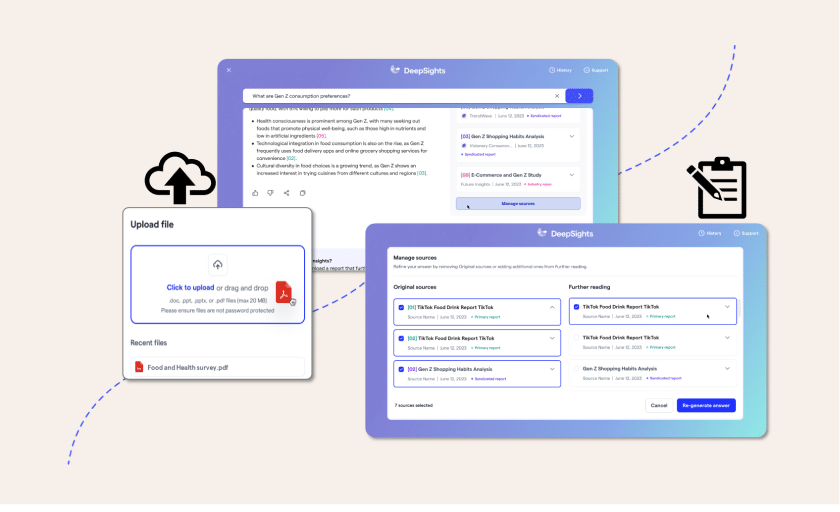
For agencies, this means they can give clients more confidence that insights are drawn from the right evidence, not from a general model’s best guess.
In CPG and retail, this can support several agency-led services, such as:
- A category intelligence hub for a global food or beverage brand
- A shopper insight environment for retail activation teams
- A claims and messaging evidence base for a personal care brand
- A pet care or veterinary knowledge base for regulated product communications
- A competitive intelligence system for tracking category movement, innovation, and channel trends
- A retailer-specific insight library that supports sell-in presentations and joint business planning.
The overall benefit is that agencies can move from one-off project delivery to a more continuous service model that is beneficial to the agency and the client. Instead of producing a deck and moving on, the agency helps the client build a reusable intelligence environment that supports future briefs, faster answers, and better alignment across teams.
It’s a win-win. For clients, this creates access to trusted intelligence without requiring every team to search through old reports or commission new research for questions that may already have evidence behind them. For agencies, it creates a more durable value proposition. They are not only delivering insight, but they are also helping clients make existing knowledge usable.
3. Use synthetic personas and panels for early-stage ideas exploration
Synthetic personas are one of the most powerful and practical ways agencies can apply AI-powered research for clients, especially when they are used in the right part of the research process. The best use case is early-stage exploration.
Synthetic personas can help agencies refine hypotheses, compare concepts, test language, explore segment reactions, and identify which ideas deserve further investment.
Market Logic’s DeepSights Personas enable agencies to create synthetic personas from their own trusted structured and structured data. This includes surveys and segmentation data, to data tables, reports, and transcripts.
Once the synthetic personas are created, teams can speak with synthetic personas to understand segment needs, test ideas, and gather feedback in natural language — meaning, a question-and-answer format.
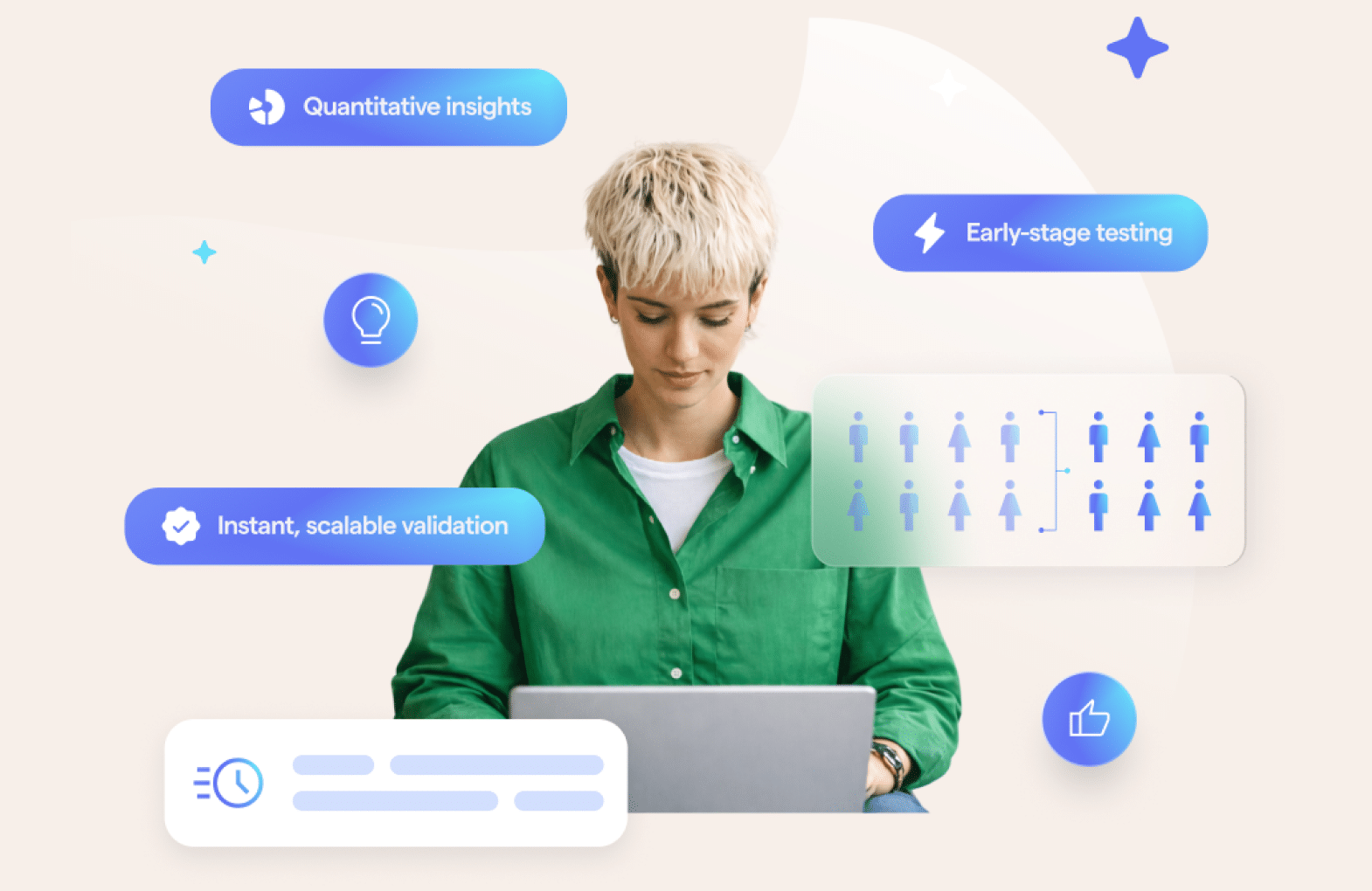
The platform can also simulate interviews and focus groups, explore behaviors and motivations, and use synthetic panels for survey-style validation at scale.
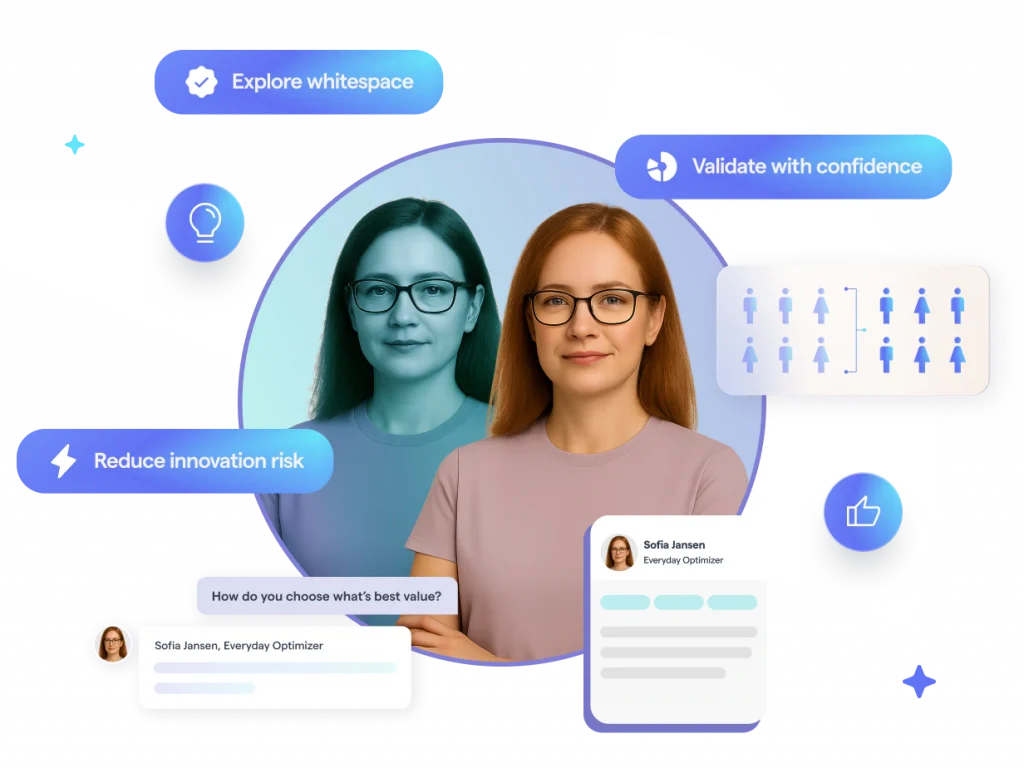
DeepSights Personas can be used to screen product concepts and claims across regions, explore hard-to-reach segments, stress-test campaign messaging, and support persona-led innovation.
Use case: How market research agencies can use synthetic personas to drive value
For agencies, this creates several practical CPG and retail applications.
- A beverage brand could use synthetic personas to explore how different consumer segments respond to new flavor concepts before choosing which ideas to move into fieldwork
- A snack brand could compare claims such as high protein, low sugar, natural ingredients, or indulgent taste across health-conscious, family-focused, and value-driven shoppers
- A personal care brand could test whether a packaging refresh communicates efficacy, sustainability, premium quality, or affordability before commissioning broader validation
- A retailer could use synthetic panels to pressure-test shopper responses to private-label expansion, shelf layout changes, or promotional messaging
- A pet care agency could compare how veterinarians, premium pet owners, and mainstream pet owners might interpret product information, provided those personas are grounded in relevant data and reviewed by qualified experts.
Melli used DeepSights to build veterinary and pet owner personas with input from qualified professionals on the team. The point was not just to create a persona that sounded like a vet or pet owner, rather, one shaped by people who understand real professional behavior, clinical decision-making, category context, and market differences.
Creating synthetic personas on the fly is a major opportunity for agencies. Many clients can access basic AI tools. Fewer can design synthetic research workflows that are properly grounded, calibrated, and interpreted.
Here is the opportunity: Agencies can help clients use synthetic personas as part of a responsible research process. They can define the right segments, choose the right source data, design the right questions, interpret the results, and decide when real respondent validation is still needed.
Synthetic personas are not meant to replace traditional research in high-stakes decisions. They should make traditional research more focused thanks to deeper consumer understanding. They help teams eliminate weak ideas earlier, sharpen concepts before fieldwork — allowing them to focus budget on the options with the strongest potential.

4. Build governance into every AI-powered research workflow
AI introduces risk when outputs look credible but are not properly checked.
This is especially important for market research agencies because clients expect agencies to protect the quality of the work. If an AI output is wrong, outdated, biased, or based on the wrong market, the agency is still accountable for what it delivers. Melli called out several risks in the webinar:
- AI can conflate unrelated studies. It can produce a US-biased answer when the brief requires a UK or European perspective. It can rely on outdated competitive information. In regulated categories, it can create reputational risk by generating technical or clinical claims that have not been reviewed by qualified experts.
- Synthetic personas add another layer of risk. A persona can be misaligned by geography. It can give an incorrect technical answer with confidence. It can also create a false sense of validation when several synthetic personas appear to agree but are really reflecting similar underlying assumptions. This is why governance should become part of the agency service model.
Clients should know how AI is being used, which data sources are approved, what outputs are exploratory, where expert review is required, and how evidence is being cited. This is not just a compliance issue. It is a trust issue.
The Insights Association’s Code of Standards and Ethics for Market Research and Data Analytics emphasizes integrity, quality, duty of care, and data protection across research practices. Its 2026 guidance on AI-driven research makes the point more directly: every AI capability in market research has a trust condition attached, and speed only earns value when trust keeps pace.
For market research agencies, this creates a practical checklist when using AI, such as:
- Define which sources can be used
- Separate exploratory AI outputs from validated findings
- Require expert review before client delivery
- Cite sources in outputs whenever possible.
- Flag uncertainty rather than hiding it
- Document assumptions behind synthetic personas
- Calibrate personas by market, segment, and category
- Use real respondent validation when decisions carry higher risk
- Protect proprietary client information
- Explain how AI changed the research process.
This is also where agencies can create value that clients may struggle to build internally. Many brand teams want the speed of AI, but they do not always have the governance model, training, or subject matter expertise to use it safely.
The biggest opportunity for market research agencies is not AI — but how they deploy it
An agency that can say “we use AI” is not especially differentiated anymore.
But an agency that can say “we use AI within a governed, expert-led research process” has a stronger client story.
In CPG, that matters for claims, packaging, innovation, shopper messaging, and retailer-facing recommendations. In healthcare, nutrition, and pet care, it matters even more because outputs may touch regulated language, clinical interpretation, or professional trust.
Good governance does not reduce the value of AI. It makes AI usable for client decisions.

5. Shift from selling research hours to selling decision-ready outcomes
AI changes the economics of agency work.
If AI reduces the time needed for desk research, summarization, and first-pass analysis, then hours become a weaker measure of value. This does not mean agencies lose value. It means agencies need to be clearer about the outcomes they deliver.
Melli’s Simon Nagel argued that the billable hour is under pressure because AI can compress large portions of research production. His view was that agencies that succeed will stop selling hours and start selling outcomes.
His take is that to provide value to clients, agencies must be far ahead of the “just good enough” curve — something that generic tools cannot provide at this time. Listen to an outtake from our webinar co-hosted with Melli below:

This is one of the most important shifts for market research agencies and professional services providers. Clients do not ultimately need more research activity. They need better decisions.
Those decisions might include:
- Which category opportunity should we prioritize?
- Which claims should move into testing?
- Which product concept should receive more investment?
- Which shopper segment should we focus on?
- Which market should we enter first?
- Which retail activation route has the strongest evidence behind it?
- Which innovation idea should be stopped before budget is wasted?
- Which emerging trend is relevant to our brand?
AI can help agencies get to the evidence faster. The agency’s value comes from turning that evidence into a recommendation the client can use. This is the strongest answer to the question many agencies are asking:
“If AI takes away work clients used to pay us for, where do we add value?”
The answer is that some lower-value work will be compressed. Agencies should not build their future around protecting manual tasks that clients can now do faster themselves. They should build services around the outcomes clients still need and the capabilities clients may not be able to operationalize alone.
That can include:
- AI-powered category intelligence hubs.
- Rapid synthesis sprints for urgent business questions.
- Synthetic persona workshops for concept and claims exploration.
- Retail sell-in intelligence packages.
- Shopper activation planning support.
- Always-on competitor and trend monitoring.
- Research repository modernization.
- AI governance and readiness consulting.
- Executive-ready insight briefings.
This is where the agency model can become stronger:
- The agency carries the expertise, process, and governance.
- Market Logic provides the active intelligence infrastructure.
- The client gets faster access to trusted insight and clearer recommendations.
The result is a more useful agency-client relationship. It is less focused on how long the work took and more focused on what decision it helped the client make.
A new era for market research agencies Market Logic’s collaboration with Melli reflects the shift to AI-led market research
The partnership between Market Logic and Melli is designed to help agencies move beyond traditional delivery models toward more scalable, technology-enabled services.
It combines Melli’s expert-led research and category expertise with Market Logic’s AI-powered insights platform, DeepSights, so clients can move beyond static analysis toward more dynamic and actionable intelligence. This is why specialist models outperform general-purpose AI here rather than relying on a generic assistant.
For market research agencies looking for a tried and tested model of deploying AI to drive value, the learnings from this collaboration can be adopted as a blueprint for how agencies become intelligence partners with AI.
Be sure to watch the webinar with Melli for some useful tips — and stay tuned for more articles to help support you in this transition to leveraging AI insights.
If you are a market research agency exploring possibilities with AI, get in touch with our team to find out more about how we can help you get started on your active intelligence journey and see what we can do for you. Get in contact with our team here.