


Share this article


As an insights professional, you and your team can run a perfectly designed customer survey, get statistically clean results, and still walk away wondering what moved the needle. That’s because consumer motivations rarely show up as neat answers in a checkbox world. They live in contradictions, context, emotion, and the small trade-offs people don’t always articulate.
Synthetic personas help you get closer to that “why” without throwing away the rigor you already have. When they’re built from your existing research, they let you explore unmet needs, nuanced preferences, and behavioral patterns in a more natural, conversational way, especially when you need direction fast.
Why consumer surveys fall short on motivations
Surveys are essential. They’re scalable, measurable, and great for validation. But when your job is to de-risk innovation and make decisions that will survive the real world, surveys can hit a few predictable walls.
They’re episodic. You run them in cycles, and by the time the results land, the team has often moved on to the next decision.
They’re constrained by pre-set questions. You must know what to ask up front, which makes discovery harder when you’re trying to identify unmet or unarticulated needs.
They flatten emotion. People rationalize. They answer in ways that feel logical or socially acceptable. You end up measuring what’s easy to say, not always what’s driving behavior.
The pressure around this is getting louder at the C-suite level. In our recent Innovation Reignited research with Ipsos and Alchemy-Rx, 70% of leaders shared they’re collecting data faster than they can analyze or apply it, and 91% say the sheer volume of data has limited their organization’s success. When insight can’t be activated, innovation slows down — and the effects are felt in a slow pipeline that affects the bottom line.
What synthetic personas reveal about consumer motivations that surveys can’t
Synthetic personas are interactive, evidence-grounded representations of your customer segments that you can engage with in natural language. They are not fictional characters, and they are not generic AI profiles trained on “the internet.” The best versions are built on what you already trust: segmentation studies, U&A, trackers, verbatims, qual learning, concept tests, and the internal knowledge your teams have invested in over years.
Because you can have a conversation, you can explore motivations the way they show up: as stories, tensions, and trade-offs.
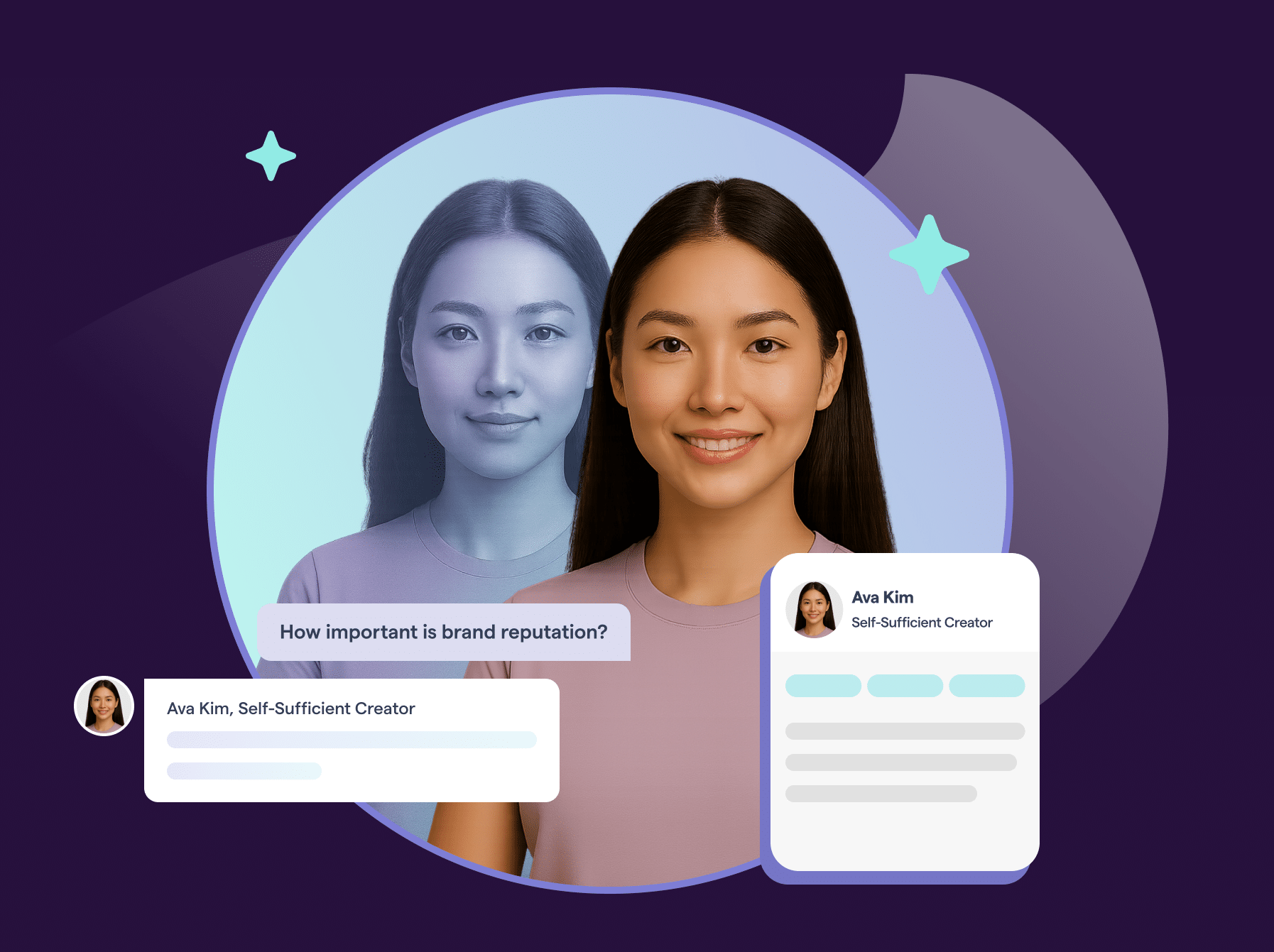
Instead of asking a traditional persona, “How important is value for money on a scale of 1–10?”, you can ask synthetic personas sentiment-specific and hyper-contextualized questions using an NLP-based (Natural Language Processing) chat functionality, such as:
- “Walk me through the moment you decided this wasn’t worth it.”
- “What would make you feel proud to choose this?”
- “What’s the risk you’re trying to avoid, even if you don’t say it out loud?”
- “What would you never compromise on, even if it cost more?”
This style of exploration tends to surface three things surveys often miss:
Unspoken emotional drivers
A survey might tell you “Convenience” matters. A synthetic persona conversation can uncover what convenience means in context, like decision fatigue, anxiety about choosing wrong, or feeling stretched thin.
Real trade-offs (not just preferences)
People don’t choose between features. They choose between outcomes, identities, and anxieties. Synthetic personas help you hear what someone gives up getting what they want.
Language that resonates
When you’re building narratives for a concept, a claim, or a product story, the phrases consumers use matter. Conversations help you pressure-test whether your messaging matches how people describe the problem in their own words.
Harvard Business Review has highlighted synthetic personas and related tools as practical ways to experiment with faster, lower-lift research workflows, especially for early exploration and iteration.
Forbes has also noted the growing adoption of synthetic approaches in research, reflecting the broader push for speed and scale in insight work.

From static personas to always-on consumer insights
Most organizations already have personas. The problem is they’re often trapped in PowerPoint, updated once a year, and treated like a deliverable rather than a capability.
Synthetic personas shift you from “persona as artifact” to “persona as interface.” They’re dynamic and refreshable, and they can become part of daily workflows. That’s the core idea behind always-on insights business operations: consumer understanding is available when decisions are being made, not just when the report is being presented.
This matters for Product, Strategy, and R&D because your work is inherently iterative. You’re constantly moving between what you know, what you suspect, and what you need to validate next. Always-on consumer understanding helps you shorten that loop.
In practice, this is where Market Logic’s DeepSights™ platform is designed to fit, including DeepSights Persona Agents (synthetic agents) that turn segment knowledge into interactive consumers, and DeepSights Agents such as DeepSights Innovation Studio, where teams of specially trained AI agents can provide whitespace descriptions, product innovation ideas, and illustrative concepts in an instant.
Agentic AI is what makes the experience feel less like search and more like collaboration: instead of only answering a prompt, the system can help you explore, iterate, and refine toward a goal.

How insights teams use synthetic personas in practice
If you’re responsible for innovation outcomes, the most useful question is: what do you actually do with these?
Here are practical, everyday use cases that show up in Product, Strategy, and R&D workflows:
- Exploring motivations behind category switching
Go beyond “price” or “availability” to understand the emotional trigger, the frustration moment, and the job the consumer is really hiring the category to do. - Identifying emotional drivers missed in surveys
Ask questions like “What feels risky about this?” and “What would make this feel worth it?” to surface the hidden barriers to trial. - Raising the bar on early concept acceptance
Use synthetic personas to challenge the first draft of a concept. What’s confusing? What’s missing? What assumption would a consumer push back on? - Accelerating hypothesis generation for your next study
Let conversations highlight what’s unclear, where segments diverge, and what you need to validate quantitatively (or deepen qualitatively). - Improving cross-functional collaboration
Synthetic personas create a shared consumer language. Product can pressure-test a feature narrative, Strategy can explore scenarios, and R&D can surface adoption barriers earlier.
If you want a practical checklist for operationalizing this, the roadmap in Turning Persona Agents into business impact lays out governance, activation habits, and how to track whether personas are influencing real decisions.

Supporting innovation and consumer testing faster, and smarter
Innovation isn’t failing because teams lack ideas. It often fails because the ideas don’t connect to a real consumer tension, or they get validated too late.
Innovation Reignited research shows a gap between ambition and impact: fewer than three-quarters of innovation launches meet all their objectives, and only one in three executives expect innovation to generate more than 20% of revenue over the next three years. At the same time, 86% say AI will be critical in the next three to five years, yet only 32% of AI users report improved idea generation so far.
One real-world example is Philips, who shared how they co-created AI personas with Market Logic to bring consumer understanding to life and accelerate decision-making across teams (watch the MRMW EU 2025 session on-demand).

Synthetic personas help in this messy middle by improving how you explore and validate earlier:
You can explore more directions before spending more
Use synthetic personas to map needs, tensions, and reactions early, then reserve primary research for the highest-value uncertainties.
You can reduce risk before committing big budgets
Before you commission a large study, you can pressure-test the framing, the message, and the “reason to believe” across segments.
You can make consumer testing more targeted
Synthetic personas don’t replace consumer testing. They help you design better tests by revealing where consumer logic breaks, what consumers are likely to question, and what you should probe.
Human expertise remains essential for gathering consumer insights
While AI is a key driver for exploration and gathering of consumer insight, synthetic personas do not replace researchers. They extend the reach of your team’s expertise.
AI should collaborate with teams and support the existing consumer research. Humans are still essential for:
- Choosing the right source inputs and ensuring research quality
- Setting guardrails, governance, and ethical boundaries
- Interpreting outputs in the context of strategy, feasibility, and brand reality
- Knowing when you need fresh primary research to confirm or challenge what you’re seeing
The win is not automation. The win is empowerment: faster exploration, clearer decision support, and more consistent consumer centricity across teams.
Synthetic, AI-powered personas bridge the gap from periodic research to continuous learning
Surveys will always have a role. But if you’re trying to uncover deeper consumer motivations, especially the kind that drive adoption, rejection, and loyalty, you need tools that let you explore the “why” in a more flexible way.
Synthetic personas turn existing insight into living, usable intelligence. They help you ask better questions sooner, accelerate early-stage validation, and embed consumer understanding into always-on insights business operations.
And when you combine AI-powered exploration with strong human judgment, you get the best of both worlds: speed without guesswork, and innovation that stays anchored to real consumer needs.
Market Logic can bring you transformative capabilities in one comprehensive platform that will elevate the way your teams achieve success and business growth with its trusted, award-winning solution DeepSights™. This centralized knowledge management system is designed to enhance the way your teams capture and analyze data, turning it into actionable insights. Book a demo.