


Share this article


Innovation doesn’t need more ideas — it needs better collaboration
For years, the conversation around innovation has focused on generating more ideas. But that framing no longer reflects reality.
Organizations today are not short on inputs — they are overwhelmed by them.
Data is abundant. Signals are constant. AI is accelerating both.
And yet, innovation is slowing down.
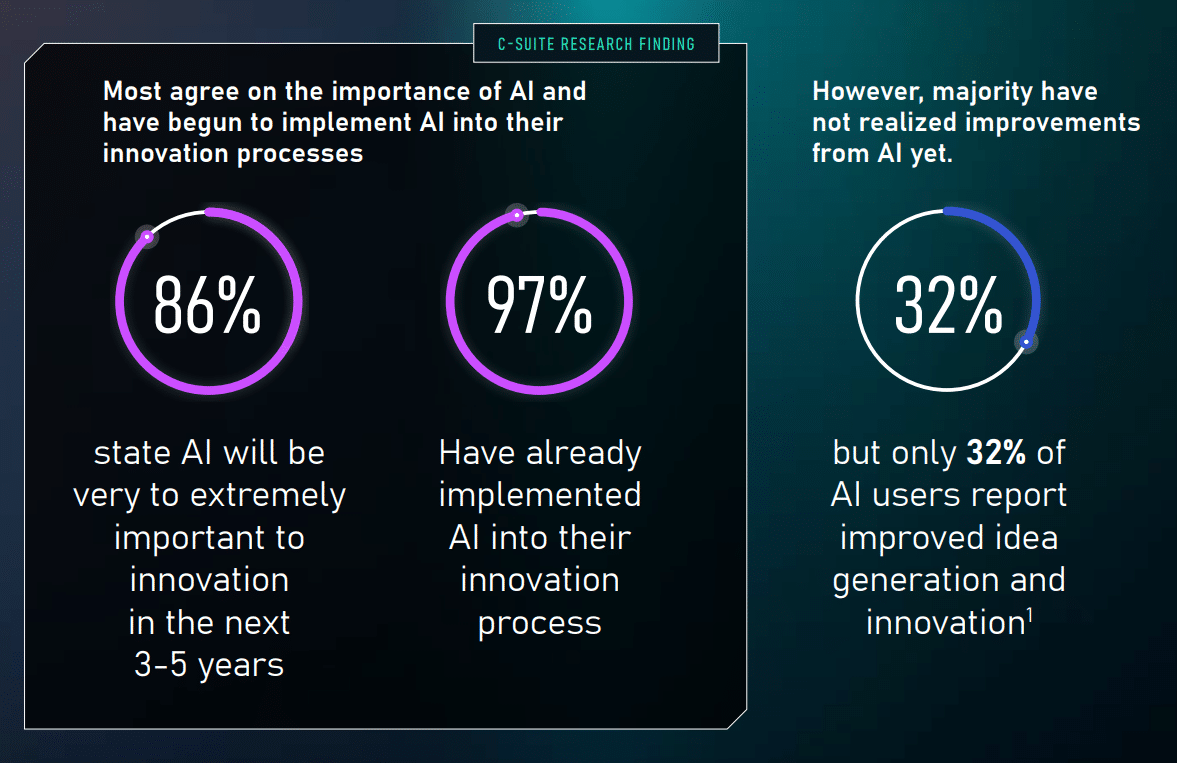
Newly published C-suite survey by Market Logic, Ipsos and Alchemy-Rx shows a clear disconnect between deploying AI and using it effectively to drive innovation.
As the findings of the Innovation Reignited Report reveal, while 82% of organizations cite growth as their top priority, most effort is still directed toward safer, incremental change. In fact, 74% of activity is focused on renovation, compared to just 26% on true innovation.
We haven’t yet figured out how humans and AI should work together to drive meaningful innovation.

AI is essential — but we’re using it incorrectly
There is no debate about AI’s importance, as 86% of organizations believe it will be extremely important to innovation. But importance doesn’t equal impact.
Too often, organizations fall into one of two traps:
- Treating AI as an “answer machine” expected to generate breakthrough ideas
- Using AI only for efficiency, limiting it to low-value automation
Both approaches miss the point.
AI is neither the innovator nor just an assistant. It is a thinking partner — one that operates at a fundamentally different scale.
The real shift is not adopting AI, but learning how to think alongside it.
The real constraint isn’t data — it’s understanding
Modern innovation is defined by a paradox: more information, less clarity.
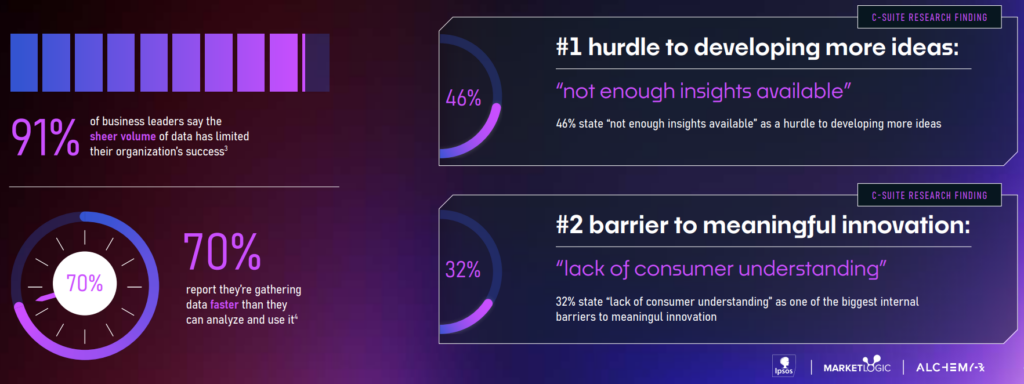
70% of companies say they are gathering data faster than they can use it. At the same time, as our Innovation Report reveals:
- 46% say their biggest barrier to developing ideas is not enough insights
- 32% cite lack of consumer understanding as a key barrier
This is not a technology problem. It’s a translation problem.
AI has transformed our ability to collect and process information. But insight — the kind that drives innovation — still depends on interpretation, context, and judgment.
And those remain deeply human capabilities.
From delegation to collaboration
Most organizations still approach AI through delegation: assign a task, receive an output, evaluate the result.
But innovation doesn’t behave like a linear process. It is iterative, ambiguous, and context-driven.
The more effective model is collaborative.
Rather than separating responsibilities, leading organizations are building a continuous loop:
- AI surfaces patterns, signals, and possibilities
- Humans interpret, challenge, and prioritize
- AI expands and stress-tests directions
- Humans refine decisions and define action
This is where real progress happens — not in isolated outputs, but in interaction.
Why most AI initiatives stall before they scale
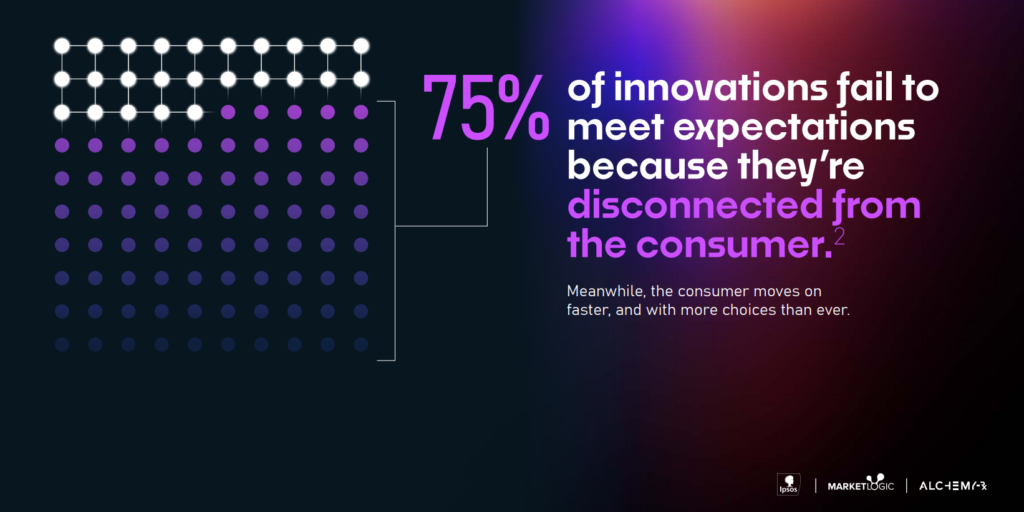
Even with the right intent, many organizations struggle to turn AI into impact. 75% still find it difficult to act on insights.
The core problem is not that insights don’t exist, but that they don’t reach decision-makers at the right moment.
This creates a familiar pattern:
- Insights remain siloed or underused
- AI outputs feel disconnected from real decisions
- Teams revert to intuition or legacy processes
In other words, the gap isn’t between data and AI — it’s between AI and people.
Making human–AI collaboration actually work
The issue isn’t just adopting the right technology — such as a deploying the right specialized consumer intelligence solution for insights, rather than a generic AI tool — it’s also, effective adoption within the organization.
If collaboration is the goal, then operating models need to change, not just tools.
The most successful organizations treat AI adoption as a change journey, not a deployment via effective change management strategies across the board.
A useful way to think about this is in three phases:
-
Create belief in the value of AI
Before people change how they work, they need to understand why it matters. That means making AI visible, relevant, and endorsed at a leadership level. Organizations that succeed here don’t position AI as a tool — they position it as a strategic capability. -
Built the right capacities
Adoption doesn’t come from generic training. It comes from showing people how AI fits into their actual workflows. The most effective programs are grounded in real use cases, often delivered in short, practical sessions that demonstrate immediate value. -
Sustain momentum.
AI adoption is not a one-off event. It requires reinforcement — through internal champions, continuous engagement, and visible success stories that make the value tangible across the organization.
This is where many AI strategies fall short. They invest in capability, but not in behavior change.
Global CPG organization Mars is a strong example of how organizations can successfully embed AI into everyday decision-making by building an “always-on” insights culture.
Rather than treating insights as something teams actively search for, Mars focused on making them instantly accessible and usable. They found that employees would only spend about 30 seconds searching for insights before giving up or asking the insights team directly. By introducing AI-powered tools like DeepSights, they transformed this behavior: employees began using the platform as their first stop, asking more strategic questions and spending significantly more time engaging with insights.
This shift led to a fundamental change in how insights were used across the business — with usage growing 174% year over year and insights becoming embedded in everyday workflows.
In short, Mars didn’t just adopt AI — they redesigned how people interact with insights, turning them from a static resource into a continuous, organization-wide capability.
Rethinking the roles: what humans and agentic AI each bring
To move forward, organizations need to be intentional about how work is divided — not rigidly, but strategically.
AI’s strengths are rooted in scale and speed. It is most powerful when:
- Processing and synthesizing large volumes of data
- Identifying patterns and weak signals
- Expanding the range of possible ideas
Humans, by contrast, provide direction. Their value lies in:
- Interpreting meaning and nuance
- Applying business and cultural context
- Making decisions under uncertainty
AI can tell you what is happening.
Humans decide what it means — and what to do about it.
The goal is not a clean split, but a complementary system.
Turning collaboration into capability
Understanding the theory is one thing. Operationalizing it is another.
To truly unlock value, organizations need systems designed for this kind of collaboration — not generic AI tools, but solutions purpose-built for insight and innovation work.
The most effective approach is to use AI agents trained specifically for this domain. These systems can synthesize insights across vast and fragmented research libraries, identify emerging themes, and help shape early-stage idea territories.
This is exactly the thinking behind Market Logic’s DeepSights Innovation Studio.
Through a layer of enterprise and active intelligence, it brings together specialized AI agents that:
- Connect insights across disparate sources
- Spark new opportunity spaces
- Draft concept directions in seconds
Crucially, these tools are not designed to replace human thinking, but to work alongside it — accelerating how teams crystallize opportunities from the knowledge they already have.
From active intelligence AI platform to thinking systems
This shift changes more than workflows. It changes how organizations think.
AI is no longer just part of the toolkit. It becomes part of the organization’s cognitive process — how it gathers, interprets, and acts on information.
That requires intentional design:
- Workflows built around continuous human–AI interaction
- Insight generation treated as a shared process, not a handoff
- Decision-making that is faster, more iterative, and more exploratory
Organizations that embrace this don’t just move faster — they move with greater confidence.

The future of innovation is co-created, but not led solely by AI
Innovation hasn’t stalled because of a lack of ideas or technology.
It has stalled because we are still applying old models of work to a new reality.
As AI becomes embedded in how organizations operate, the competitive advantage will shift.
It will no longer be defined by who has the most advanced tools — but by who understands how to combine human and machine intelligence most effectively.
The organizations that get this right won’t just innovate more. They will think differently.
And in today’s environment, that is what sets leaders apart.
Ready to see how a trusted, award‑winning consumer insights platform can help you boost your innovation pipeline and work seamlessly along your teams every step of the way? Explore DeepSights and request a tailored demo today.